


Arriving in Canada is exciting — and overwhelming. Between finding a place to live, registering your SIN, and navigating a completely new system, opening a bank account might feel like just another item on an already endless to-do list. But here’s the thing: it should actually be your very first financial priority.
Without a Canadian bank account, you can’t receive a paycheck, pay rent electronically, or build the credit history that will eventually help you get a credit card, car loan, or mortgage. And the longer you delay, the more financial friction you create for yourself in those critical early weeks.
The good news? Canada’s major banks have spent years competing for newcomer customers, and that competition works in your favour. Dedicated newcomer programs, fee waivers, and multilingual support have made the process more accessible than ever before — even if you arrived just days ago without a Canadian address.
This guide walks you through everything you need to open a bank account in Canada as a newcomer: which banks have the best newcomer programs, what documents you’ll actually need (not just what the website says), how the process works step by step, and the insider tips that can save you time and money from day one.
Why Opening a Bank Account Should Be Your First Financial Step in Canada
Many newcomers underestimate how central a bank account is to everyday life in Canada. Unlike many countries where cash is king, Canada is a heavily digital economy. Most landlords require electronic funds transfers (EFTs) or pre-authorized debits for rent. Employers deposit wages directly. Government benefits like the GST/HST credit, Canada Child Benefit, and even tax refunds are all sent by direct deposit.
There are also less obvious reasons to open a bank account quickly. Every month you bank in Canada, you’re building a domestic financial record. This record — your banking history — is something lenders consider when you eventually apply for credit products. It won’t replace a credit score, but it signals financial stability. And that matters enormously when you’re trying to establish yourself in a new country.
The Credit History Advantage
Canada uses its own credit bureaus — Equifax Canada and TransUnion Canada — and your credit history from another country doesn’t transfer automatically. (Note: Some banks, like Nova Credit partners, are beginning to work around this, but it’s not universally available yet.) Opening a bank account and eventually getting a secured credit card is how most newcomers start building their Canadian credit profile from scratch.
Banking Fees: What to Expect
Canadian banking does come with fees — this is one area where Canada differs notably from some European and Asian banking systems. Most major bank chequing accounts charge between $4 and $30 per month depending on the tier. However, newcomer programs typically waive these fees for 6 to 12 months, giving you time to get settled before costs kick in. Free alternatives like EQ Bank and Tangerine also exist, and we’ll cover those later.
Documents You Need to Open a Bank Account in Canada as a Newcomer
One of the most common newcomer frustrations is showing up to a bank branch with the wrong documents. Banks in Canada are required under the Proceeds of Crime (Money Laundering) and Terrorist Financing Act to verify your identity — but what they accept can vary significantly from one institution to another. Here’s a clear breakdown.
Primary Identification (Required by All Banks)
- Passport — the gold standard accepted everywhere
- Canadian Permanent Resident (PR) Card
- Confirmation of Permanent Residence (COPR) letter — usually accepted within the first 3 months of landing
- Canadian Citizenship Certificate or Card
Immigration Status Documents (Required for Newcomer Programs)
- Study Permit — required to access student newcomer programs
- Work Permit — required for worker-category newcomer programs
- IRCC (Immigration, Refugees and Citizenship Canada) decision letter
- Temporary Resident Visa (TRV) — in some cases
Supporting Documents (Sometimes Required)
- Proof of Canadian address (lease agreement, utility bill, or letter from employer or school)
- Social Insurance Number (SIN) — not always required to open an account but strongly recommended to have
- A second piece of government-issued photo ID (if your first doesn’t have a photo)
One important caveat: if you’ve just arrived and don’t yet have a Canadian address, most major banks will allow you to use a hotel address or a sponsor’s address temporarily. Always call ahead or check the bank’s newcomer webpage to confirm their specific requirements before your visit.
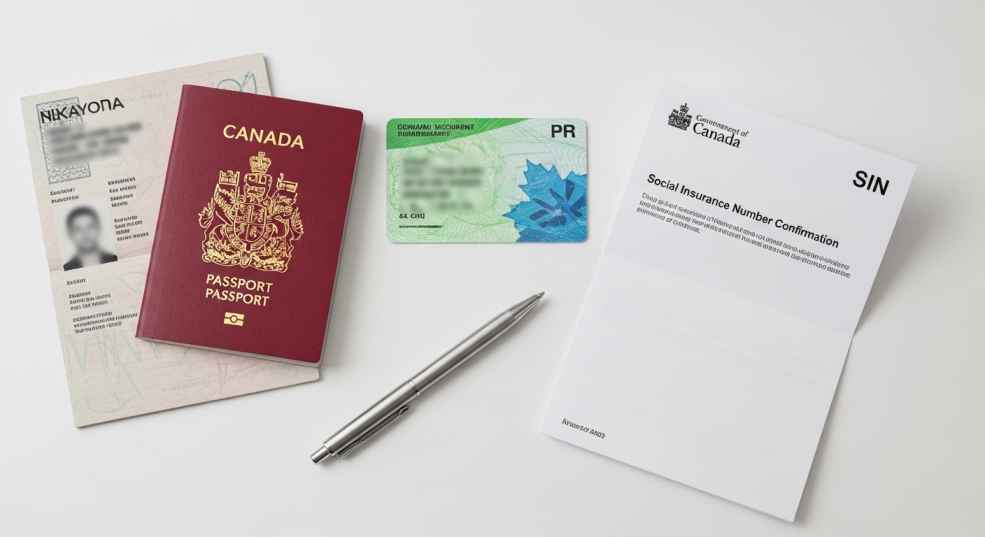
Document Requirements at a Glance
Document Type | Required By Most Banks? | Notes |
Passport | ✅ Yes | Primary ID — accepted by all banks |
Study or Work Permit | ✅ Yes | Required for newcomer program eligibility |
Permanent Resident (PR) Card | ✅ Yes (if applicable) | Or COPR letter for new PRs |
IRCC Confirmation Letter (COPR) | ✅ Yes (within first 3 months) | Accepted by major banks during transition |
Proof of Address in Canada | ⚠️ Sometimes | Lease, utility bill, or employer letter |
SIN (Social Insurance Number) | ⚠️ Recommended | Not always required to open, but needed later |
Second Government-Issued ID | ⚠️ Sometimes | Driver’s license, national ID, etc. |
📝 Table 1: Document requirements vary by bank and program. Always verify directly with your chosen bank before visiting a branch.
Best Banks for Newcomers to Canada: A Detailed Comparison
Not all banks are created equal when it comes to serving newcomers. The Big Five Canadian banks (RBC, TD, Scotiabank, BMO, and CIBC) all have dedicated newcomer programs, but they differ in meaningful ways — from fee waiver periods to multilingual support to credit-building opportunities. Let’s break them down.
1. RBC (Royal Bank of Canada) — Best Overall Newcomer Program
RBC’s Newcomer Advantage program is widely considered the most comprehensive of the Big Five. It offers up to 12 months of free banking on select chequing accounts, a credit card without a Canadian credit history requirement, and exclusive mortgage rates for newcomers. RBC also provides free international money transfers for the first 12 months, which is a significant perk if you’re still supporting family abroad or transferring savings from your home country.
RBC’s multilingual support is among the best in the industry, with services available in over 200 languages through their phone banking line. Their newcomer web portal also provides guides in multiple languages, making it especially accessible for those still learning English or French.
Learn more: https://www.rbcroyalbank.com/newcomers/
2. TD Bank — Best for Students and Families
TD’s New to Canada Banking Package offers solid perks, including a waived monthly fee for up to 6 months and access to a secured credit card with a low minimum deposit. TD stands out for its extensive branch and ATM network, which is helpful if you’re in a smaller city or suburb. Their Student Banking Package is particularly well-suited to international students on study permits.
TD also offers family banking packages that can benefit newcomers who arrive with a spouse and children, allowing multiple accounts to be linked under one umbrella for easier management.
Learn more: https://www.td.com/ca/en/personal-banking/solutions/new-to-canada/
3. Scotiabank — Best for Latin American Newcomers (StartRight Program)
Scotiabank’s StartRight Program is particularly strong for newcomers from Latin America, given the bank’s deep roots in the Caribbean and Central and South America. The program offers up to 12 months of free banking, a credit card without a Canadian credit history, and the option to speak with banking advisors in Spanish and other languages.
Scotiabank also has partnerships with several newcomer settlement agencies, which means you might encounter their representatives directly at welcome centres or orientation events. Their Scene+ rewards program, which combines everyday banking with entertainment rewards, is also a nice bonus.
Learn more: https://www.scotiabank.com/ca/en/personal/bank-accounts/newcomers-to-canada.html
4. BMO (Bank of Montreal) — Best for Professionals
BMO’s NewStart Program is geared towards skilled workers and professionals, offering up to 12 months of free banking and a credit card that doesn’t require Canadian credit history. What sets BMO apart is its focus on professional financial planning — their newcomer advisors are trained to discuss longer-term financial goals like mortgage pre-qualification timelines and RRSP contributions early in the onboarding process.
BMO also participates in the Global Money Transfer program, offering competitive exchange rates for international transfers. For newcomers from India, China, and the Philippines specifically, BMO has advisors who speak the most common languages from those communities.
Learn more: https://www.bmo.com/en-ca/main/personal-banking/newcomers-to-canada/
5. CIBC — Best for Credit Building
CIBC’s Welcome to Canada Package is particularly notable for its credit-building focus. They offer a secured Visa card that reports to both major credit bureaus from the very first month, helping newcomers establish their credit score faster. CIBC’s Smart Account also includes up to 12 months of fee waivers and rebates on interac e-transfers.
One unique CIBC feature is their international student program, which is specifically designed for students coming from China, India, and several other countries, with dedicated advisors who understand the specific documentation challenges students often face.
Learn more: https://www.cibc.com/en/personal-banking/accounts/newcomers.html
6. Digital Banks: Tangerine and EQ Bank — Best for Fee-Free Banking
If you’re comfortable with online banking and don’t need in-person branch support, Tangerine and EQ Bank are outstanding options. Tangerine (owned by Scotiabank) offers no monthly fees forever, free unlimited transactions, and a competitive interest rate on savings. EQ Bank offers one of the highest interest rates on savings accounts of any Canadian bank, with no monthly fees and no minimum balance.
The trade-off with digital banks is that they lack the newcomer-specific programs, dedicated newcomer advisors, and in-person branch experience of the Big Five. Many newcomers choose to open an account with a major bank for their day-to-day chequing needs and a digital bank for savings — a strategy that maximises both service access and interest earnings.
Bank Comparison Table: Newcomer Programs at a Glance
Bank | Newcomer Program | Monthly Fee | Free Period | Min. Documents | Best For |
RBC | RBC Newcomer Advantage | $0–$16.95 | Up to 12 months | Passport + visa | Overall value |
TD Bank | TD New to Canada | $0–$29.95 | Up to 6 months | Passport + visa | Students & families |
Scotiabank | StartRight Program | $0–$30.95 | Up to 12 months | Passport + visa | Latin American newcomers |
BMO | BMO NewStart | $0–$30 | Up to 12 months | Passport + visa | Professionals |
CIBC | Welcome to Canada Package | $0–$29.95 | Up to 12 months | Passport + immigration doc | New credit builders |
Tangerine | Standard (no dedicated program) | $0 always | N/A | Standard ID | Digital-first users |
EQ Bank | Standard (no branch needed) | $0 always | N/A | Standard ID | High-interest savings |
📝 Table 2: Fee information is approximate and may change. Always verify current offers directly with the bank. Free period eligibility typically requires proof of newcomer status and is available within a defined period of your arrival date (usually 2–5 years).
How to Open a Bank Account in Canada: Step-by-Step
Now that you know which bank might suit you best, here’s exactly how the process works. Most major banks offer two options: opening in-branch or opening online. For newcomers, in-branch is often recommended for the first account, as it allows you to ask questions, verify your documents in real-time, and meet an advisor who can help you choose the right account type.
Step 1: Choose Your Bank and Account Type
Before you walk into a branch, do your research. Visit the bank’s newcomer webpage (links provided above), confirm which documents they require, and decide whether you need a chequing account, savings account, or both. Most newcomers start with a chequing account for everyday spending and an attached savings account.
Step 2: Book an Appointment (Recommended)
While walk-ins are accepted at most branches, booking an appointment with a newcomer advisor will save you time and ensure you’re speaking with someone trained to handle your specific situation. All of the Big Five allow you to book appointments online or by phone. Some banks, like RBC and Scotiabank, have dedicated newcomer specialists at branches in high-immigration cities like Toronto, Vancouver, Brampton, Mississauga, and Calgary.
Step 3: Gather Your Documents
Based on Table 1 above, prepare your documents in advance. Bring originals — photocopies are generally not accepted. If you’re unsure about a specific document, call the branch ahead of your appointment and confirm with a representative.
Step 4: Visit the Branch and Complete the Application
At the branch, your advisor will verify your identity, help you select the right account, explain the fee structure, and set up your account. The entire process typically takes 30–60 minutes. You’ll usually receive your debit card on the spot or within 5–7 business days by mail.
Step 5: Set Up Online Banking and E-Transfers
Before you leave the branch, ask your advisor to help you set up online banking. This gives you immediate access to your account and allows you to receive Interac e-Transfers — a uniquely Canadian digital payment method used for everything from paying a friend back to receiving freelance income.
Step 6: Apply for a Credit Card
Once your chequing account is open, ask your advisor about applying for a secured credit card. Secured cards require a deposit (usually $200–$500) that acts as your credit limit, but they report to credit bureaus just like a regular credit card. This is the fastest legitimate way to start building your Canadian credit score.

Newcomer Banking Tips That Most Guides Don’t Tell You
Beyond the basics, there are several practical insights that can make a real difference in your first months of banking in Canada.
Tip 1: Apply Before You Arrive (If You Can)
Several banks — including RBC, TD, and Scotiabank — allow newcomers with permanent resident status to begin their account application before they land in Canada. This means you could arrive with a bank account already partially set up, reducing the stress of your first week. Ask specifically about “pre-arrival banking” when contacting a bank’s newcomer service line.
Tip 2: Watch for the Newcomer Eligibility Window
Most newcomer programs have an eligibility window — typically 2 to 5 years from your date of first entry into Canada. If you’ve been in Canada for a few years already on a temporary permit and are just now applying for permanent residence, confirm whether you still qualify for a newcomer program. Some banks extend eligibility to new PRs regardless of how long they’ve been in Canada on other status types.
Tip 3: Don’t Overlook Credit Unions
Canada’s credit unions — like Desjardins (Quebec-focused), Meridian Credit Union (Ontario), and Vancity (British Columbia) — are member-owned financial cooperatives that often offer lower fees and more personalized service than the big banks. Some credit unions also have strong ties to specific cultural communities and can offer banking support in additional languages. While they may not have dedicated newcomer programs with fee waivers, they’re worth exploring alongside the Big Five.
Tip 4: Understand CDIC Deposit Insurance
Canada’s major banks are insured by the Canada Deposit Insurance Corporation (CDIC), a federal Crown corporation. Your eligible deposits at CDIC member institutions are protected up to $100,000 per insured category in case the bank fails. This includes deposits at TD, RBC, Scotiabank, BMO, CIBC, and other CDIC members. Credit unions are covered by provincial deposit insurance programs instead.
Source: CDIC — https://www.cdic.ca/your-coverage/
Tip 5: Avoid Currency Exchange at the Airport
If you arrive with foreign currency, resist the temptation to exchange it at the airport. Airport exchange booths typically offer the worst rates in Canada. Instead, deposit foreign currency at your new bank (most accept USD and Euros) or use a specialist transfer service like Wise (formerly TransferWise) or Remitly for better exchange rates when sending money internationally.
Tip 6: Use Your Bank’s Multilingual Resources
You don’t have to navigate Canadian banking in English or French alone. Most of the Big Five have phone banking lines available in Mandarin, Cantonese, Punjabi, Hindi, Spanish, and many other languages. RBC and Scotiabank, in particular, have invested heavily in multilingual digital resources. Don’t hesitate to request a bank advisor who speaks your language — it can make the process significantly less stressful.
A Real-World Newcomer Banking Scenario
To bring this all together, let’s look at a realistic example. Meet Priya, a software engineer who arrived in Toronto on a work permit from India. She landed on a Friday and had the following situation: no Canadian address yet (staying with a friend), a valid Indian passport, her work permit from IRCC, and $3,000 in USD she needed to deposit.
On Saturday morning, she visited an RBC branch near downtown Toronto. She had called ahead and confirmed that a hotel or friend’s address would be accepted temporarily. The newcomer advisor opened a RBC Advantage Banking account with a 12-month fee waiver, accepted her passport and work permit as primary ID, used her friend’s address provisionally, and helped her deposit her USD directly into a USD savings account to avoid an immediate exchange hit.
By Tuesday, her online banking was active, her debit card had arrived by courier (she paid $15 for expedited delivery), and she had submitted an application for a secured Visa credit card with a $500 deposit. Within eight months, her secured card was upgraded to an unsecured card with a $3,000 limit — her Canadian credit journey had officially begun.
Priya’s experience illustrates something important: the process is manageable when you know what to expect. A 45-minute branch visit on her first weekend in Canada set up her entire financial foundation.

Frequently Asked Questions About Newcomer Banking in Canada
Can I open a Canadian bank account before arriving in Canada?
Yes, to a limited extent. RBC, TD, Scotiabank, and BMO all offer some form of pre-arrival account initiation for permanent residents. You typically complete the application online or over the phone, then finalize it in-branch within your first few weeks of arrival. International students can also contact their destination bank ahead of time to understand what they’ll need to bring.
Do I need a SIN to open a bank account in Canada?
No — a SIN is not required to open a bank account. However, without a SIN, your bank will withhold taxes on any interest you earn. You should apply for your SIN as soon as possible (usually within your first week or two) at a Service Canada office or online if eligible. Once you have it, provide it to your bank to ensure tax information is correctly reported.
Can I open a bank account without a Canadian address?
Yes, most major banks will accept a temporary address such as a hotel, shelter, friend’s home, or settlement agency’s address. Some banks have specific policies on this, so it’s always best to call ahead and confirm. The key is having a valid Canadian contact address on file — even a temporary one.
What if I don’t speak English or French?
All major Canadian banks offer phone banking and in some cases in-branch support in multiple languages. RBC, Scotiabank, BMO, TD, and CIBC all have advisors who speak Mandarin, Cantonese, Punjabi, Hindi, Spanish, Tagalog, and many other languages at select branches in major cities. You can also request a multilingual advisor when booking your appointment.
How long does it take to open a bank account?
At a branch with all your documents ready, the process typically takes 30–60 minutes. You’ll often leave with a temporary debit card or receive your permanent card within 5–7 business days. Online account opening can sometimes be faster — as little as 15 minutes — though document verification may extend the timeline.
Can I keep my foreign bank account while banking in Canada?
Absolutely, and many financial advisors recommend it. Keeping a foreign account makes international money transfers easier and cheaper. However, note that if you become a Canadian tax resident, you may need to report foreign bank accounts with balances over $100,000 CAD to the Canada Revenue Agency (CRA) on Form T1135. Consult a tax professional for guidance specific to your situation.
Source: CRA Foreign Asset Reporting
Conclusion: Your Financial Fresh Start Starts With One Account
Opening a bank account in Canada as a newcomer is one of the most impactful financial decisions you’ll make in your first weeks here. It unlocks your ability to receive income, pay bills, build credit, and participate fully in Canada’s digital economy. And thanks to competitive newcomer programs from Canada’s major banks, the barriers to getting started have never been lower.
To summarize what we’ve covered: gather your passport and immigration documents before visiting a branch; compare the newcomer programs at RBC, TD, Scotiabank, BMO, and CIBC to find the best fit for your situation; consider a digital bank like Tangerine or EQ Bank for long-term fee-free savings; apply for a secured credit card immediately to start building your Canadian credit history; and don’t hesitate to request multilingual support throughout the process.
Canada is a country built on newcomers. The financial system, while not perfect, has been shaped to welcome you. Take advantage of the newcomer programs available, ask every question you have in the branch, and know that every month you bank in Canada is another month of financial foundation being built — one that will serve you for years to come.
Welcome to Canada. Your fresh financial start begins today.
