






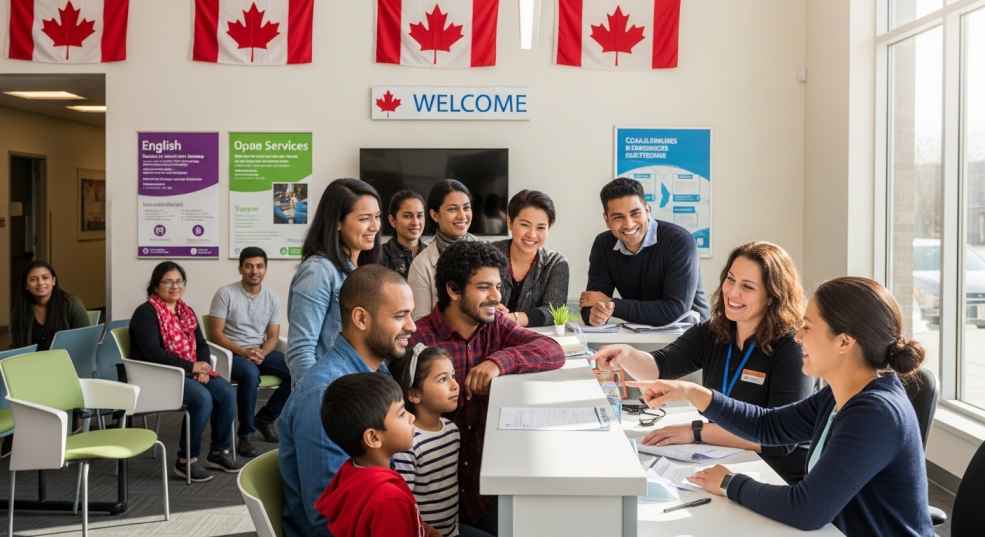
Moving to a new country is one of the most exciting — and overwhelming — experiences a person can go through. Between learning a new language, finding work, understanding your legal rights, and simply figuring out how the bus system works, the list of things to figure out can feel endless. The good news? Canada has one of the most robust newcomer support systems in the world, and most of it is completely free.
Whether you arrived last week or a year ago, whether you’re a skilled worker, a refugee, or a sponsored family member, there is a wide range of free settlement services Canada offers to help you get established. These programs are funded primarily by Immigration, Refugees and Citizenship Canada (IRCC) and are delivered through a network of trusted community organizations across every province and territory.
In this guide, you’ll find a comprehensive breakdown of the newcomer services available to you — from free ESL classes Canada-wide to employment mentorship, housing navigation, mental health support, and community connection programs. Consider this your go-to roadmap for making the most of what Canada has to offer.
You don’t need to navigate all of this at once. Bookmark this page, and refer back to each section as your needs evolve.
TIP
What Are Free Settlement Services in Canada?
Free settlement services Canada-wide are government-subsidized programs designed to help newcomers integrate successfully into Canadian life. They are not charity — they are an investment Canada makes in its own future, recognizing that newcomers contribute enormously to the country’s economy, culture, and social fabric.
These services are typically offered through Settlement Provider Organizations (SPOs) — registered nonprofits and community agencies that receive federal and provincial funding to deliver programs directly to immigrants, refugees, and temporary residents who meet eligibility criteria.
Who Is Eligible?
Eligibility varies by program, but most federally funded settlement services are available to:
- Permanent residents of Canada
- Convention refugees and Government-Assisted Refugees (GARs)
- Protected persons
- Certain temporary residents with a pathway to permanent residence
- Family members of eligible persons
Canadian citizens are generally not eligible for most IRCC-funded settlement programs. However, many provincial and municipal programs are open to a broader audience, including naturalized citizens who arrived in Canada within the last few years.
Source: IRCC official eligibility guidelines — ircc.canada.ca/settlement
Types of Free Newcomer Services Available Across Canada
The following table gives you a bird’s eye view of the major categories of support available. Below the table, we dive into each one in detail.
Table 1: Overview of Free Settlement Services in Canada
Service Type | What It Covers | Who Provides It |
Language Training (LINC/CLIC) | ESL and French classes, literacy, conversation skills | Federally funded colleges, school boards, community orgs |
Employment Services | Résumé writing, job search, credential recognition, mentorship | ACCES Employment, immigrant-serving agencies, WorkBC |
Settlement Counselling | Housing, legal rights, healthcare navigation, benefits | IRCC-funded SPOs (Settlement Provider Organizations) |
Community Connection | Cultural events, volunteer networks, peer support groups | Multicultural associations, libraries, faith communities |
Children & Youth Programs | School readiness, tutoring, youth mentorship | School boards, YMCAs, newcomer-focused nonprofits |
Mental Health & Wellness | Counselling, stress management, trauma support | Ethnocultural health orgs, CMHA, government-funded clinics |

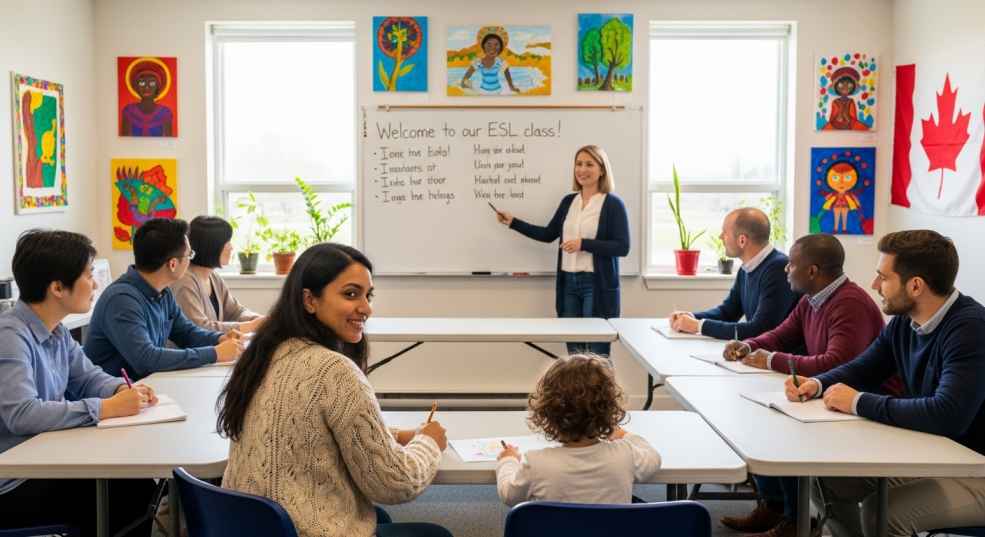
Free ESL Classes Canada: Learning the Language of Opportunity
Language is the single biggest barrier most newcomers face. It affects your ability to get a job, navigate healthcare, help your children with school, and build friendships. That’s why free ESL classes Canada-wide are one of the most heavily funded and most impactful programs in the settlement system.
The LINC Program (Language Instruction for Newcomers to Canada)
The LINC program is the federal government’s flagship language training initiative for adult newcomers. It provides free, full-time and part-time English classes to eligible permanent residents and refugees. Classes are offered at community centers, school boards, libraries, and even online — making them accessible to people with children, jobs, or mobility challenges.
LINC is structured around Canadian Language Benchmarks (CLBs), a standardized system that measures language ability from CLB 1 (beginner) to CLB 10+ (near-native fluency). After a free language assessment at a local assessment center, you’ll be placed at the right level. Childcare is often provided free of charge for LINC participants.
To find a LINC provider near you, visit: settlement.org/linc or call 211 in your province.
CLIC (Cours de langue pour les immigrants au Canada)
For newcomers settling in Quebec and francophone communities elsewhere, CLIC provides the equivalent free French-language training. Quebec also operates its own distinct program — Francisation Québec — which is particularly robust for those integrating into Montreal and other francophone cities.
Online ESL and English Upgrade Programs
For those who can’t attend in-person classes, many provinces now fund hybrid and fully online ESL options. CanLearnOnline.ca, BCLN (BC Learning Network), and various school board platforms offer accredited online courses at no cost. These are especially useful for newcomers in rural areas or those working shift jobs.
Employment Support: Free Job Help for Newcomers to Canada
Finding work in Canada as a newcomer is rarely straightforward. Employers often want “Canadian experience” — a frustrating catch-22 when you’re trying to get that first foot in the door. Free newcomer employment services exist precisely to bridge this gap.
Résumé Writing and Job Search Coaching
Settlement agencies and employment centers across Canada offer free, one-on-one résumé coaching tailored specifically to the Canadian job market. Canadian résumés differ significantly from those used in many other countries — no photos, no marital status, typically two pages maximum — and getting this right makes a measurable difference in callback rates.
Bridging Programs and Credential Recognition
One of the most valuable (and underutilized) free settlement services Canada provides is bridging programs. These are short-term, sector-specific training programs that help internationally trained professionals — doctors, engineers, nurses, accountants — get their credentials recognized in Canada.
For example, the Ontario Bridge Training Partnership funds dozens of programs connecting newcomer professionals directly with Canadian employers in their field. Engineers Canada’s National Licensure Campaign and ACCES Employment’s Mentorship programs have helped thousands of internationally educated professionals find work in their fields within 6–12 months of arriving.
Mentorship and Networking
Organizations like ACCES Employment, Toronto Region Immigrant Employment Council (TRIEC), and Skills for Change run free mentorship programs that connect newcomers with established Canadian professionals in their field. These programs typically run 3–6 months and have a strong track record: TRIEC reports that over 80% of mentees credit their mentor with helping them find work within the program period.
Source: TRIEC Annual Mentorship Report — triec.ca/mentoring-partnerships
Real Story: From Certified Engineer in Brazil to Licensed Engineer in Ontario
Consider the case of a mechanical engineer who arrived in Toronto with 15 years of experience but no Canadian credentials. Through a free ACCES Employment bridging program and 12 weeks of LINC classes to polish his technical English, he was connected with a mentor at a mid-sized manufacturing firm. Four months later, he was hired full-time — at a salary comparable to what he earned in Brazil. His story is not unique. Thousands of newcomers follow this same path every year, and the services that enabled it cost him nothing.
Settlement Counselling: Navigating Housing, Health & Legal Rights
Beyond language and jobs, newcomers often face urgent practical challenges: finding affordable housing, understanding tenant rights, accessing healthcare with a new provincial health card, enrolling children in school, and knowing what government benefits they may be entitled to.
Housing Navigation
Settlement counsellors at IRCC-funded agencies can help you understand the rental market, explain your rights as a tenant under provincial tenancy law, connect you with emergency housing if needed, and provide referrals to subsidized housing programs. This is especially critical in high-cost cities like Toronto and Vancouver, where the rental market is notoriously competitive.
Healthcare Navigation
Every province has a public health insurance program, but coverage typically doesn’t begin until 3 months after arrival in some provinces (such as Ontario’s OHIP). Free newcomer services include guidance on what to do during the waiting period, how to register for provincial health insurance, and how to find a family doctor or walk-in clinic.
Legal Information and Rights
Many settlement agencies partner with legal aid organizations to provide free legal information sessions on topics like employment rights, family law, immigration status, and landlord-tenant disputes. These are information sessions — not legal advice — but they are enormously helpful for newcomers unfamiliar with the Canadian legal system.

Community Connection: Building Your Life in Canada
Isolation is one of the silent struggles of immigration. You may have a good job and a safe apartment, but without a sense of community — of belonging — Canada can still feel like a foreign place. Free community connection programs are designed to address exactly this.
Cultural and Recreational Programs
Public libraries across Canada offer free programming for newcomers, including conversation circles, citizenship test preparation, digital literacy workshops, and cultural events. The YMCA, multicultural associations, and local sports leagues also provide subsidized or fully funded participation for newcomers who meet income criteria.
Peer Support Groups and Volunteer Opportunities
Volunteering is one of the fastest ways to build Canadian work experience, improve language skills, and make meaningful connections. Settlement agencies actively facilitate connections to volunteer opportunities in newcomers’ fields, and many organizations specifically recruit newcomers for volunteer roles that can lead to paid positions.
Programs for Children, Youth, and Seniors
Newcomer children and youth benefit from free tutoring programs, after-school clubs, sports leagues, and school-based settlement workers (funded through school boards). Seniors, who are often the most isolated newcomer demographic, can access free community programs through multicultural seniors’ centers and senior-focused settlement services.
Free Settlement Services Canada: Province-by-Province Snapshot
While most federally funded programs are available across Canada, the delivery model and specific organizations vary by province and territory. The table below highlights key programs and access points in major regions.
Table 2: Key Free Settlement Services by Province/Territory
Province/Territory | Key Program | Primary Access Point |
Ontario | LINC, ACCES Employment, CIC Settlement | IRCC Settlement Portal / 211 Ontario |
British Columbia | MOSAIC, S.U.C.C.E.S.S., Immigrant Services Society | WorkBC / settlement.org BC equivalent |
Alberta | Immigrant & Refugee Community Org. (IRCOM), Catholic Social Services | Alberta Supports / alis.alberta.ca |
Quebec | MIDI (French integration classes), PRAIDA | Francisation Québec program |
Manitoba | Manitoba Start, Immigrant Centre Winnipeg | ManitobaSettles.ca |
Nova Scotia | ISANS (Immigrant Services Association) | isans.ca |
All Provinces | IRCC-funded SPOs, 211 Helpline | settlement.org / 211.ca |
Note: This table provides a starting-point overview. Program availability and eligibility criteria change periodically. Always verify current offerings directly with the listed organizations or through 211.ca.
Mental Health and Wellness Support for Newcomers
The emotional and psychological toll of immigration is real and significant — and it’s still not talked about enough. Leaving behind family, friends, a career, and everything familiar takes a serious toll. Research from the Canadian Institute for Health Information (CIHI) indicates that newcomers are at elevated risk for depression, anxiety, and social isolation within the first two years of arrival.
Free newcomer mental health supports include:
- Individual counselling through ethnocultural health organizations (often in your home language)
- Group support programs at settlement agencies
- Community mental health programs through CMHA (Canadian Mental Health Association) branches
- Crisis support through the 988 Suicide Crisis Helpline (available in multiple languages)
- Peer support programs facilitated by people with lived experience of immigration
Many settlement agencies now have dedicated mental health navigators — professionals who can connect you with the right support without long waitlists. If you’re struggling, reaching out to your local settlement agency is a good first step.
Source: CIHI Report on Immigrant Mental Health Outcomes — cihi.ca
How to Access Free Settlement Services Canada: A Step-by-Step Guide
Knowing these services exist is one thing — actually accessing them is another. Here’s how to get started, no matter where you are in Canada:
Step 1: Call 211
211 is a free, 24/7 helpline available in every province that connects you with social services, including settlement agencies, in your area. You can call, text, or visit 211.ca. Operators speak dozens of languages and can help you identify which programs you qualify for and how to register.
Step 2: Visit the IRCC Settlement Portal
The Government of Canada’s official settlement portal at settlement.org (for Ontario) and ircc.canada.ca provides a searchable database of funded settlement agencies by postal code. You can filter by service type, language of service, and distance from your location.
Step 3: Book a Settlement Needs Assessment
Most settlement agencies offer a free initial needs assessment — a conversation with a settlement worker who will help map out your priorities and connect you with the right programs. This assessment is confidential and usually available in your language.
Step 4: Get a Language Assessment
If language training is a priority, book a free language assessment at a CLARS (Community Language Assessment and Referral Service) or CLIC assessment center near you. You’ll be assessed on your reading, writing, listening, and speaking and placed into the appropriate LINC or French-language program level.
Step 5: Connect, Engage, and Revisit
Settlement is not a one-time event — it’s an ongoing process. Your needs will change over time, and the services available to you will evolve as your language improves, your employment situation changes, and your children grow. Revisit your local settlement agency regularly, and don’t hesitate to ask for a referral to a new program as your needs shift.
Common Mistakes Newcomers Make (And How to Avoid Them)
After speaking with dozens of settlement workers and newcomers across Canada, a few avoidable mistakes come up again and again:
Waiting Too Long to Access Services
Many newcomers wait until they’re in crisis — out of money, struggling to find work, or feeling dangerously isolated — before reaching out for help. Settlement services are most effective when accessed early. Contact a settlement agency in your first week or two in Canada, even if you think you don’t need help yet.
Not Knowing That Services Are Free
A surprising number of newcomers assume that professional-quality settlement services must cost money, and either pay for private consultants they don’t need or simply go without. These services are completely free. You have paid into this system through your immigration fees and your future tax contributions — use what you’re entitled to.
Staying Within Your Own Community
It’s natural and comforting to gravitate toward people who speak your language and share your culture. But settlement experts consistently note that newcomers who make an active effort to build cross-cultural connections — through volunteer work, sports leagues, neighborhood events — adapt faster and report higher life satisfaction. Free community connection programs make this easier.
Not Following Up on Credential Recognition
Internationally trained professionals who don’t pursue credential recognition quickly often end up in jobs far below their skill level for years — sometimes permanently. If you have professional credentials from outside Canada, contact the relevant regulatory body (College of Physicians, Professional Engineers Ontario, etc.) within your first month and initiate the recognition process even if it seems long or complicated.

Conclusion: Canada’s Promise to Newcomers — And How to Hold It
Canada’s free settlement services represent a genuine national commitment: the belief that when newcomers succeed, Canada succeeds. From free ESL classes that open doors to employment, to settlement counsellors who help you understand your rights, to community programs that turn a foreign city into a home — these services can make an enormous difference in how quickly and fully you feel at home here.
To summarize what we’ve covered:
- Free settlement services Canada are funded by IRCC and delivered through a network of community organizations across every province and territory
- Free ESL classes Canada-wide (LINC and CLIC) are available to eligible newcomers at no cost, often with free childcare
- Employment services include résumé coaching, bridging programs, credential recognition, and professional mentorship
- Settlement counselling covers housing navigation, healthcare access, legal information, and benefit guidance
- Community connection programs fight isolation and help newcomers build meaningful social networks
- Mental health support is available in many languages through ethnocultural health organizations and CMHA branches
- Accessing services is as simple as calling 211, visiting settlement.org, or walking into your local settlement agency
Canada has built an extraordinary infrastructure to welcome and support newcomers. The only thing left is for you to use it. If you found this guide helpful, explore more resources at FreshStartCanada.com — your trusted companion for navigating life as a newcomer in Canada.