








Here’s something that surprises a lot of prospective immigrants: you don’t necessarily need a Canadian job offer to get a provincial nomination. While a job offer can definitely strengthen your application — and in some streams it’s outright required — there are dozens of active PNP streams across Canada that will consider you purely on the strength of your education, work experience, language skills, and CRS score.
The confusion is understandable. Job offers feel concrete and reassuring. If a Canadian employer wants you, surely the immigration system wants you too, right? That’s partially true — but the full picture is far more nuanced, and for many skilled workers, a job offer simply isn’t the right (or even feasible) first step.
In this guide, we break down exactly which PNP streams require employment and which don’t, walk through real applicant scenarios, and help you figure out the smartest path for your specific situation.
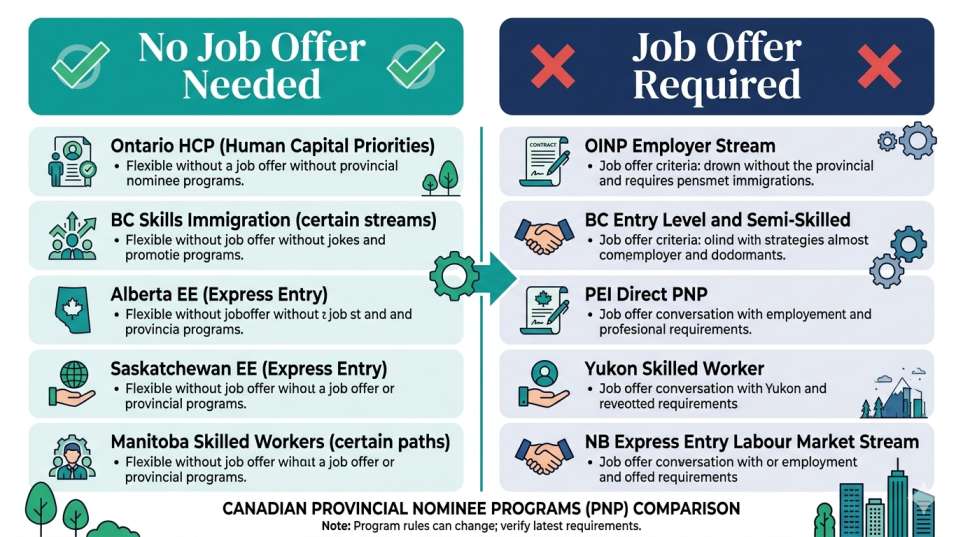
Many of Canada’s most popular PNP streams — including Ontario’s Human Capital Priorities stream, BC’s Skills Immigration: Skilled Worker and International Graduate streams, and Alberta’s Express Entry and Opportunity streams — do NOT require a job offer. Eligibility is typically based on CRS score, NOC/TEER code, education, and language proficiency.
💡 QUICK ANSWER
Why Job Offer Requirements Vary So Much Across Provinces
Canada’s immigration system is intentionally decentralized when it comes to provincial nominees. Each province has its own labour market gaps, demographic challenges, and economic development priorities — and PNP streams are designed to address those specific needs. A province like Saskatchewan, which is actively trying to attract skilled agricultural workers and healthcare professionals to smaller communities, has different requirements than Ontario, which is competing for global tech talent.
This means that the role of a job offer in a PNP application varies considerably:
- Some streams use job offers as the primary eligibility criterion. If you don’t have one, you simply can’t apply.
- Other streams treat a job offer as a bonus factor. It may add points to your score but isn’t required.
- Many streams focus entirely on human capital factors. Your skills, experience, and language ability are what count — employment plays no role.
Understanding which category applies to your target province (and target NOC code) is one of the most strategic decisions you’ll make in your immigration journey.
PNP Streams That Do NOT Require a Job Offer
These are the streams that attract the most attention from internationally-based applicants — and for good reason. If you haven’t yet secured Canadian employment, these pathways give you a legitimate route to a provincial nomination based on who you are and what you bring, not who you already work for.
Ontario Immigrant Nominee Program (OINP) — Human Capital Priorities Stream
Ontario’s Human Capital Priorities (HCP) stream is one of Canada’s most sought-after employer-free PNP pathways. The province draws directly from the Express Entry pool, reaching out to candidates who meet its criteria — there is no job offer required. Candidates typically need a CRS score of around 400+ (though this fluctuates), a valid Express Entry profile, and work experience in a high-demand NOC category. [Source: IRCC]
British Columbia PNP — Skills Immigration: Skilled Worker & International Graduate
BC’s Skills Immigration Registration System (SIRS) ranks candidates on a points-based system. The Skilled Worker and International Graduate streams under the BC Tech Pilot, and several general skilled worker categories, do not require a job offer — though having one will boost your SIRS score substantially. Candidates are ranked and invited when their score crosses the draw threshold. [Source: BC PNP]
Alberta Immigrant Nominee Program (AINP) — Alberta Express Entry Stream
Alberta’s Express Entry stream operates similarly to Ontario’s HCP — it draws from the federal Express Entry pool and does not require a job offer. Alberta focuses on candidates whose skills align with the province’s labour market needs, particularly in engineering, trades, healthcare, and technology. [Source: Alberta Government]
Saskatchewan Immigrant Nominee Program (SINP) — International Skilled Worker: Express Entry
Saskatchewan’s Express Entry sub-category allows candidates to self-declare their interest in settling in Saskatchewan — no job offer needed. Candidates must have an active Express Entry profile and work experience in an eligible occupation. The province draws regularly from this sub-category and often targets lower CRS scores than the federal pool. [Source: SINP]
Manitoba Provincial Nominee Program (MPNP) — Skilled Workers Overseas
Manitoba’s Skilled Workers Overseas stream can be accessed without a job offer if you have a close connection to Manitoba — such as a family member residing there, or a previous period of authorized work or study in the province. This pathway is particularly valuable for candidates who have lived in Manitoba before or have established ties. [Source: MPNP]
Nova Scotia Nominee Program — Labour Market Priorities Stream
Nova Scotia’s Labour Market Priorities stream works by invitation — Nova Scotia signals its labour market priorities and draws from the Express Entry pool targeting those occupations. No job offer is required. The province has used this stream aggressively to attract healthcare workers, engineers, and other skilled professionals.
PNP Streams That DO Require a Job Offer
For completeness, it’s important to understand which streams are employer-driven — so you don’t waste time applying to pathways you’re not yet eligible for.
- OINP Employer Job Offer Stream: Requires a full-time, permanent, non-seasonal job offer from an Ontario employer. The position must be in a skilled NOC TEER 0, 1, 2, or 3 occupation.
- BC PNP — Entry Level & Semi-Skilled: Requires a job offer in specific industries (tourism, hospitality, food processing, long-haul trucking) — no job offer, no application.
- PEI Office of Immigration — Direct PNP: Nearly all PEI streams require a job offer, making this one of the more employer-dependent provincial programs in Canada.
- Yukon Nominee Program — Skilled Worker Stream: Requires an employer in Yukon to have attempted local recruitment first, then sponsor the nominee.
- New Brunswick PNP — Express Entry Labour Market Stream: Requires employment in New Brunswick as the central qualifying factor.

Comparison Table 1: PNP Streams by Job Offer Requirement
Table 1: Major PNP Streams — Job Offer Requirement at a Glance (2026)
Province | Stream Name | Job Offer Required? | Express Entry Linked? | Key Eligibility Factor |
Ontario | Human Capital Priorities (HCP) | No | Yes | CRS score, NOC TEER 0/1/2/3 |
British Columbia | Skills Immigration: Skilled Worker | No (boosts score) | Yes (BCPNP-EE) | SIRS points, work experience |
Alberta | Alberta Express Entry Stream | No | Yes | Labour market alignment |
Saskatchewan | Int’l Skilled Worker: Express Entry | No | Yes | Active EE profile, eligible NOC |
Manitoba | Skilled Workers Overseas | No (with MB connection) | Yes | Family ties or prior MB residence |
Nova Scotia | Labour Market Priorities | No | Yes | Invited from EE pool |
Ontario | Employer Job Offer Stream | Yes | Optional | Valid Ontario employer offer |
PEI | Direct PNP Streams | Yes | No | PEI employer sponsorship |
New Brunswick | EE Labour Market Stream | Yes | Yes | Current employment in NB |
Source: IRCC, provincial PNP program guides (2025–2026). Data subject to change.
Real Applicant Scenarios: Who Succeeds in No-Job-Offer Streams?
Theory is helpful, but seeing how these streams play out for real applicants makes the picture much clearer. Here are three composite scenarios based on common applicant profiles:
Scenario A: The Software Engineer with a Mid-Range CRS Score
Applicant Profile Priya, 31, software engineer from India. 4 years of experience, Master’s degree, CLB 9 in English, CRS score: 435. She does not have a Canadian job offer. |
Priya’s best bets are Ontario’s HCP stream and the Alberta Express Entry stream. Her CRS score of 435 places her just above the average cut-off for Ontario HCP in a good draw cycle. Alberta frequently invites candidates with lower scores than the federal pool. Her NOC code (likely TEER 1 under the software developer category) makes her eligible for most skilled worker streams. She should ensure her Express Entry profile is active and well-optimized, flag interest in both provinces, and monitor draw cycles closely. A provincial nomination would add 600 CRS points, virtually guaranteeing an ITA from the federal pool.
Scenario B: The Registered Nurse With Atlantic Canada Options
Applicant Profile Carlos, 38, registered nurse from the Philippines. 8 years of experience, Bachelor’s in Nursing, CLB 8, CRS score: 380. No Canadian job offer yet. |
Carlos’s healthcare background opens several doors. Nova Scotia’s Labour Market Priorities stream has specifically targeted healthcare professionals in recent draw cycles. Prince Edward Island’s Expression of Interest system also invites healthcare candidates — though PEI typically expects you to apply for jobs first and works better with a connection. For Carlos, the smart move is to watch Nova Scotia and New Brunswick draws closely while also submitting applications to Canadian healthcare employers — a job offer, if secured, would unlock additional pathways.
Scenario C: The Trades Worker Targeting Saskatchewan
Applicant Profile Mikhail, 27, electrician from Ukraine. 5 years of experience, Red Seal equivalent certification, CLB 7, CRS score: 310. No Canadian job offer. |
Saskatchewan’s SINP Express Entry sub-category regularly invites candidates in skilled trades occupations at CRS scores well below the federal pool. Mikhail’s NOC code (TEER 2 under electrician) is eligible, and his score of 310 may be competitive in a Saskatchewan-specific draw. Manitoba’s Skilled Workers Overseas stream could also be viable if he has any Manitoba connections. Mikhail should also consider whether any Alberta or BC employers in the trades sector are recruiting internationally — trades job offers, even if not required, can meaningfully accelerate the process.
Comparison Table 2: No-Job-Offer PNP Streams — Key Requirements Side by Side
Table 2: What You Actually Need to Qualify (No-Job-Offer Streams, 2026)
Stream | Min. Work Experience | Language Req. | Education | Approx. CRS/Score | Key Advantage |
Ontario HCP | 1 yr (last 10 yrs) | CLB 7+ | Post-secondary preferred | ~400–420 CRS | Invitation-based, low friction |
BC Skills Immigration (EE) | 2 yrs (last 5 yrs) | CLB 4–8 (varies by NOC) | Varies by stream | 70+ SIRS pts | Tech-friendly, flexible |
Alberta Express Entry | 1 yr | CLB 7+ | Post-secondary preferred | ~300–360 CRS | Lower CRS than federal |
Saskatchewan SINP EE | 1 yr (last 10 yrs) | CLB 4+ | Post-secondary preferred | ~280–350 CRS | Competitive for trades |
Manitoba MPNP (Overseas) | 6 months | CLB 5+ | Varies | Connection-based | Family/prior ties recognized |
Nova Scotia LMP | 1 yr | CLB 7+ | Varies by NOC | ~380–420 CRS | Healthcare/tech focus |
Source: IRCC, provincial PNP program guides (2025–2026). Data subject to change.
Should You Still Try to Get a Job Offer? The Honest Answer
This is the question most applicants arrive at after reviewing the above — and the answer is: it depends on your NOC, your timeline, and your province of interest.
A job offer is not required for many streams, but it is almost always beneficial. In BC’s SIRS system, a job offer in your NOC adds a significant number of points that could push you above the invitation threshold. In the federal Express Entry pool, a valid job offer supported by an LMIA (or an LMIA-exempt offer under certain conditions) adds 50 or 200 CRS points.
Here’s a framework for thinking about it:
- High CRS score (450+): You likely don’t need a job offer — you may receive a federal ITA without provincial help. Monitor category-based draws for your NOC.
- Mid CRS score (370–449): Pursue a no-job-offer PNP stream in parallel. A provincial nomination adds 600 CRS points and changes everything.
- Low CRS score (<370): A job offer that adds CRS points, or a province with consistently low draw thresholds (Saskatchewan, Manitoba), should be your priority strategy.
- Healthcare or trades background: Your NOC category may qualify you for dedicated draws with much lower score thresholds — check provincial Labour Market Priorities streams first.
Even if a PNP stream doesn’t require a job offer, applying for Canadian jobs in your NOC category simultaneously is a smart hedging strategy. A job offer might not be required — but it might open a faster lane you didn’t know existed.
💡 PRO TIP
How to Find PNP Streams That Match You — Without a Job Offer
The landscape of PNP streams is large and constantly shifting. Here’s a practical process for narrowing your options:
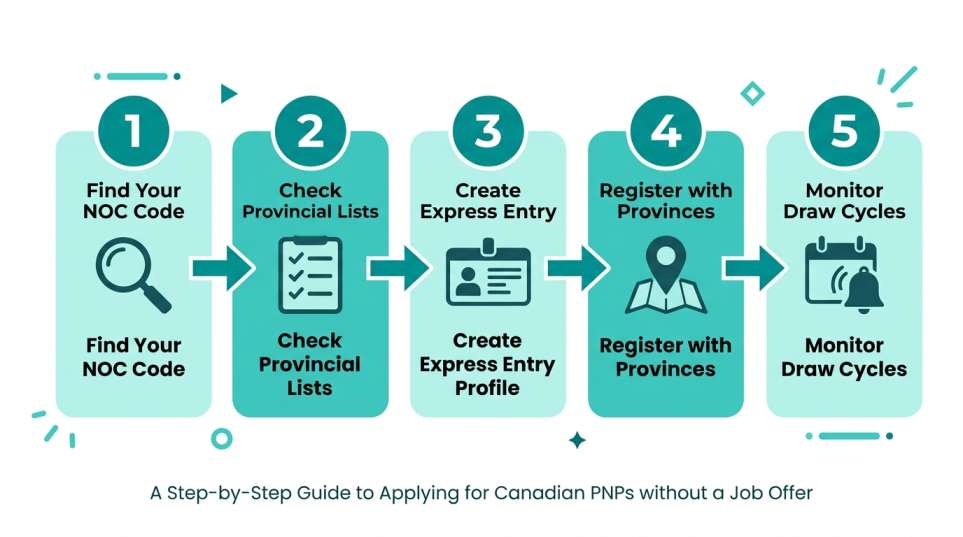
- Step 1: Confirm your NOC/TEER code. Use Canada’s National Occupational Classification tool on the IRCC website. Your TEER level determines which streams you’re eligible for.
- Step 2: Check if your occupation is in demand. Each province publishes an In-Demand Occupations list. Cross-reference your NOC code against these lists to identify high-probability provinces.
- Step 3: Create and optimize an Express Entry profile. Many no-job-offer streams draw from the federal pool or require an active profile. Even if your CRS is not high enough for a federal ITA, a provincial nomination changes the math.
- Step 4: Register with provincial expression-of-interest systems. BC (SIRS), Ontario (OINP portal), and other provinces have their own pools. Submit profiles to each province where you’re eligible.
- Step 5: Monitor draw cycles consistently. PNP draws happen monthly or bi-monthly in most provinces. Follow IRCC and provincial immigration authority announcements. Consider setting up email alerts.
Key Takeaways: PNP Without a Job Offer
- Multiple provinces offer viable pathways without employer sponsorship. Ontario, BC, Alberta, Saskatchewan, Manitoba, and Nova Scotia all have active streams where a job offer is not mandatory.
- Your CRS score is the single most important factor. Even in PNP streams that don’t require employment, a competitive score relative to that province’s draw threshold is what determines success.
- A job offer still provides a strategic advantage in most streams, even when it’s not required — particularly in BC and in the federal Express Entry pool.
- NOC/TEER code compatibility matters. Skilled, semi-skilled, and trade occupations are often eligible for different streams. Know your category.
- Apply to provinces, not just the federal pool. A provincial nomination adds 600 CRS points — arguably the most powerful lever available to mid-range CRS candidates.
- Stay current. Draw thresholds shift with labour market conditions, IRCC policy changes, and political priorities. Strategies that worked in 2024 may need adjustment in 2026.
Conclusion
The idea that you need a Canadian employer to sponsor your immigration journey is a widespread misconception — and one that keeps many qualified candidates from pursuing the provincial pathways they’re already eligible for.
If you have the skills, the language proficiency, and the right occupational background, there is a very real chance that a PNP stream exists specifically for someone like you — no job offer required. The key is understanding which provinces are drawing in your NOC category, optimizing your Express Entry profile, and registering with the right provincial expression-of-interest systems.
Not sure where to start? Explore our detailed guides on Express Entry vs. PNP, category-based selection strategy, and the BC Tech PNP eligible occupations — and keep this page bookmarked as draw thresholds evolve through 2026.
⚠️ Legal Disclaimer
The information provided in this article is intended for general informational purposes only and does not constitute legal, immigration, or professional advice. Canadian immigration laws, policies, and program requirements change frequently. The eligibility criteria, draw thresholds, and program details referenced in this article were accurate as of April 2026 but may have changed since publication. Always consult a Regulated Canadian Immigration Consultant (RCIC) or a licensed immigration lawyer before making any immigration decisions. Fresh Start Canada is not affiliated with Immigration, Refugees and Citizenship Canada (IRCC) or any provincial government.


