





Bringing your spouse to Canada just got more complicated—but understanding the new 2026 rules can still open doors to building your life together in one of the world’s most welcoming countries.
If you’re a foreign worker or international student in Canada, you’ve probably wondered: Can my spouse work here too? The answer used to be straightforward. For years, spouses of most work and study permit holders could apply for a Spousal Open Work Permit (SOWP) with minimal restrictions. But effective January 21, 2025, Canada implemented sweeping changes that dramatically reshaped who qualifies.
This isn’t just policy jargon—these changes affect thousands of families planning their Canadian journey in 2026. Whether you’re an IT professional on a work permit, a PhD student, or a skilled tradesperson, the new eligibility requirements based on TEER (Training, Education, Experience, and Responsibilities) classifications will determine whether your spouse can join you in the workforce.
In this comprehensive guide, we’ll break down everything you need to know about spousal open work permit requirements in 2026—from TEER categories and the 16-month validity rule to application strategies and common refusal reasons. By the end, you’ll have a clear roadmap for bringing your spouse to Canada under the new regulations.


What Changed: The January 2025 Policy Shift That Affects 2026 Applications
On January 14, 2025, Immigration, Refugees and Citizenship Canada (IRCC) announced a fundamental restructuring of spousal open work permit eligibility. What was once a broadly accessible pathway became highly selective, focusing on high-skilled workers and advanced students.
The Old Rules vs. The New Reality
Before January 21, 2025, eligibility was straightforward: if you held a valid Canadian work permit or were enrolled as an international student, your spouse could typically apply for an open work permit. The system didn’t discriminate based on your job title, education level, or occupation category.
The new framework flipped this approach on its head. Canada’s government determined that spousal work permits should align with broader economic priorities—specifically, supporting sectors facing labour shortages and encouraging highly skilled immigration. The result? A TEER-based system that creates clear winners and losers.
Table 1: Pre-2025 vs. 2026 Spousal Open Work Permit Requirements
Criteria | Before Jan 21, 2025 | After Jan 21, 2025 (2026) |
Occupation Requirements | Any valid work permit holder’s spouse eligible | Only TEER 0, 1, or select TEER 2/3 occupations |
Work Permit Validity | 6 months minimum | 16 months minimum at time of application |
Student Spouse Eligibility | Most international students | Only Master’s (16+ months), PhD, or approved professional programs |
Dependent Children | Could apply for open work permits | No longer eligible (must use study/visitor permits) |
[Source: Immigration, Refugees and Citizenship Canada (IRCC), 2025 policy updates]
Why Did Canada Make These Changes?
The policy shift wasn’t arbitrary. IRCC stated that the temporary expansion of family open work permits (introduced in December 2022) had served its purpose during post-pandemic labour shortages. By 2025, Canada wanted to:
- Align temporary immigration with permanent residence priorities (focusing on high-skilled workers)
- Target sectors with critical labour shortages (healthcare, trades, technology)
- Reduce application volumes and processing backlogs
- Encourage international graduates to secure skilled employment before bringing family members
Understanding TEER Categories: The Foundation of 2026 SOWP Eligibility
The National Occupational Classification (NOC) system is Canada’s official framework for categorizing jobs. In 2022, it introduced the TEER system, which replaced the old NOC skill levels. TEER stands for Training, Education, Experience, and Responsibilities—and it’s now the gatekeeper for spousal work permit eligibility.
TEER Categories Explained
TEER 0: Management Occupations
These are senior leadership roles requiring significant management responsibilities. Examples include chief executives, financial managers, engineering managers, and IT managers. All TEER 0 occupations qualify for spousal open work permits.
TEER 1: Professional Occupations
Typically require a university degree. This category includes software engineers, physicians, university professors, civil engineers, and financial analysts. All TEER 1 occupations qualify.
TEER 2: Technical and Skilled Occupations
Usually require a college diploma or apprenticeship. Only select TEER 2 occupations qualify—specifically those in natural and applied sciences, healthcare, skilled trades, and certain technical fields. Administrative and sales roles in TEER 2 generally do not qualify.
TEER 3: Technical, Skilled, and Supervisory Occupations
Typically require high school plus job-specific training or some college. Like TEER 2, only select TEER 3 occupations qualify—primarily in trades, healthcare support, and transportation.
TEER 4 and TEER 5: No Longer Eligible (With Exceptions)
TEER 4 (intermediate duties) and TEER 5 (basic labor and support roles) do not qualify unless the principal applicant is on a specific pathway to permanent residence (PR)—such as the Agri-Food Pilot, Atlantic Immigration Program, or certain Provincial Nominee Programs. In these exceptional cases, spouses may still qualify if the work permit has at least 6 months of validity remaining.
Table 2: Sample of Eligible TEER 2 and 3 Occupations for Spousal Open Work Permits (2026)
NOC Code | Occupation | Sector |
22310 | Electrical and electronics engineering technologists | Natural and Applied Sciences |
22313 | Aircraft instrument, electrical and avionics mechanics | Natural and Applied Sciences |
32101 | Licensed practical nurses | Healthcare |
32103 | Respiratory therapists, clinical perfusionists | Healthcare |
42202 | Early childhood educators and assistants | Education Services |
72010 | Contractors and supervisors, machining/metal trades | Skilled Trades |
72011 | Contractors and supervisors, electrical trades | Skilled Trades |
72013 | Contractors and supervisors, carpentry trades | Skilled Trades |
73200 | Residential and commercial installers and servicers | Skilled Trades |
75101 | Transport truck drivers | Transportation |
75110 | Construction trades helpers and labourers | Construction |
[Note: This is a representative sample. For the complete list of eligible TEER 2 and 3 occupations, consult the official IRCC website. Source: IRCC, January 2025]
Critical Detail: It’s Not About Job Title—It’s About Duties
Here’s where many applicants trip up: your employer might call you an “Administrative Coordinator,” but if your actual day-to-day responsibilities match the NOC duties for a different occupation, that NOC code is what matters—not your title.
To determine your NOC code, you must match at least 51% of the main duties listed in the NOC description. This means carefully reviewing your job offer letter, employment contract, and actual responsibilities. If you’re on the borderline between two NOC codes, document your duties thoroughly and consult with an immigration professional.
The 16-Month Rule: Timing Your Spousal Open Work Permit Application
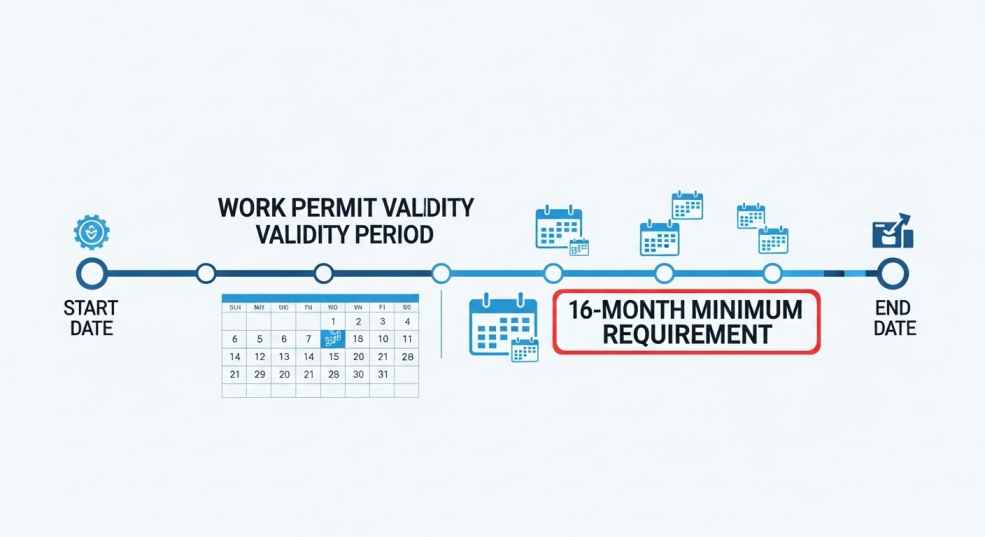
One of the most significant—and strictest—requirements introduced in 2025 is the 16-month validity rule. For your spouse to qualify for a spousal open work permit in 2026, you (the principal applicant) must have at least 16 months remaining on your work permit at the time your spouse submits their application.
Why This Matters More Than You Think
This requirement forces strategic planning. Consider these scenarios:
Scenario 1: The Close Call
Sarah holds a 2-year work permit expiring on December 31, 2026. She wants to apply for her spouse’s open work permit in October 2026. At that point, she has only 3 months remaining—far below the 16-month requirement. Her spouse’s application would be refused.
Solution: Sarah should apply for a work permit extension before her spouse submits the SOWP application, ensuring she has 16+ months of validity. Alternatively, she could have applied for her spouse’s permit much earlier—ideally within the first 8 months of receiving her own work permit.
Scenario 2: The Post-Graduation Trap
Michael just graduated from a Canadian university and received a 3-year Post-Graduation Work Permit (PGWP). His spouse had an open work permit as a student spouse, but that permit is about to expire. Michael hasn’t secured a job yet in an eligible TEER category.
The problem: Even though Michael has 3 years on his PGWP, his spouse cannot apply for a spousal open work permit until Michael is employed in a qualifying occupation (TEER 0, 1, or eligible TEER 2/3). A PGWP alone doesn’t automatically qualify—the job offer and actual employment matter.
Exceptions to the 16-Month Rule
There are limited exceptions where the 6-month minimum (instead of 16 months) still applies:
- Principal applicants on certain PR pathways (Express Entry, Provincial Nominee Programs, Atlantic Immigration Program, Agri-Food Pilot, etc.)
- Work permit holders under specific Free Trade Agreements (FTAs) such as CETA, CPTPP, Canada-Korea FTA, or Canada-UK TCA
- Inland spousal sponsorship applicants who have received Approval in Principle (AIP)
SOWP Eligibility for Spouses of International Students in 2026
If you’re an international student hoping to bring your spouse to Canada, the 2026 rules are particularly restrictive. Gone are the days when nearly any study permit holder could sponsor their spouse for an open work permit.

Who Still Qualifies: The Three Eligible Categories
- Master’s Degree Students (16+ Month Programs)
If you’re enrolled in a Master’s program that is at least 16 months in duration at a Designated Learning Institution (DLI), your spouse can apply for an open work permit. One-year Master’s programs do not qualify.
- Doctoral (PhD) Students
PhD students at any recognized Canadian institution continue to qualify, regardless of program length.
- Approved Professional Degree Programs
Students in select professional programs—such as Medicine (MD), Law (JD), Nursing (BScN), Pharmacy (PharmD), Dentistry (DDS), or Veterinary Medicine (DVM)—may qualify if their program is on IRCC’s approved list and meets minimum duration requirements.
Who No Longer Qualifies
- Undergraduate students (Bachelor’s degree programs)
- College diploma or certificate students
- Language program students
- One-year Master’s programs (under 16 months)
- Post-secondary programs below degree level
The Post-Graduation Gap: What Happens After You Graduate
Here’s a critical transition many students overlook: if your spouse has been working in Canada on a spousal open work permit while you studied, their permit typically expires when yours does. When you transition from a study permit to a Post-Graduation Work Permit (PGWP), your spouse’s eligibility changes.
Under 2026 rules, holding a PGWP is not enough. You must be employed in an eligible TEER 0, 1, or select TEER 2/3 occupation for your spouse to renew or apply for a new spousal open work permit. If you graduate and take a few months to find work—or accept a job in a TEER 4 or 5 category—your spouse will lose their work authorization.
Pathways to Permanent Residence and SOWP Eligibility
One of the most important exceptions to the restrictive 2026 rules applies to individuals who are on a pathway to permanent residence. If you’ve applied for PR through eligible economic programs, your spouse may qualify for an open work permit even if your occupation falls into TEER 4 or 5.
Eligible PR Programs That Bypass TEER Restrictions
- Express Entry (Federal Skilled Worker, Canadian Experience Class, Federal Skilled Trades)
If you’ve submitted an Express Entry application and received an Acknowledgement of Receipt (AOR), your spouse can apply for an open work permit, typically valid for up to 2 years or until a decision is made on your PR application.
- Provincial Nominee Programs (PNPs)
Individuals nominated by a province or territory and who have applied for federal PR can support spousal open work permits. This applies even if the nominee works in a lower-skilled occupation (TEER 4 or 5).
- Atlantic Immigration Program (AIP)
Workers in the Atlantic provinces pursuing PR through AIP can bring spouses on open work permits, regardless of TEER level, as long as the work permit has at least 6 months validity.
- Agri-Food Pilot
Workers in agriculture and low-wage sectors who have applied for PR under this pilot can sponsor spouses for open work permits.
- Rural and Northern Immigration Pilot (RNIP)
Similar to AIP, RNIP applicants can support spousal open work permits once they’ve submitted their PR application and received AOR.
- Inland Spousal Sponsorship
If you’re being sponsored by your Canadian citizen or PR spouse/partner from within Canada, you can apply for an open work permit once you’ve received your AOR (or Approval in Principle if you were out of status when you applied).
Bridging Open Work Permits: Maintaining Status During PR Processing
For individuals already in Canada with temporary work permits who have applied for PR, a Bridging Open Work Permit (BOWP) can be a lifeline. The BOWP allows you to continue working in Canada while your PR application is being processed, and it also enables your spouse to maintain or apply for their own open work permit.
In 2026, the Temporary Resident to Permanent Resident (TR to PR) pathway public policy has been extended until December 31, 2026. This means applicants under this pathway—and their family members—can obtain open work permits while their PR applications are in process.
Step-by-Step: How to Apply for a Spousal Open Work Permit in 2026
Applying for a spousal open work permit requires meticulous preparation. Here’s a detailed walkthrough of the process for 2026 applications.
Step 1: Confirm Eligibility
Before starting your application, verify that:
- The principal applicant (foreign worker or student) meets the TEER or program requirements
- The principal applicant has at least 16 months of validity remaining (or 6 months for PR pathway/FTA exceptions)
- You (the spouse/partner) meet general work permit requirements (no criminal inadmissibility, medical exams if required)
- You can prove a genuine relationship (married or common-law for at least 12 months)
Step 2: Gather Required Documents
Document requirements vary slightly depending on whether you’re applying from inside or outside Canada, but the core documents include:
For All Applicants:
- Valid passport (must extend beyond the intended work permit duration)
- Marriage certificate or proof of common-law relationship (statutory declarations, joint bank accounts, lease agreements, cohabitation evidence for 12+ consecutive months)
- Principal applicant’s valid work permit or study permit (or letter of introduction if not yet activated)
- Proof of principal applicant’s employment in eligible occupation (job offer letter, employment contract, recent pay stubs, employer letter confirming NOC duties)
- Proof of sufficient funds to support yourself in Canada
- Digital photo meeting IRCC specifications
Additional Documents for Specific Scenarios:
- PR Pathway Applicants: Acknowledgement of Receipt (AOR) letter from IRCC confirming PR application is complete and being processed
- Student Spouses: Letter from Designated Learning Institution confirming enrollment in Master’s (16+ months), PhD, or professional program
- Inside Canada Applicants: Proof of valid temporary resident status (work permit, study permit, visitor record, or proof of maintained status)
Step 3: Create an IRCC Secure Account and Complete the Application
Most SOWP applications are submitted online through the IRCC secure portal:
- Go to the IRCC website and create a secure account (or log in if you already have one)
- Answer the eligibility questions to generate a personalized document checklist
- When asked “What type of work permit do you want to apply for?”, select “A work permit for a spouse of an international student, or for a family member of a worker”
- Complete the IMM 5710 form (Application to Change Conditions, Extend my Stay or Remain in Canada as a Worker) or the work permit application form
- Upload all required documents according to the checklist
- Pay the application fee (CAD $255 as of 2026, including the work permit processing fee and open work permit holder fee)
- Submit the application and save your confirmation receipt
Step 4: Biometrics and Medical Exams (If Required)
After submission, IRCC will review your application. Most applicants will receive a biometrics instruction letter within a few days. You must:
- Book an appointment at a designated biometrics collection center (additional fee: CAD $85)
- Provide fingerprints and a digital photo
- Medical exams are only required for certain countries or if you plan to work in specific sectors (healthcare, childcare, etc.). If required, IRCC will send you instructions.
Step 5: Processing Times and Tracking Your Application
Processing times vary significantly based on whether you apply from inside or outside Canada:
- Inside Canada: Typically 4–6 months (as of early 2026)
- Outside Canada: Varies widely by visa office (2–8 months, sometimes longer)
You can track your application status through your IRCC secure account. Watch for:
- Document requests (additional evidence needed)
- Biometrics validity confirmation
- Final decision notification

Common Refusal Reasons and How to Avoid Them
Understanding why spousal open work permit applications get refused can save you months of frustration and reapplication fees. Based on recent IRCC data and immigration practitioner experience, here are the top reasons for SOWP refusals in 2026:
1. Insufficient Proof of Genuine Relationship
IRCC officers scrutinize marriages and common-law partnerships to ensure they’re not relationships of convenience. Weak applications often include:
- Marriage certificates with no supporting relationship evidence
- Common-law claims without adequate proof of 12+ months of cohabitation
- Limited shared financial documentation (bank accounts, property ownership, joint bills)
- Few or no photos together spanning the relationship timeline
How to Strengthen Your Application:
- Provide comprehensive relationship evidence: joint lease or mortgage, shared utility bills, joint bank account statements (6–12 months)
- Include 15–20 photos spanning your relationship (engagement, wedding, vacations, family gatherings) with dates and context
- Submit affidavits from friends and family attesting to your genuine relationship
- For common-law partnerships: provide lease agreements, utility bills in both names, and statutory declarations
2. NOC Code Mismatch or Ineligible Occupation
This is the most common refusal reason under the new 2026 rules. Officers reject applications when:
- The principal applicant’s actual job duties don’t match the claimed NOC code
- The occupation falls under an ineligible TEER category (e.g., administrative roles in TEER 2 instead of technical roles)
- Job offer letters are vague or don’t detail specific responsibilities
How to Strengthen Your Application:
- Obtain a detailed employment letter from the employer explicitly listing job duties that align with the NOC description
- Cross-reference your job duties against the official NOC 2021 matrix to ensure at least 51% match
- If your NOC code is in the TEER 2 or 3 range, verify it’s on the eligible occupations list published by IRCC
- Consider obtaining a professional NOC assessment if you’re uncertain
3. Insufficient Work Permit Validity (Under 16 Months)
Applications are automatically refused if the principal applicant doesn’t have 16 months of validity remaining at the time of submission (unless an exception applies).
How to Strengthen Your Application:
- Apply for a work permit extension before submitting the SOWP application
- Time your SOWP application strategically—ideally within the first 8 months of receiving your work permit
- If you’re on a PR pathway, clearly document this with your AOR letter to qualify for the 6-month exception
4. Financial Insufficiency
Officers must be satisfied that you have adequate funds to support yourself (and any dependents) during your stay in Canada. Weak applications show:
- Bank statements with minimal balances
- No proof of employment income or financial support
- Large, unexplained deposits shortly before application (raises suspicion of borrowed funds)
How to Strengthen Your Application:
- Provide 3–6 months of bank statements showing consistent balances
- Include proof of employment income (pay stubs from both you and your spouse)
- Demonstrate housing arrangements (lease agreement, proof of accommodation)
- While there’s no official minimum amount, aim to show at least CAD $10,000–$15,000 in available funds (more if you have dependents)
5. Status Issues (Out of Status or Restoration Eligibility)
For applicants inside Canada, maintaining valid temporary resident status is crucial. Applications are refused if:
- You’re out of status and don’t qualify for restoration (more than 90 days past expiry)
- You apply before your current status expires but without proper documentation
How to Strengthen Your Application:
- Apply before your current status expires to maintain “maintained status” while processing
- If you’re out of status but within 90 days, apply for restoration along with your work permit
- For inland spousal sponsorship applicants who are out of status, wait for Approval in Principle (AIP) before applying for SOWP
Key Takeaways and Strategic Planning for 2026
The 2026 landscape for spousal open work permits is fundamentally different than it was just two years ago. Success requires careful planning, strategic timing, and meticulous documentation. Here are the essential points to remember:
Critical Success Factors
- Know Your TEER Category
Your eligibility hinges on whether the principal applicant’s occupation falls into TEER 0, TEER 1, or an eligible TEER 2/3 category. Don’t assume your job title determines your NOC—verify your actual job duties match the NOC description. Use the official NOC 2021 matrix and consult IRCC’s list of eligible TEER 2/3 occupations.
- Time Your Application Strategically
The 16-month validity requirement means you should apply for your spouse’s permit early in your own work permit cycle—ideally within the first 6–8 months. If you’re approaching the end of your work permit, extend it first before submitting the SOWP application. For students transitioning to PGWPs, secure employment in an eligible occupation before applying for your spouse’s permit.
- Leverage PR Pathways When Possible
If you’re in a TEER 4 or 5 occupation, your best path to bringing your spouse may be through a permanent residence application. Programs like the Atlantic Immigration Program, Provincial Nominee Programs, or Agri-Food Pilot allow spouses to work even if the principal applicant isn’t in a high-skilled role. Apply for PR early in your Canadian journey if this is your situation.
- Document Everything Thoroughly
IRCC officers are looking for reasons to refuse applications that don’t meet the strict criteria. Provide comprehensive documentation: detailed employment letters showing NOC-aligned duties, extensive relationship evidence, strong financial documentation, and clear proof of valid status. Don’t leave room for assumptions or interpretation.
- Consider Professional Assistance for Complex Cases
If your situation involves NOC code ambiguity, common-law relationship proof, restoration of status, or previous refusals, consulting a Regulated Canadian Immigration Consultant (RCIC) or immigration lawyer can significantly increase your success rate. The investment often pays for itself by avoiding costly refusals and reapplications.
What If You Don’t Qualify?
If your spouse doesn’t meet the 2026 SOWP eligibility requirements, you still have options:
- Employer-Specific Work Permit: Your spouse can apply for a regular work permit if they secure a job offer from a Canadian employer. This may require a Labour Market Impact Assessment (LMIA).
- Study Permit: Your spouse could pursue their own education in Canada, which would provide a study permit and potentially open pathways to work permits later.
- Visitor Status: While not ideal, your spouse could visit you in Canada on a visitor visa or visa-exempt entry. This doesn’t allow work, but it keeps your family together while you explore longer-term options.
- Plan for Permanent Residence: Focus on becoming a permanent resident as quickly as possible through Express Entry, PNPs, or other programs. Once you have PR, you can sponsor your spouse directly through spousal sponsorship.
Final Thoughts: Navigating the New Normal
The spousal open work permit landscape in 2026 is more selective, more technical, and more challenging to navigate than ever before. What was once a straightforward process now requires careful analysis of NOC codes, TEER categories, work permit validity timelines, and relationship documentation.
But don’t let these changes discourage you. Thousands of families successfully bring spouses to Canada every year under these new rules. The key is understanding the requirements, planning strategically, and presenting a compelling, well-documented application.
Remember that immigration policies can change. What’s true in February 2026 may evolve later in the year. Always verify your eligibility using the official IRCC website and consider professional advice for complex situations.
Canada remains committed to family reunification—it’s just prioritizing high-skilled immigration pathways to meet economic needs. If you work in a qualifying occupation or are on a pathway to permanent residence, bringing your spouse to build your life together in Canada is absolutely achievable.
Start your application early, document thoroughly, and approach the process with patience and attention to detail. Your Canadian family journey is worth the effort.