


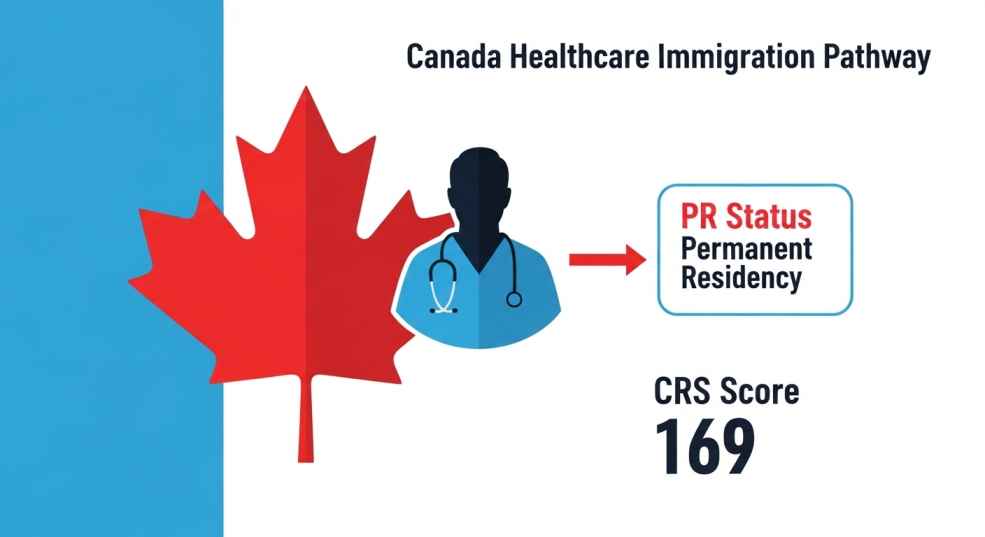
If you are a foreign-trained physician already working in Canada, February 2026 may be the most important month in your immigration journey. On February 18, 2026, Immigration Minister Lena Metlege Diab announced a brand-new, dedicated Express Entry category exclusively for medical doctors with Canadian work experience — and just one day later, the first draw was held with a record-breaking CRS cutoff of only 169 points. That is the lowest score ever recorded in any Express Entry draw in the program’s history.
This article breaks down everything you need to know about the medical doctors Express Entry 2026 pathway: what it is, who qualifies, how to apply, and what strategy gives you the strongest chance of receiving an Invitation to Apply (ITA). Whether you are a general practitioner, a surgeon, or a clinical specialist currently holding a work permit in Canada, this guide is written for you.
What Is the Medical Doctors Express Entry Category?
Canada’s Express Entry system is the federal government’s flagship application management platform for economic immigration. It manages three main programs: the Federal Skilled Worker Program (FSWP), the Federal Skilled Trades Program (FSTP), and the Canadian Experience Class (CEC). Since 2023, IRCC has also used “category-based selection” to issue targeted Invitations to Apply (ITAs) to candidates in specific high-demand occupations, often at CRS scores significantly lower than general draws.
The physicians category launched on February 18, 2026 is a completely separate stream from the existing general Healthcare and Social Services category that has been running since 2023. This distinction is critical. While the broader healthcare category includes over 35 different occupations — from nurses to pharmacists to physiotherapists — the new physicians category is exclusively for medical doctors under three specific NOC codes. This narrower pool is exactly why CRS scores for this category are dramatically lower.
According to the official Government of Canada announcement, the new category is part of a broader International Talent Attraction Strategy aimed at moving beyond simply filling labour shortages toward proactively attracting strategic leadership and specialized expertise. (Source: canada.ca, February 18, 2026 )
Who Qualifies: Eligible NOC Codes for Medical Doctors Express Entry 2026
To be eligible for this category, your work experience must fall under one of the following three National Occupational Classification (NOC) 2021 codes. Your actual job duties — not just your job title — must match the NOC description by approximately 80%.
The three eligible physician NOC codes are:
- NOC 31100 — Specialists in Clinical and Laboratory Medicine: Includes cardiologists, neurologists, internists, radiologists, pathologists, psychiatrists, and other medical specialists who diagnose and treat diseases using clinical and laboratory methods.
- NOC 31101 — Specialists in Surgery: Covers general surgeons, orthopedic surgeons, neurosurgeons, cardiac surgeons, plastic surgeons, and other surgical subspecialties who perform operations to treat injuries, diseases, and deformities.
- NOC 31102 — General Practitioners and Family Physicians: Encompasses family doctors and GPs who provide primary care, diagnose and treat illnesses, manage chronic conditions, and refer patients to specialists when needed.
It is important to understand that your NOC classification is based on your primary duties. A hospitalist whose daily work mirrors a general internist would likely fall under NOC 31100. A walk-in clinic physician primarily performing primary care duties would likely be NOC 31102. If you are unsure of your NOC, consult a Regulated Canadian Immigration Consultant (RCIC) or immigration lawyer before creating your Express Entry profile. Misclassifying your NOC is one of the most common and costly mistakes applicants make.
Key Eligibility Requirements for Physician Express Entry 2026
1. Canadian Work Experience — The Non-Negotiable Requirement
Unlike the general healthcare category, which accepts work experience gained anywhere in the world, the physicians category specifically requires Canadian work experience. This is a hard requirement with no exceptions. You must have a minimum of 12 months of full-time work experience (or the equivalent in accumulated part-time hours) in one of the three eligible NOC codes, gained within the three years before you receive your Invitation to Apply.
This 12-month requirement does not need to be continuous. Cumulative hours in the same eligible NOC code count, which is helpful for doctors who may have worked locum shifts, split positions, or had gaps between roles. What matters is that your total hours reach the equivalent of 12 months of full-time work within the qualifying three-year window.
Importantly, work done under a residency or fellowship program in Canada does count as Canadian work experience for Express Entry purposes, provided you were being compensated. Unpaid clinical placements typically do not qualify.
2. Express Entry Profile in an Eligible Program
You must have an active Express Entry profile under the Federal Skilled Worker Program (FSWP) or the Canadian Experience Class (CEC) to be considered for category-based draws. Most physicians with 12 months of Canadian work experience will qualify for the CEC, which has no minimum CRS score requirement for the pool itself. For those with less Canadian experience or applying under FSWP, meeting the 67-point eligibility threshold is required.
3. Language Proficiency
All Express Entry candidates must demonstrate English or French proficiency through an approved language test. For English, accepted tests are IELTS General Training or Academic, or CELPIP General. For French, the TEF Canada or TCF Canada are accepted. Scores are converted to Canadian Language Benchmark (CLB) levels. Most Express Entry programs require a minimum CLB 7, though higher scores improve your CRS ranking. Given how low the CRS threshold was in the February 2026 draw (169 points), even moderate language scores would likely qualify you.
4. Education Credential Assessment (ECA)
If your medical degree was earned outside Canada, you need an Educational Credential Assessment (ECA) from a designated organization, such as WES (World Education Services) or IQAS, to confirm your credentials are equivalent to Canadian standards. This process takes time — often 3 to 6 months — so if you have not started your ECA, begin immediately. Canadian-trained physicians are exempt from this requirement.
5. Active License or Registration (Important but Separate)
Qualifying for Express Entry as a physician does not require you to hold a provincial medical license at the time of application. However, practicing medicine in Canada does require a license from a provincial regulatory body such as the College of Physicians and Surgeons. Your work experience letters should reference the scope of your clinical work and your authorization to practice (whether under a full license, conditional license, or residency supervision arrangement).
📋 Eligibility Checklist: Medical Doctors Express Entry 2026
Eligibility Requirement | Details | Your Status |
NOC Code | 31100, 31101, or 31102 | ✓ / ✗ |
Canadian Work Experience | Minimum 12 months within last 3 years | ✓ / ✗ |
Express Entry Profile | Active FSW, CEC, or FST profile | ✓ / ✗ |
Language Test | Valid IELTS/CELPIP (English) or TEF/TCF (French) | ✓ / ✗ |
Education Credential Assessment (ECA) | Required if degree earned outside Canada | ✓ / ✗ |
CRS Score | Low threshold expected (169 in Feb 2026 draw) | Check your score |
Medical Exam | Completed as part of PR application | Required at PR stage |
Police Clearance | From all countries lived 6+ months since age 18 | Required at PR stage |
Table 1: Use this checklist to assess your readiness for the physicians category draw.
How the First Physicians Draw Unfolded: Key Insights from February 19, 2026
The inaugural physicians draw took place on February 19, 2026 — just one day after the category was announced, making it one of the fastest category launches in Express Entry history. Here are the draw statistics and what they tell us about this new pathway:
- Draw Type: Physicians with Canadian Work Experience (2026 – Version 1)
- Date: February 19, 2026
- CRS Cutoff: 169 points
- Invitations Issued: 391
- Tie-Breaking Rule: January 3, 2026 at 03:25:14 UTC
The CRS cutoff of 169 is extraordinary. To put it in context, general Express Entry draws in 2025 typically required CRS scores in the 490–530 range. Even specialty healthcare draws — which already ran lower than average — had cutoffs between 430 and 480. A score of 169 is essentially an invitation for any eligible physician in the pool, and it reflects the very small candidate pool at launch, since many physicians may not yet have updated their Express Entry profiles to reflect this new category.
This is a critical insight: if you are eligible but not yet in the Express Entry pool, you are missing draws with historically low CRS thresholds. There is no benefit in waiting.
Physicians Category vs. General Healthcare Category: What’s the Difference?
Many doctors already in Canada may be tempted to apply under the broader Healthcare and Social Services category, which has been running draws since 2023. But there are compelling reasons why the new dedicated physicians category is almost always the better choice for eligible doctors. The table below compares both streams side by side.
Feature | Physicians Category (2026 NEW) | General Healthcare Category |
Eligible Occupations | NOC 31100, 31101, 31102 only | 35+ NOC codes (nurses, pharmacists, etc.) |
Work Experience Required | 12 months Canadian experience | 12 months (Canada or abroad) |
CRS Cutoff (Feb 2026 Draw) | 169 (record low) | 430–480 typical |
First Draw Date | February 19, 2026 | Ongoing since 2023 |
Competition Level | Very low (small pool) | High (large pool) |
Foreign Experience Counts? | No — must be Canadian | Yes — foreign experience accepted |
Job Offer Required? | No | No |
Draws Per Year (Expected) | Multiple rounds in 2026 | Multiple rounds per year |
Table 2: Physicians Category vs. General Healthcare Category — Key Differences (Source: IRCC, 2026)
The bottom line is straightforward: if you are an eligible physician with 12 months of Canadian work experience, the physicians category gives you a dramatically better chance of receiving an ITA at a far lower CRS score. The smaller, more targeted pool means less competition. Doctors who qualify for this category should prioritize it over the general healthcare stream.
Step-by-Step: How to Apply Under the Medical Doctors Express Entry Category
Here is a practical action plan for physicians looking to navigate this pathway:
Step 1 — Confirm Your NOC Code
Visit the official Government of Canada NOC 2021 website and search by your duties, not your job title. Cross-reference your reference letters and employment contract against the NOC’s “Main Duties” description. Aim for at least 80% alignment. (Source: noc.esdc.gc.ca)
Step 2 — Calculate Your Canadian Work Experience
Tally up your total hours in eligible NOC positions in Canada over the past three years. Full-time work is typically 30+ hours per week. If you worked part-time or locum shifts, calculate the equivalent full-time months. Ensure you can document this experience with offer letters, pay stubs, and reference letters on official letterhead.
Step 3 — Take or Update Your Language Tests
If your IELTS or CELPIP scores are valid (within two years) and meet the minimum requirement, you are set. If they have expired or you need to improve your CLB score, book a test immediately. Language test results can take 2 to 4 weeks to receive. Higher language scores increase your CRS, though given the February 2026 draw’s cutoff of 169, even modest scores likely qualify most physicians.
Step 4 — Obtain Your Educational Credential Assessment
If your medical degree was earned outside Canada, submit your ECA application to WES, IQAS, or another designated organization. Start this process early — it is often the longest step. You will typically need official transcripts sent directly from your university and certified translations if documents are not in English or French.
Step 5 — Create or Update Your Express Entry Profile
Log in to IRCC’s online portal and create or update your Express Entry profile. Ensure your NOC code accurately reflects your work experience. Include all qualifying Canadian work experience. Your profile will be automatically assessed against all eligible programs (FSW, CEC, FST) and you will be placed in the pool if you meet the criteria.
Step 6 — Monitor Draws and Receive Your ITA
Once your profile is in the pool, IRCC will issue ITAs through draws. Monitor IRCC’s “Express Entry rounds of invitations” page regularly. When you receive an ITA, you have 60 days to submit a complete PR application. This deadline is strict and extensions are rarely granted, so begin gathering documents as soon as your profile is active.
Step 7 — Submit Your Permanent Residence Application
Your PR application will include proof of identity, language results, ECA (if applicable), proof of Canadian work experience, medical exams, police certificates, and settlement funds documentation. Hiring a licensed RCIC or immigration lawyer to review your application before submission is strongly recommended.
Provincial Nominee Program: An Additional Pathway for Physicians
Beyond the federal Express Entry physicians category, doctors should also explore the Provincial Nominee Program (PNP) as a complementary or parallel pathway. Many provinces have streams specifically designed for physicians and healthcare workers, and a provincial nomination adds 600 CRS points to your Express Entry score — effectively guaranteeing an ITA in the next general draw.
Provinces with notable physician-focused immigration streams include Ontario, British Columbia, Alberta, Saskatchewan, and Nova Scotia. Each province has its own eligibility criteria, application process, and intake cycles. Some require a job offer or licensing by the provincial college; others are more flexible. Exploring PNP options simultaneously with your Express Entry profile is a sound dual-track strategy.
What the 2026 Physicians Category Means for Canada’s Healthcare System
Canada has faced a persistent and worsening physician shortage for over a decade. According to the Canadian Medical Association, more than 6.5 million Canadians do not have access to a family doctor, with rural and remote communities most severely affected. (Source: Canadian Medical Association, 2024 )
The new Express Entry physicians category is a direct policy response to this crisis. By creating a dedicated, fast-tracked pathway for foreign-trained doctors who have already demonstrated their competence within the Canadian system, the government is betting that targeted immigration is a faster solution than waiting years for domestic medical schools to increase capacity.
From an employer perspective — whether you work at a hospital, a community health centre, or a family health team — this policy creates a real incentive to hire foreign-trained physicians on temporary permits as a bridge to permanent residency. Doctors who might have previously left Canada after their work permits expired now have a strong, predictable reason to stay.
Real-World Scenario: Would Dr. Patel Qualify?
To illustrate how this pathway works in practice, consider this hypothetical scenario:
Hypothetical Case Study: Dr. Priya Patel
Dr. Patel is a cardiologist from India who completed her residency training in Canada and has been working as a specialist at a hospital in Hamilton, Ontario for the past 14 months under a post-graduation work permit. Her NOC code is 31100 (Specialists in Clinical and Laboratory Medicine). She holds a valid IELTS score of 7.5 overall, has a WES ECA confirming her Indian medical degree, and has accumulated 14 months of full-time Canadian work experience.
Does she qualify? Yes. Dr. Patel meets every requirement for the physicians category. She should create or update her Express Entry profile immediately, select CEC as her primary program, and ensure her NOC code and Canadian work experience are accurately reflected. Given the February 2026 draw’s CRS cutoff of 169, she would almost certainly receive an ITA in the next draw.
Conclusion: Act Now — The Window Is Open for Eligible Doctors
The launch of the medical doctors Express Entry 2026 category is one of the most significant and immediate opportunities in Canadian immigration for foreign-trained physicians. The record-low CRS cutoff of 169 in the first draw signals that the pool of eligible physicians is still relatively small — meaning those who enter now have an exceptional chance of receiving an invitation before the pool grows more competitive.
Here are the key takeaways from this guide:
- The physicians category launched February 18, 2026, with the first draw on February 19, 2026 at a CRS of 169 — the lowest in Express Entry history.
- Eligible NOC codes are 31100, 31101, and 31102 — covering specialists, surgeons, and GPs/family physicians.
- You need 12 months of Canadian work experience (not foreign experience) within the last 3 years.
- Unlike the general healthcare category, competition is limited to physicians only, resulting in dramatically lower CRS thresholds.
- Start or update your Express Entry profile immediately if you qualify — waiting means missing future draws.
- Complement your Express Entry strategy with a provincial nominee application for a 600-point CRS boost.
If you are a physician working in Canada and haven’t yet started your immigration journey, or if your Express Entry profile has been sitting idle waiting for a better opportunity — this is that opportunity. Get your documents in order, update your profile, and position yourself for the next draw.
Need help navigating your Express Entry application? Consult a licensed RCIC or immigration lawyer to review your profile for accuracy and maximize your chances of success.
