


Canada has long been celebrated as one of the world’s most welcoming countries for immigrants. For decades, polling consistently showed Canadians broadly supportive of immigration — a political consensus that set Canada apart from many peer nations wrestling with nativist backlash. That consensus has cracked.
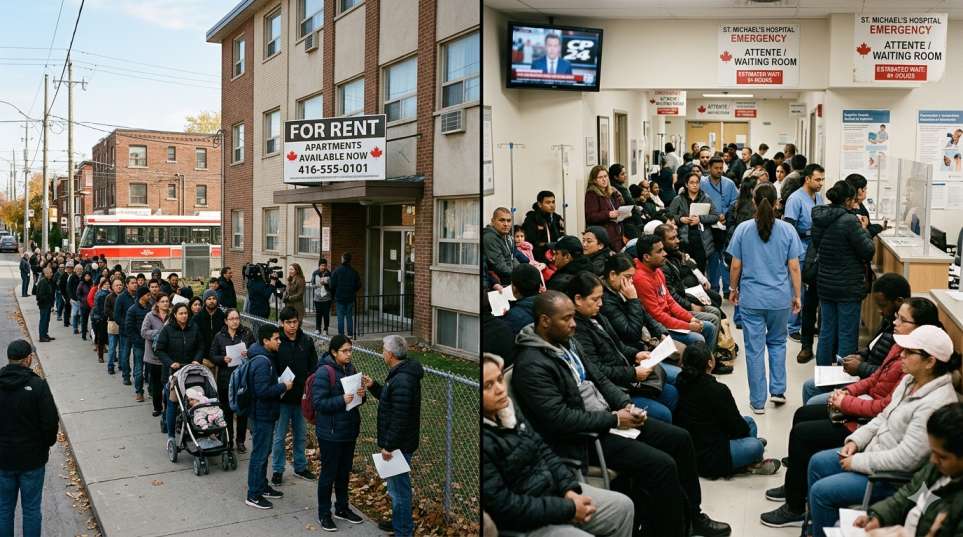
The question driving policy debates across Ottawa, Toronto, and Vancouver today is not whether Canadians still believe in immigration — most do, at a principled level — but how many newcomers they feel the country can realistically absorb. As housing costs spiral, hospital wait times lengthen, and a cost-of-living crisis squeezes household budgets, Canadians are expressing growing unease with immigration levels. The mood is measurable, important, and shifting.
This article compiles the most up-to-date polling data available on Canadian public opinion on immigration in 2026. We explore what Canadians actually think, which regions and age groups hold the strongest views, and what this means for newcomers navigating the immigration system right now. If you are planning to immigrate to Canada — or already have — understanding the political climate helps you appreciate the landscape you are entering.
The Numbers Don’t Lie: What 2025–2026 Polls Actually Show
Multiple national surveys conducted between late 2024 and early 2026 paint a consistent picture: a majority of Canadians believe current immigration levels are too high, but the situation is more nuanced than the headline figures suggest.
Negative Views Are at a Historic High — But Stabilizing
A January 2026 Research Co. poll found that only 34% of Canadians consider immigration to be having a mostly positive effect on the country — down nine points from July 2025 alone. Nearly half (48%) said the effect is mostly negative. To put that in historical context: in February 2022, only 26% of Canadians described immigration negatively. The proportion has nearly doubled in four years.
Source: Research Co. (January 2026) — online survey of 1,001 Canadian adults, Jan 11–13, 2026. [Source: Research Co. Immigration Poll, January 2026]
Yet the news is not uniformly bleak for immigration supporters. Other surveys conducted throughout 2025 show that while opposition is widespread, it has stopped accelerating. Environics Institute’s Fall 2025 Focus Canada report found that 56% of Canadians believe the country accepts too many immigrants — but this figure was down two percentage points from 2024, ending what had been a dramatic two-year rise.
Source: Environics Institute Focus Canada Survey (Fall 2025) — telephone interviews with 2,004 Canadians, Sept 8–21, 2025. [Source: Environics Institute, Canadian Public Opinion on Immigration, Fall 2025]
Similarly, Abacus Data’s October 2025 survey showed that 49% of Canadians view immigration negatively — virtually identical to the 50% recorded in November 2024. The plateau suggests that the government’s policy reductions may be having a calming effect on public anxieties.
Source: Abacus Data National Survey (October 2025) — 2,922 Canadian adults surveyed, Oct 24–29, 2025. [Source: Abacus Data Immigration Survey, November 2025]
Where Is Opposition Strongest? A Regional and Demographic Breakdown
National averages only tell part of the story. Polling consistently finds significant variation by province, age group, and political affiliation.
Provincial Variation
According to the January 2026 Research Co. poll, more than half of Canadians in Ontario (53%), Saskatchewan and Manitoba combined (52%), and Alberta (51%) say immigration is having a mostly negative effect. Opposition is somewhat lower in British Columbia (43%), Atlantic Canada (43%), and Quebec (39%).
The Environics Fall 2025 data adds texture to the provincial picture: concern about too much immigration has risen in Quebec and Alberta over the past year, while declining modestly in Ontario and parts of the Prairies. Two-thirds of Albertans now agree there is too much immigration.
The Age Divide — A Reversal Worth Watching
Perhaps the most surprising finding from recent research is the partial reversal of the traditional age gradient on immigration. Historically, older Canadians were the most skeptical of immigration. But research from the Centre of Excellence on the Canadian Federation found that by 2024, Canadians aged 18–29 showed the most opposition — with 32% strongly agreeing there was too much immigration.
Source: Centre of Excellence on the Canadian Federation, IRPP (January 2026). [Source: IRPP Centre of Excellence — Who Changed Their Minds? Two Shifts in Canadian Public Opinion on Immigration]
However, a separate Leger poll from August 2025 found a more optimistic picture among younger cohorts: Canadians aged 18–24 were significantly more supportive of immigration than older groups, with 40% of overall respondents agreeing Canada needs new immigrants. The discrepancy between these findings likely reflects how questions are framed — levels vs. need — and underscores that younger Canadians hold complex, sometimes contradictory views.
The Partisan Gap Is Widening
Policy Options / IRPP data from December 2025 highlights a growing partisan divide. Conservative Party supporters (82%) are now twice as likely as Liberal Party supporters (40%) to agree that immigration levels are too high. This divergence has significant implications for how immigration will be debated in any future federal election.
Source: Policy Options / IRPP, December 2025. [Source: Policy Options — What Public Opinion Tells Us About the Political Outlook for 2026]
Immigration Sentiment by Region and Demographic Group (2025–2026)
The following table summarizes key polling data across major demographic and regional groups.
Group / Region | % Saying Levels Too High / Negative Effect | Source & Date |
National average (too many) | 56% | Environics, Fall 2025 |
National average (mostly negative effect) | 48% | Research Co., Jan 2026 |
Ontario | 53% negative effect | Research Co., Jan 2026 |
Alberta | 51% negative effect; 66%+ too many | Research Co. / Environics 2025 |
Quebec | 39% negative effect | Research Co., Jan 2026 |
Atlantic Canada | 43% negative effect | Research Co., Jan 2026 |
Conservative supporters | 82% say levels too high | IRPP / Policy Options, Dec 2025 |
Liberal supporters | 40% say levels too high | IRPP / Policy Options, Dec 2025 |
Aged 18–24 (Leger) | More supportive; 40% say Canada needs immigrants | Leger / ACS, Aug 2025 |
Aged 60+ (Abacus) | 68% say 2026 target is too high | Abacus Data, Oct 2025 |
What Is Driving the Shift in Immigration Sentiment Canada?
Understanding the ‘why’ behind the numbers is just as important as the numbers themselves. Survey after survey points to a consistent set of economic and social pressures.
Housing Affordability Is the Number One Concern
Across every major poll, housing affordability tops the list of immigration-related concerns. An IRCC-commissioned Léger survey from November 2024 found that over two-thirds of Canadians believe new immigrants are having a negative impact on housing market costs and availability. Abacus Data’s 2025 survey found that 69% linked immigration to worsening housing affordability — down only four points from the prior year.
This is not simply an abstract policy concern. In major cities like Toronto, Vancouver, and Calgary, Canadians are experiencing housing costs firsthand. When they see a direct (even if oversimplified) link between population growth and rising rents, immigration becomes a tangible scapegoat.
Healthcare and Public Services Strain
Close behind housing is the perception that immigration is straining healthcare and other public services. Sixty percent of Abacus respondents linked immigration to healthcare pressure, and two-thirds of Canadians in the IRCC November 2024 survey agreed that ‘immigration has placed too much pressure on public services in Canada.’
Source: IRCC Minister Transition Binder, Public Opinion Research, May 2025. [Source: IRCC — Public Opinion Research on Canadians’ Attitudes Towards Immigration, 2025]
Government Management — Not Immigration Itself
A crucial nuance in the Environics Fall 2025 data is that Canadians who say there is too much immigration are increasingly framing the problem as poor government management rather than immigration per se. In other words, many Canadians are not anti-immigrant — they are frustrated with a system they perceive as poorly controlled and underfunded for the volume it is handling. This distinction matters enormously for how politicians and policymakers should respond.
The Scarcity Mindset
Polling firm Abacus Data has described the phenomenon as a ‘scarcity mindset.’ As competition intensifies for housing, healthcare appointments, and public infrastructure, zero-sum thinking takes hold: more newcomers means less for existing residents. This mindset is emotionally powerful even when empirically contested by economists who point to immigration’s long-run contributions to productivity, tax revenues, and labour supply.
The 380,000 Question: How Canadians Rate the 2026 Immigration Target
The federal government’s 2026 target of 380,000 new permanent residents — a significant reduction from the 500,000-per-year ambitions of the early Trudeau era — is itself a response to public sentiment. But has it been enough to satisfy Canadians?
The short answer is: partially, but not fully.
When asked about the 380,000 target, 67% of Canadians in Abacus Data’s October 2025 survey still said the number was too high — down modestly from 72% who said so about the prior, higher target. Nearly 44% described it as ‘way too high.’ Only 22% said it was about right. The government’s reduction took some heat out of the issue but did not resolve it.
The IRCC’s own November 2024 telephone survey found an even starker divide: when respondents were informed the 2025 target was 395,000, 63% said that was too many, while just 28% said it was either about right or too few.
Canadian Public Opinion on Immigration Levels: Year-Over-Year Comparison
The table below tracks shifting sentiment using consistent metrics from credible polling organizations across multiple years.
Metric | 2022 | 2023 | 2024 | 2025 (Fall) | 2026 (Jan) |
% saying ‘too many’ immigrants (Environics) | ~37% | ~46% | ~58% | 56% | N/A |
% viewing immigration as ‘mostly negative’ (Research Co.) | 26% | ~35% | ~42% | 43% | 48% |
% saying 2026 target is too high (Abacus) | N/A | N/A | 72%* | 67% | N/A |
% agreeing imm. strains housing (IRCC/Abacus) | N/A | N/A | ~73% | 69% | N/A |
% agreeing imm. strains healthcare (Abacus) | N/A | N/A | ~60% | 60% | N/A |
*2024 figure based on response to then-higher 500,000 target. Sources: Environics Institute, Research Co., Abacus Data, IRCC.
The Other Side: Where Canadians Still Support Immigration
It would be misleading to present Canadian opinion as uniformly hostile to immigration. The data consistently reveals important pockets of continued support — and strongly pro-immigration arguments that resonate even among skeptics.
Economic Arguments Still Land
Even in IRCC’s November 2024 survey, half of respondents agreed that ‘immigration is necessary to fill skill and labour shortages in my local economy’ and that ‘immigration is necessary if Canada is to sustain its economic growth in the face of an aging population.’ These are powerful arguments that cut across partisan lines when housing and healthcare concerns are temporarily set aside.
Newcomers Themselves See the Value
The Leger August 2025 poll found that immigrants are more likely than non-immigrants to say Canada needs new arrivals — a finding grounded in personal experience of the economic and social value of migration. As Canada’s immigrant population grows, this demographic voice will carry more weight in future polling.
Younger Canadians Lean More Open
Despite the complicated picture on youth sentiment noted earlier, polling from multiple organizations shows that Canadians under 35 are, on balance, more open to immigration than those over 45. If these attitudes persist as younger cohorts age, Canada’s long-run trajectory on immigration support may recover — but that is a generational story, not a 2026 story.
Organizational Stakeholders Want More, Not Less
The IRCC 2025 Stakeholder Consultation Report — based on 840 survey responses from academic institutions, businesses, chambers of commerce, labour unions, and settlement agencies — told a different story than the general public: half of these organizations considered the 2026 temporary resident target to be ‘about right,’ and a quarter believed it was too low. This business-and-sector view directly contradicts the public’s preference for restraint, highlighting the tension between political sentiment and economic need.
Source: IRCC 2025 Consultations on Immigration Levels — Final Report. [Source: IRCC 2025 Consultations on Immigration Levels — Final Report]

What Shifting Canadian Public Opinion Means for Newcomers and Applicants
If you are currently in the immigration process — or planning to apply — the political climate described above has real, practical implications.
Government Policy Is Responding to Public Pressure
The Carney government (elected in 2025) has continued the policy reductions first implemented under former IRCC Minister Marc Miller. The 2026–2028 Immigration Levels Plan reflects reduced permanent resident targets and tighter temporary resident caps. These are direct responses to public sentiment. Expect the policy environment to remain cautious through at least 2027.
Processing Backlogs and Program Changes
Lower targets do not automatically mean faster processing. IRCC is managing a significant application backlog, and program rule changes — including stricter LMIA requirements for temporary workers, tighter international student permit rules, and revised Express Entry category-based draw criteria — are ongoing. Stay current on official IRCC announcements.
Integration Expectations Are Rising
With 60% of Canadians in the Environics 2025 survey agreeing that ‘too many immigrants are not adopting Canadian values’ (up 3 points from 2024), newcomers will find that integration support and language settlement services are more politically valued than ever. Taking advantage of settlement programs is not just personally beneficial — it addresses a visible public concern.
The Welcome Varies by Region
Atlantic Canada and Quebec — despite its higher skepticism in raw percentage terms — have unique immigration programs (Atlantic Immigration Program, Quebec Skilled Worker Program) with built-in community support infrastructure. Provinces with high opposition numbers, like Ontario and Alberta, are also home to the largest and most established immigrant communities, which provide invaluable peer support networks.
Key Takeaways: Canadian Opinion on Immigration in 2026
- Public sentiment on immigration reached a historic negative peak in 2023–2024 and has since stabilized — but remains majority-negative in 2026.
- 48% of Canadians view immigration as having a mostly negative effect as of January 2026, compared to just 26% in early 2022 (Research Co.).
- 56% of Canadians say the country accepts too many immigrants, down slightly from the 2024 peak (Environics, Fall 2025).
- Housing affordability, healthcare strain, and perceived poor government management of the system are the primary drivers of negative sentiment.
- The partisan divide is significant: 82% of Conservative supporters vs. 40% of Liberal supporters say levels are too high.
- Despite headline negativity, half of Canadians still recognize immigration is necessary for labour markets and economic growth.
- Organizational stakeholders (businesses, post-secondary institutions, settlement agencies) are significantly more pro-immigration than the general public.
- The government has responded with lower targets and stricter temporary resident rules — expect this cautious policy stance to continue through 2027–2028.
Conclusion: A Country at a Crossroads
Canada stands at a genuine inflection point in its relationship with immigration. The open-arms, growth-at-all-costs approach of the early 2020s has given way to a more cautious, managed stance — driven by real economic pressures that Canadians feel acutely every time they pay rent or wait for a family doctor.
But public opinion is not destiny. Canadians have shifted before — steeply toward anti-immigration sentiment in the mid-1990s, then dramatically back toward openness in the early 2000s. The factors that drove that reversal — improved housing supply, a growing economy, visible examples of immigrant success — remain available to policymakers today.
For prospective newcomers, the message is clear: Canada remains open, but the welcome is more conditional than it once was. The strongest path forward is through the economic categories — Express Entry, Provincial Nominee Programs, Atlantic Immigration — where your skills and community ties make the most compelling case for your contribution.
At FreshStartCanada.com, we track these trends so you don’t have to navigate them alone. Browse our guides on Express Entry, category-based draws, and provincial programs to understand exactly where your skills fit in Canada’s evolving immigration landscape.
Related Articles on FreshStartCanada.com
- Express Entry 2026: Category-Based Draws Explained
- Provincial Nominee Programs: Which Province Is Right for You?
- Canada’s 2026–2028 Immigration Levels Plan: What You Need to Know
- Atlantic Immigration Program: A Pathway for Skilled Workers
- How to Improve Your CRS Score Before the Next Express Entry Draw
Sources & References
- Research Co. — Immigration Poll, January 2026
- Environics Institute — Canadian Public Opinion on Immigration and Refugees, Fall 2025
- Abacus Data — Canadians’ Views on Immigration, November 2025
- IRCC — Public Opinion Research on Canadians’ Attitudes Towards Immigration, Minister Transition Binder, May 2025
- Policy Options / IRPP — What Public Opinion Tells Us About the Political Outlook for 2026, December 2025
- IRPP Centre of Excellence on the Canadian Federation — Who Changed Their Minds? Two Shifts in Canadian Public Opinion on Immigration, January 2026
- Immigration.ca / Leger Poll — Most Canadians Say Canada Does Not Need More Immigrants, August 2025
- IRCC 2025 Consultations on Immigration Levels — Final Report
Disclaimer
FreshStartCanada.com is an independent immigration information website. We are not affiliated with, endorsed by, or representative of the Government of Canada, Immigration, Refugees and Citizenship Canada (IRCC), or any provincial or territorial immigration authority.
The content in this article is intended for general informational purposes only and reflects publicly available polling data and research at the time of publication (April 2026). Public opinion data is subject to change; readers are encouraged to consult the original polling organizations and the official IRCC website (canada.ca/immigration) for the most current information.
This article does not constitute legal or immigration advice. For guidance specific to your immigration situation, please consult a Regulated Canadian Immigration Consultant (RCIC) or a licensed Canadian immigration lawyer.
FreshStartCanada.com does not guarantee the accuracy, completeness, or timeliness of the information presented. Immigration law and policy change frequently. Always verify current requirements and procedures directly with IRCC or a qualified immigration professional.
