







If you’re eyeing permanent residence in Canada through a province with robust economic opportunities and a welcoming immigration system, the Alberta PNP 2026 should be at the top of your list. The Alberta Advantage Immigration Program (AAIP) has undergone significant changes entering 2026, and understanding these shifts could be the difference between a successful application and months of frustration.
With 6,403 nomination spaces allocated for 2026 and priority focus on healthcare, technology, construction, agriculture, and rural communities, Alberta is actively seeking skilled workers who can contribute to its growing economy. But here’s what most applicants don’t realize: the Alberta immigration program is no longer operating on a first-come, first-served basis. It’s become highly strategic, sector-driven, and competitive.
This comprehensive guide breaks down everything you need to know about the Alberta PNP 2026, from eligibility requirements and stream selection to insider strategies that actually work in today’s competitive landscape. Whether you’re already working in Alberta or planning your entry strategy from abroad, this guide will help you navigate the AAIP requirements with clarity and confidence.’


Understanding Alberta PNP 2026: What’s Changed and Why It Matters
The Alberta PNP 2026, officially known as the Alberta Advantage Immigration Program (AAIP), represents a fundamental shift in how Alberta selects newcomers for permanent residence. Gone are the days of passive waiting and generic applications. The AAIP requirements now demand strategic alignment with provincial priorities.
The 2026 Nomination Allocation: Breaking Down the Numbers
Alberta received a total allocation of 6,403 provincial nomination spaces for 2026, representing approximately a 31% increase from the initial 2025 allocation of 4,875. However, demand has grown even faster than supply. As of early February 2026, over 45,000 Expressions of Interest sit in the AAIP pool, competing for these limited spaces.
Here’s the reality check: with the largest stream, Alberta Opportunity Stream, having 28,412 EOIs competing for 3,425 nomination spots, only about 12% of applicants will receive nominations. This means your application needs to be exceptional, not just eligible.
Additionally, Alberta can nominate unlimited practice-ready physicians and francophone candidates without counting them against the 6,403 allocation, as part of a federal initiative providing up to 10,000 spaces across all provinces. If you’re a healthcare professional or French speaker, this represents a significant advantage.
Table 1: Alberta PNP 2026 Nomination Allocation by Stream
Stream/Pathway | Total Allocation 2026 | Issued (as of Feb 2026) | Remaining Spaces | Current EOI Pool |
Alberta Opportunity Stream | 3,425 | 255 | 3,170 | 28,412 |
Alberta Express Entry Stream | 1,265 | 16 | 1,249 | 7,947 |
Tourism & Hospitality Stream | 630 | 10 | 620 | 6,836 |
Rural Renewal Stream | 850 | <10 | ~845 | 1,866 |
Dedicated Healthcare Pathways | 233 | <10 | ~225 | 598 |
Entrepreneur Streams | TBD | TBD | TBD | TBD |
TOTAL | 6,403 | 111 | 6,292 | 45,659 |
Source: Alberta.ca AAIP Processing Information (January 2026)
Why Alberta Changed Its Immigration Strategy in 2026
The strategic pivot in Alberta’s immigration approach stems from three key factors:
- Labour Market Precision: Alberta is facing critical shortages in specific sectors. Rather than accepting all skilled workers, the province now prioritizes healthcare professionals, tech workers, tradespeople in construction, agriculture workers, and those willing to work in rural communities. This targeted approach ensures newcomers fill actual labour gaps rather than adding to competitive job markets.
- Reduced Federal Allocation Pressure: Following federal immigration policy adjustments, provincial programs like the Alberta immigration program must be more selective. With fewer spaces relative to demand, every nomination must serve clear economic objectives.
- Settlement Success Optimization: Data shows that candidates already working in Alberta have significantly better long-term settlement outcomes. More than 85% of 2025 nominations went to temporary foreign workers already in the province, reflecting this priority for proven local labour market attachment.
Alberta Immigration Program Streams: Your Pathway Options
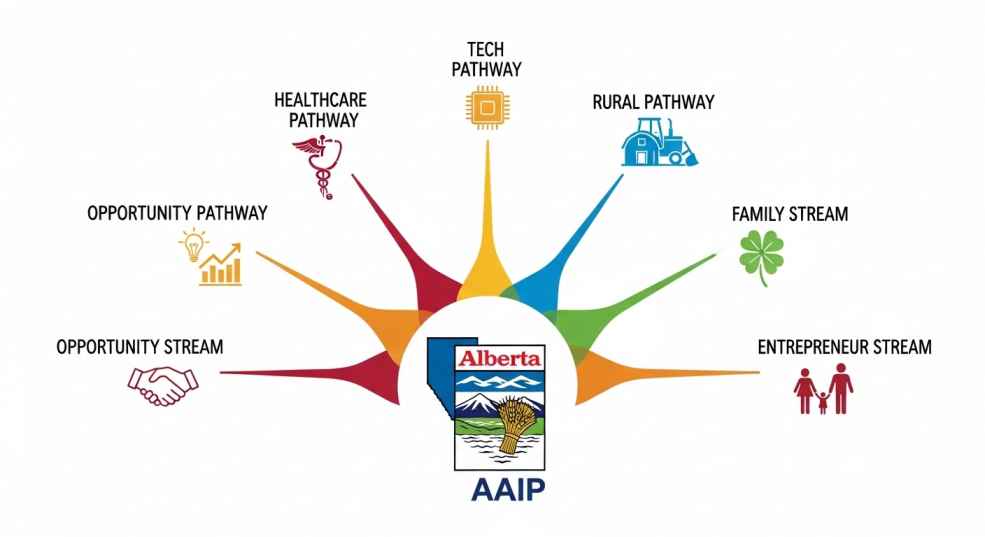
The Alberta PNP 2026 operates through multiple streams, each designed for different candidate profiles. Understanding which stream aligns with your situation is the first critical decision in your application journey. Here’s the strategic breakdown of each pathway, including insider insights on what actually matters for selection.
Alberta Opportunity Stream: The Workhorse of Alberta PNP 2026
The Alberta Opportunity Stream (AOS) is the backbone of the AAIP, accounting for more than half of all nominations. It’s designed for foreign workers already living and working in Alberta with valid work permits.
Key AAIP Requirements for Alberta Opportunity Stream:
- Must be physically working in Alberta on a valid work permit at the time of application and assessment
- Full-time, permanent job offer from an Alberta employer in an eligible occupation (TEER 0, 1, 2, 3, 4, or 5)
- Minimum 12 months of work experience in your occupation (can be in Alberta or elsewhere)
- Language proficiency: CLB 5 for TEER 0, 1, 2, or 3 occupations; CLB 4 for TEER 4 or 5
- Education equivalent to Canadian high school or higher
Insider Strategy: With an EOI score minimum of 57 points in recent draws and over 28,000 candidates in the pool, you need more than just eligibility. Priority goes to candidates in healthcare, construction, agriculture, and those with longer Alberta work experience. If your occupation isn’t in a priority sector, consider the Rural Renewal Stream as an alternative pathway.
Current Processing Time: Approximately 4 months. As of February 2026, AAIP is processing applications received on or before October 21, 2025.
Alberta Express Entry Stream: The Fast Track for Priority Occupations
This stream is an invitation-only pathway for candidates in the federal Express Entry pool. Alberta sends Notifications of Interest (NOI) to candidates whose profiles align with provincial priorities. If you receive an NOI and accept it, you gain 600 additional CRS points, virtually guaranteeing a federal ITA.
AAIP Requirements for Express Entry Stream:
- Active Express Entry profile with minimum 300 CRS points
- Indication of interest in Alberta as settlement destination
- Work experience in an occupation supporting Alberta’s economic priorities
- For Accelerated Tech Pathway: job offer from Alberta tech employer in eligible NAICS codes
The Reality Check: While the minimum CRS is 300, this number is almost meaningless. Alberta conducts targeted draws for specific occupations. A software developer with a CRS of 350 and an Alberta tech job offer has a far better chance than someone with 450 CRS points in a non-priority occupation. The key is sector alignment, not just a high score.
Current Processing Time: 1 month for Accelerated Tech Pathway; 4-6 months for general Express Entry nominations.
Rural Renewal Stream: The Hidden Opportunity for 2026
If you’re not in a priority sector or don’t have Alberta work experience yet, the Rural Renewal Stream (RRS) is increasingly becoming the smartest strategic pathway. This stream supports designated rural communities (population under 100,000) by nominating workers with job offers and community endorsements.
Critical Changes Effective January 1, 2026:
- Each designated community now receives a yearly endorsement cap
- Community endorsement letters valid for only one year (down from indefinite)
- TEER-based endorsement model prioritizes higher-skilled occupations
- Foreign nationals inside Canada must hold valid work permits at application and assessment
Why This Matters: These changes make the Rural Renewal Stream more competitive but still less crowded than the Opportunity Stream. With only 1,866 EOIs competing for 850 nomination spots, your odds are significantly better; roughly 46% compared to 12% in the Opportunity Stream. Plus, rural communities actively recruit candidates, providing built-in support networks.
Current Processing Time: Approximately 2 months, though times vary by designated community application volumes.
Tourism and Hospitality Stream: Sector-Specific Pathway
Designed for workers in Alberta’s tourism and hospitality sector, this stream requires you to be working full-time in eligible occupations with a valid job offer and Labour Market Impact Assessment (LMIA).
Key Requirements:
- Currently working full-time in Alberta in tourism/hospitality
- Valid work permit with positive LMIA
- Full-time job offer to continue with Alberta employer
- Minimum language and education requirements based on occupation
Strategic Note: With 6,836 EOIs competing for 630 spots (9% selection rate), this stream is highly competitive. If you’re in tourism/hospitality but your employer can’t support an LMIA, consider the Alberta Opportunity Stream instead if you have sufficient work experience.
Dedicated Healthcare Pathways: Priority Track for Medical Professionals
If you’e a practice-ready physician (NOC 31100, 31101, or 31102), this pathway offers the fastest route to permanent residence through AAIP. Importantly, physician nominations don’t count against Alberta’s 6,403 allocation, meaning unlimited spaces are available for qualified doctors.
Healthcare workers in other occupations (nurses, allied health) can apply through either the Express Entry or Opportunity streams, with priority consideration in draws.
Table 2: Alberta PNP 2026 Streams Quick Comparison
Stream | Need Alberta Job Offer? | Need to Be in Alberta? | Express Entry Required? | Avg Processing Time | 2026 Allocation |
Alberta Opportunity Stream | Yes | Yes | No | 4 months | 3,425 |
Alberta Express Entry | Depends on pathway | No | Yes | 1-6 months | 1,265 |
Rural Renewal Stream | Yes | Depends | No | 2 months | 850 |
Tourism & Hospitality | Yes | Yes | No | 4 months | 630 |
Healthcare Pathways | Yes | No | Depends | Varies | Unlimited* |
*For practice-ready physicians meeting federal criteria
2026 Priority Sectors: Where Alberta Needs You Most
Understanding Alberta’s priority sectors is crucial because the Alberta PNP 2026 isn’t just about meeting minimum requirements’s about strategic alignment with provincial labour market needs. Here’s where Alberta is actively recruiting, based on official AAIP guidance and recent draw patterns:
1. Healthcare: The Top Priority Sector
Healthcare workers remain Alberta’s number one recruitment priority. From physicians and nurses to allied health professionals, if you work in healthcare, you have a significant advantage in the AAIP selection process.
High-demand healthcare occupations:
- Physicians (all specialties) – unlimited nomination spaces available
- Registered nurses and registered psychiatric nurses
- Licensed practical nurses
- Paramedics
- Medical laboratory technologists
- Respiratory therapists
- Diagnostic imaging technologists (X-ray, ultrasound, MRI)
2. Technology: Alberta’s Growth Engine
Alberta’s tech sector is rapidly expanding, particularly in Calgary and Edmonton. The Accelerated Tech Pathway under Alberta Express Entry provides expedited processing (1 month) for tech workers with job offers from eligible employers.
In-demand tech roles:
- Software engineers and developers
- Database administrators and data analysts
- Computer network technicians
- Information systems analysts and consultants
- Web designers and developers
- Cybersecurity specialists
3. Construction and Skilled Trades: Building Alberta’s Future
With major infrastructure projects and housing development across the province, skilled tradespeople are in critical demand. Recent draws have shown consistent priority for construction occupations.
Priority trades:
- Electricians
- Plumbers, pipefitters, and steamfitters
- Carpenters
- Heavy equipment operators
- Welders
- Construction managers and supervisors
- HVAC technicians

4. Agriculture and Agri-Food: Feeding Canada
Agriculture remains a cornerstone of Alberta’s economy, with significant opportunities for farm managers, equipment operators, and food processing workers.
Key roles include farm supervisors, agricultural equipment operators, food processing supervisors, and farm managers (who can also qualify under the specialized Farm Entrepreneur Stream).
5. Aviation and Manufacturing: Specialized Sectors
Alberta is growing its aerospace and manufacturing capabilities, creating demand for aircraft maintenance engineers, industrial electricians, machinists, and quality control inspectors. While smaller in volume than healthcare or construction, these sectors offer excellent opportunities for candidates with specialized skills.
The Alberta PNP 2026 Application Process: Step-by-Step Guide
Since September 30, 2024, all AAIP worker stream applicants must begin with an Expression of Interest (EOI) submission through the AAIP online portal. Here’s the complete roadmap from EOI to provincial nomination:
Step 1: Create Your Alberta.ca Account and Submit EOI (Free)
What you’ll need:
- Valid passport
- Language test results (IELTS, CELPIP, TEF, TCF, or PTE Core)
- Educational Credential Assessment (ECA) if educated outside Canada
- Work permit details (if applicable)
- Job offer details from Alberta employer
- Previous work experience documentation
Your EOI profile receives a score based on the AAIP Worker Points Grid, considering factors like occupation, work experience in Alberta, language proficiency, education, and family connections. EOIs remain valid for 12 months and can be updated if your circumstances change.
Critical Tip: The EOI score is NOT the only selection factor. Alberta conducts targeted draws based on occupation, sector priorities, and other factors they don’t publicly disclose. A lower score in a priority occupation often beats a higher score in a non-priority field.
Step 2: Receive Invitation to Apply (ITA)
AAIP conducts draws irregularly based on labour market needs. In 2026, draws have occurred 1-2 times per week on average, but frequency varies. When selected, you receive an email invitation to submit a full application. You then have a specific timeframe (typically 14 days) to submit your complete application through the AAIP portal.
Step 3: Submit Complete Application with $1,500 Fee
The application fee increased to $1,500 effective April 1, 2025. This is your most critical phase’ incomplete applications cause processing delays and potential refusals.
Required documentation includes:
- Valid passport copies for you and all dependents
- Current work permit (if in Canada)
- Job offer letter meeting specific AAIP format requirements
- LMIA or LMIA-exempt work permit documentation
- Language test results (less than 2 years old)
- Educational credentials and ECA
- Employment reference letters proving work experience
- Settlement funds proof (if required for your stream)
- Additional documents based on your specific occupation (licensing, certifications)
Common Pitfall to Avoid: Many applicants submit generic job offer letters that don’t meet AAIP specifications. Your job offer must include specific details about duties, salary, benefits, and employment terms. Review the AAIP job offer requirements checklist carefully before submission.
Step 4: Application Assessment and Processing
AAIP officers review your application for completeness, verify your employment and credentials, and may request additional information or clarification. Processing times vary by stream (see processing time information above). During this phase, ensure you respond promptly to any AAIP requests’ delays in responding can significantly extend your processing time.
Step 5: Receive Provincial Nomination Certificate
If approved, you receive an official nomination certificate from Alberta. For Express Entry candidates, this adds 600 CRS points to your profile. For non-Express Entry streams, you submit this certificate with your federal permanent residence application directly to IRCC.
Step 6: Apply for Permanent Residence with IRCC
Your provincial nomination is valid for 6 months. Within this timeframe, submit your federal PR application to Immigration, Refugees and Citizenship Canada (IRCC). Federal processing typically takes 15-19 months for provincial nominee program applications, though Express Entry-linked applications process faster (6-12 months).
Proven Success Strategies for Alberta PNP 2026
Meeting minimum AAIP requirements isn’t enough in 2026’s competitive environment. Here are actionable strategies based on actual selection patterns and immigration consultant insights:
1. Prioritize Getting Alberta Work Experience First
More than 85% of 2025 nominations went to candidates already working in Alberta. If you’re not in Alberta yet, your first priority should be securing a valid work permit and building local work experience. Consider pathways like Post-Graduation Work Permits (if you study in Alberta), International Experience Canada programs, or LMIA-supported work permits. Even 6-12 months of Alberta work experience dramatically improves your selection chances.
2. Target Priority Sectors, Not Just Eligible Occupations
While most NOC TEER 0-5 occupations are technically eligible, draws heavily favor healthcare, technology, construction, agriculture, and aviation. If you’e in a non-priority occupation, consider upskilling or transitioning to an in-demand field before applying. Career pivots are common and often worth the investment when they align with provincial priorities.
3. Consider Rural Communities Strategically
The Rural Renewal Stream offers significantly better odds (46% vs 12% in the Opportunity Stream) and faster processing. If you’e open to living in smaller communities like Grande Prairie, Lethbridge, Medicine Hat, or Fort McMurray, actively research and contact designated communities. Many rural areas provide recruitment assistance, housing support, and settlement services’ resources not available through urban-focused streams.
4. Maximize Your Language Scores
While minimum language requirements are CLB 4-5, higher scores improve your EOI ranking and demonstrate better settlement potential. If you’re close to a higher benchmark (CLB 7 or 9), invest in language training before applying. For francophone candidates, achieving NCLC 5 across all competencies unlocks unlimited nomination spaces through the federal francophone initiative.
5. Maintain Valid Work Authorization Throughout
Especially critical for the Alberta Opportunity Stream and post-January 1, 2026 Rural Renewal Stream applications: you must hold a valid work permit not just when you apply, but also when AAIP assesses your file (which can be 4+ months later). Track your work permit expiry carefully and apply for extensions well in advance. IRCC bridging work permits can help if your original permit expires during processing.
6. Build a Comprehensive Documentation Package
Don’t just meet minimum documentation requirements’ exceed them. Provide detailed employment reference letters with specific duty descriptions, include pay stubs and tax documents proving continuous employment, and submit comprehensive educational transcripts. The more evidence you provide of legitimate, skilled employment and qualifications, the faster AAIP can process your application without requesting additional information.
Common Mistakes That Delay or Derail Alberta PNP Applications
Learning from others’ mistakes is cheaper than making your own. Here are the most frequent errors that trip up AAIP applicants:
Mistake #1: Applying with a Non-Compliant Job Offer
Many job offers lack required details or don’t meet AAIP criteria for full-time, permanent, non-seasonal employment. Ensure your job offer letter includes: detailed job duties matching your NOC, salary meeting Alberta standards for the occupation, benefits package, employment start date, and employer’s business registration details. Generic job offers get flagged immediately.
Mistake #2: Insufficient Work Experience Documentation
Reference letters must be on company letterhead, include specific job duties (not just job titles), show start and end dates, list salary and hours per week, and be signed by direct supervisors or HR. Vague letters stating – worked as manager; without duty descriptions lead to refusals or lengthy verification delays.
Mistake #3: Waiting Too Long to Apply After Receiving ITA
ITAs typically expire 14 days after issuance. Applicants who wait until the last minute often submit incomplete applications in their rush, leading to refusals. Start gathering documents before receiving your ITA so you can submit a complete application immediately when invited.
Mistake #4: Not Updating EOI Profile When Circumstances Change
If you change employers, get promoted, improve language scores, or complete additional education, update your EOI immediately. Outdated information can lead to discrepancies between your EOI and application, raising red flags with AAIP officers.
Mistake #5: Assuming High CRS Score Guarantees Selection
Under Alberta Express Entry, a 450 CRS score in a non-priority occupation has less chance of selection than a 350 CRS score in healthcare or technology. Alberta prioritizes occupational fit over point totals. Focus on sector alignment, not just boosting your CRS.

Recent Draw Trends and What They Tell Us About 2026
Analyzing recent AAIP draws provides valuable insights into selection patterns. Between January 26 and February 2, 2026, Alberta conducted four draws issuing 1,169 total invitations across multiple streams. Here’s what the data reveals:
Draw Frequency: Accelerating Pace
Early 2026 shows an aggressive draw schedule with 4 draws in just 7 days, suggesting Alberta is determined to use its full allocation efficiently. While draws aren’t regularly scheduled, candidates should be ready to respond quickly when invitations arrive. Past patterns show draws averaging 1-2 per week during peak periods, with occasional weeks having no draws at all.
Stream Distribution: Opportunity Stream Dominates
The February 2, 2026 draw alone issued 915 invitations through Alberta Opportunity Stream (minimum score 57), making it by far the largest single draw. This reinforces that AOS remains the primary pathway for most applicants. However, the three earlier January draws targeted specific priority sectors: Dedicated Healthcare Pathway and Accelerated Tech Pathway draws occurred on January 26, 27, and 29.
EOI Score Trends: Moderate Competition
Recent minimum scores have ranged from 49 (Healthcare Pathway) to 57 (Opportunity Stream). These relatively moderate scores suggest that while competition is significant, having strong sector alignment matters more than maximizing every possible point. A healthcare professional with 49 points gets selected over a retail manager with 70 points.
Sector Focus: Healthcare and Tech Leading
The fact that Alberta conducted dedicated healthcare and technology draws in late January signals these sectors remain top priorities. Expect this trend to continue throughout 2026, with periodic occupation-specific draws targeting critical shortages.
Processing Times: Setting Realistic Expectations
Understanding processing times helps you plan your immigration timeline accurately. Here’s the current reality as of February 2026:
Provincial Application Processing (After ITA)
Alberta Opportunity Stream: Currently processing applications received on or before October 21, 2025, indicating approximately 4-month processing time. With 741 applications in queue, expect this timeline to remain stable through early 2026.
Alberta Express Entry – Accelerated Tech Pathway: Approximately 1 month for priority processing. This stream demonstrates Alberta’s commitment to fast-tracking critical tech talent.
Alberta Express Entry – General: 4-6 months depending on complexity and verification requirements.
Rural Renewal Stream: Approximately 2 months, though times vary significantly by designated community volumes.
Tourism and Hospitality Stream: Approximately 4 months, similar to Opportunity Stream.
Healthcare Pathways: Variable depending on credential verification requirements and pathway (Express Entry vs. non-Express Entry).
Federal Permanent Residence Processing (After Provincial Nomination)
Express Entry-Linked Nominations: 6-12 months after receiving provincial nomination and federal ITA. The 600 CRS points from your nomination virtually guarantee a federal invitation in the next eligible Express Entry draw.
Non-Express Entry (Paper-Based): 15-19 months for complete federal processing. While longer than Express Entry, this pathway remains viable for candidates not eligible for the federal Express Entry system.
Total Timeline: From EOI Submission to Permanent Residence
Fastest Possible Path (Express Entry + Accelerated Tech): 8-14 months total (1 month provincial + 7-13 months federal)
Typical Express Entry Path: 10-18 months total (4-6 months provincial + 6-12 months federal)
Non-Express Entry Path: 19-23 months total (4 months provincial + 15-19 months federal)
These timelines assume complete applications with no additional document requests or complications. Incomplete applications, credential verification issues, or background check delays can extend processing significantly.

Frequently Asked Questions About Alberta PNP 2026
Q: Do I need a job offer to apply for Alberta PNP?
A: For most streams, yes. Alberta Opportunity Stream, Tourism and Hospitality Stream, and Rural Renewal Stream all require valid job offers from Alberta employers. The Alberta Express Entry Stream is the exception’ while a job offer significantly improves your chances and is required for the Accelerated Tech Pathway, it’s not mandatory for general Express Entry nominations.
Q: Can I apply for Alberta PNP if I’m currently outside Canada?
A: Yes, through Alberta Express Entry Stream or Rural Renewal Stream (if you have a community endorsement). However, candidates already working in Alberta have significantly better selection chances. If you’re abroad, focus on securing a work permit first or building a very strong Express Entry profile in a priority occupation.
Q: What’s the difference between AINP and AAIP?
A: AINP (Alberta Immigrant Nominee Program) was the former name. The program was rebranded to AAIP (Alberta Advantage Immigration Program) but functions the same way. Both terms refer to Alberta’s provincial nominee program.
Q: How long is my provincial nomination valid?
A: Your AAIP nomination certificate is valid for 6 months from the date of issuance. You must submit your federal permanent residence application to IRCC within this timeframe. If your nomination expires before you apply federally, you’ll need to reapply to AAIP.
Q: Can I include my spouse and children in my Alberta PNP application?
A: Yes, when you apply for permanent residence through IRCC after receiving provincial nomination, you can include your spouse/common-law partner and dependent children as accompanying family members.
Q: What happens if I change jobs after receiving my provincial nomination?
A: This is complicated and stream-dependent. Generally, you must inform AAIP of any material changes to your application. Changing employers after nomination but before receiving permanent residence can jeopardize your application, especially for employer-specific streams. Consult with an immigration professional before making job changes during the nomination or PR application process.
Q: Are there occupations that are ineligible for Alberta PNP?
A: Yes. The Alberta Opportunity Stream specifically excludes certain occupations including home child care providers, live-in caregivers, and workers in some service occupations. Check the official AAIP ineligible occupation list for your stream before applying.
Q: Do I need a Labour Market Impact Assessment (LMIA) for all streams?
A: No. LMIA is required for Tourism and Hospitality Stream. For Alberta Opportunity Stream and Rural Renewal Stream, you need either an LMIA or an LMIA-exempt work permit (such as Post-Graduation Work Permit, intra-company transfer, or CUSMA/international agreement work permit). Alberta Express Entry Stream doesn’t require LMIA unless you’re applying through the Accelerated Tech Pathway.
Your Next Steps: Turning AAIP Requirements Into Action
The Alberta PNP 2026 offers genuine opportunities for skilled workers, but success requires more than just meeting minimum AAIP requirements. It demands strategic planning, sector alignment, and meticulous application preparation.
Here’s your immediate action plan:
- Assess Your Alignment: Honestly evaluate whether your occupation matches Alberta’s 2026 priorities. If you’re in healthcare, technology, construction, agriculture, or aviation, you’re well-positioned. If not, consider the Rural Renewal Stream or strategic career transitions.
- Secure Alberta Work Experience: If you’re not in Alberta yet, make this your priority. Research work permit options through LMIA-supported positions, study permits leading to Post-Graduation Work Permits, or International Experience Canada programs.
- Maximize Your Documentation: Start gathering comprehensive employment references, educational credentials, and language test results now. Don’t wait until you receive an ITA.
- Create Your EOI Profile: Submit your Expression of Interest as soon as you’re eligible. EOIs are free and entering the pool early helps you understand where you stand competitively.
- Stay Informed: Monitor AAIP draw results and processing updates on the official Alberta.ca website. Draw patterns and priorities can shift based on labour market conditions.
- Consider Professional Support: Immigration consultants and lawyers can provide personalized strategy guidance, help you avoid common pitfalls, and ensure your application meets all AAIP requirements. While professional help isn’t mandatory, it often proves valuable for complex cases.
Remember, the Alberta immigration program is competitive but not impossible. Thousands of applicants successfully navigate AAIP every year. Your success depends on strategic thinking, thorough preparation, and alignment with provincial priorities. With 6,292 nomination spaces still available in 2026 and draws occurring regularly, the opportunity is there; you just need to position yourself to seize it.
Alberta offers not just a pathway to permanent residence but a high quality of life, strong economy, and welcoming communities. Whether you see yourself in Calgary’s vibrant tech scene, Edmonton’s diverse industries, or one of the province’s thriving rural communities, the Alberta PNP 2026 can make your Canadian dream a reality.
The question isn’t whether the Alberta PNP can work for you; whether you’re ready to take strategic action to make it happen.