


If you’re a teacher with dreams of building a life in Canada, 2026 could be your year. Canada’s Express Entry system now includes a dedicated Education Category that gives teaching professionals a direct pathway to permanent residence — often at significantly lower CRS scores than a general pool draw would require. But the rules have changed for 2026, and if you’re not up to speed, you could find yourself waiting longer than necessary.
In this guide, we’ll walk you through everything you need to know about the education Express Entry 2026 pathway: which occupations are eligible, how the new 12-month work experience rule affects you, what documents you’ll need, and practical strategies to maximize your chances of receiving an Invitation to Apply (ITA). Whether you’re a kindergarten teacher, a secondary school educator, or an early childhood educator, this article is your starting point.
What Is the Express Entry Education Category?
Canada’s Express Entry system is an online points-based system that manages applications for permanent residency under three federal programs: the Federal Skilled Worker Program (FSWP), the Federal Skilled Trades Program (FSTP), and the Canadian Experience Class (CEC). Candidates are ranked using the Comprehensive Ranking System (CRS), which awards points for age, education, language skills, and work experience.
Since May 2023, Immigration, Refugees and Citizenship Canada (IRCC) has been running category-based selection draws — special rounds that invite candidates in specific occupations regardless of whether they’d make the cut in a general draw. This approach allows Canada to directly address labour shortages in targeted fields.
The Education Category was introduced in February 2025 as one of these targeted streams, reflecting a nationwide shortage of qualified educators. It was officially confirmed as a continuing priority for 2026 alongside healthcare, STEM, trades, and French-language proficiency categories. [Source: IRCC Category-Based Selection — canada.ca]
Category-based draws create a separate competition pool. A teacher with a CRS of 460–480 who qualifies for the Education Category may receive an ITA in a dedicated draw, even though a general pool draw might require 520+.
💡 KEY INSIGHT
Eligible Occupations: Which Teachers Qualify for Education Express Entry 2026?
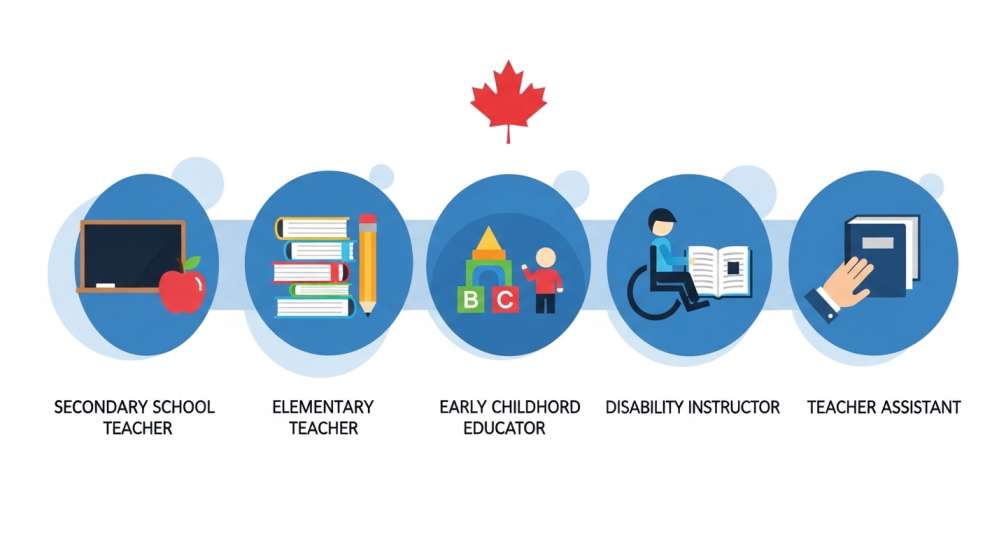
To qualify for the education Express Entry 2026 stream, your occupation must match one of five NOC (National Occupational Classification) codes under Canada’s 2021 NOC system. It is critical to understand that IRCC classifies candidates by their actual job duties, not simply their job title. A “Learning Specialist” or “Curriculum Developer” may qualify under NOC 41220 if their day-to-day responsibilities align with the NOC description.
Table 1: Eligible NOC Codes for the Express Entry Education Category (2026)
Occupation | NOC Code | TEER | Description |
Secondary School Teachers | 41220 | TEER 1 | Teaches grades 9–12 in academic/vocational subjects |
Elementary School & Kindergarten Teachers | 41221 | TEER 1 | Teaches grades 1–8, including kindergarten |
Early Childhood Educators & Assistants | 42202 | TEER 2 | Works in licensed daycare, nurseries & preschools |
Instructors of Persons with Disabilities | 42203 | TEER 2 | Specialised education for students with disabilities |
Elementary & Secondary School Teacher Assistants | 43100 | TEER 3 | Supports teachers in classrooms |
Source: IRCC Category-Based Selection, canada.ca/express-entry/category-based-selection
How to Confirm Your NOC Code
Matching your experience to the right NOC is one of the most critical steps in your application. Visit the official NOC search tool at noc.esdc.gc.ca and search using your job title. Then compare the listed “main duties” with what you actually do at work. If at least the majority of your duties match, that NOC code is likely a fit.
If your job title doesn’t match but your duties do, ask your employer to write a reference letter that explicitly describes your responsibilities using language from the NOC description. IRCC assesses experience based on duties performed, not what it says on your business card.
The Big 2026 Change: New 12-Month Work Experience Rule
Here’s the update that every teacher immigration applicant needs to know: as of 2026, the minimum work experience required to qualify for the Education Category draw has doubled from six months to twelve months.
This change was announced on February 18, 2026 by Immigration Minister Lena Metlege Diab as part of the International Talent Attraction Strategy. The stated goal is to prioritize candidates with more substantial and recent professional experience who are more likely to succeed in the Canadian labour market. [Source: immigrationnewscanada.ca, February 2026]
What This Means for You
If you have at least 12 months of full-time work experience (or an equivalent in part-time hours) in one of the five eligible NOC codes above, gained within the past three years, you are now eligible to participate in Education Category draws. This experience does not need to be gained in Canada — international teaching experience counts.
If you have between 6 and 11 months of qualifying experience, you will need to wait until you cross the 12-month threshold before you can access the category draw. However, you may still be eligible for general Express Entry draws (CEC, FSWP) if your CRS score is competitive enough.
Because the 12-month rule reduces the total eligible pool, analysts expect Education Category CRS cutoffs to trend lower in 2026 compared to 2025, as IRCC needs to reach further into the pool to fill its invitation targets. [Source: immigrationnewscanada.ca — CRS Cutoff Analysis]
💡 SILVER LINING
General Eligibility Requirements for Education Express Entry 2026
Meeting the category-specific work experience requirement is just one piece of the puzzle. You must also satisfy the baseline requirements of at least one of the three federal Express Entry programs before you can receive an Education Category invitation.
Federal Skilled Worker Program (FSWP) — The Most Common Pathway for Teachers
The FSWP is the most accessible program for internationally educated teachers. To qualify, you need all of the following:
- At least 12 months of continuous full-time (or equivalent part-time) skilled work experience in a TEER 0, 1, 2, or 3 occupation within the past 10 years
- A valid English or French language test result meeting the minimum Canadian Language Benchmark (CLB) 7 for all four abilities (speaking, listening, reading, writing)
- An Educational Credential Assessment (ECA) from an IRCC-approved organization confirming your foreign degree meets Canadian standards — World Education Services (WES) is the most commonly used provider
- A minimum score of 67 out of 100 on the FSWP’s own points grid (separate from and in addition to your CRS score)
- Sufficient settlement funds to support yourself and your family upon arrival in Canada (unless you have a valid Canadian job offer)
Canadian Experience Class (CEC) — For Teachers Already Working in Canada
If you are currently working in Canada on a work permit, the CEC may be your fastest route. It requires at least 12 months of full-time skilled work experience in Canada within the past three years, along with a valid language test at CLB 7 (for TEER 0 and 1 occupations like NOC 41220 and 41221) or CLB 5 (for TEER 2 and 3 occupations). No ECA is required under the CEC.
Table 2: Education Category Express Entry Requirements — 2025 vs. 2026 Comparison
Requirement | 2025 Rules | 2026 Rules |
Min. Work Experience (Category) | 6 months | 12 months ↑ |
Experience Location | Canada or abroad | Canada or abroad |
Experience Window | Within past 3 years | Within past 3 years |
Language Minimum (English) | CLB 7 (FSWP) | CLB 7 (FSWP) |
ECA Required (foreign credentials) | Yes (FSWP) | Yes (FSWP) |
Eligible Programs | FSWP, FST, CEC | FSWP, FST, CEC |
First Education Draw CRS | 479 (Draw #344, 2025) | TBD (watch IRCC) |
Typical ITAs per Draw | 1,000–3,500 | Expected 1,000–4,000 |
Sources: IRCC, immigrationnewscanada.ca, moving2canada.com
Documents You’ll Need to Apply
Unlike some immigration systems that require extensive paperwork upfront, Express Entry operates in two stages: first you create a profile and enter the pool, then you gather documents after receiving your ITA. That said, preparing your documents early saves crucial time, since you only have 60 days to submit a complete application after receiving your ITA.
Documents to Prepare Before Submitting Your Profile
- Valid passport (must be valid for at least 6 months beyond your planned arrival)
- Language test results — IELTS Academic or General Training, CELPIP-General for English; TEF Canada or TCF Canada for French
- Educational Credential Assessment from WES or another IRCC-approved organization
- National Occupational Classification (NOC) code and supporting documentation of your duties
Documents to Gather After Receiving Your ITA
- Employment reference letters from each employer, signed and on official letterhead, detailing your job title, NOC duties, hours worked per week, and salary
- Pay stubs, T4s, or tax documents corroborating your employment history
- Police certificates from every country you’ve lived in for six months or more since age 18
- Medical examination results from an IRCC-designated panel physician
- Proof of settlement funds (bank statements covering the past 6 months, typically)
- Proof of status in Canada if currently residing here (work permit, study permit, etc.)
Understanding the Draw History and CRS Cutoff Trends
The first-ever Express Entry Education Category draw took place on April 30, 2025 (Draw #344). IRCC issued 1,000 Invitations to Apply with a CRS cutoff of 479. This was a landmark moment for teacher immigration Canada advocates, confirming that the government was serious about addressing the national educator shortage.
Education Category draws continued throughout 2025, with CRS scores varying based on the number of candidates in the pool and the size of each invitation round. General category draws have historically issued between 1,000 and 5,000 ITAs per round, and the Education Category has followed a similar pattern.
What does this mean for 2026? With the 12-month work experience threshold now in effect, the pool of eligible Education Category candidates has been narrowed. Analysts project that, assuming IRCC maintains similar invitation volumes, Education Category CRS cutoffs could trend slightly lower in 2026 — potentially in the 450–475 range — since there are fewer competing profiles. However, candidates should not rely solely on this projection and should continue actively boosting their CRS.
How to Boost Your CRS Score: Practical Strategies for Teachers
While the Education Category gives you a competitive advantage, a higher CRS score always improves your odds of selection — especially in popular draw rounds. Here are the most impactful strategies, ranked by effort-to-reward ratio.
Table 3: CRS Score Improvement Strategies for Education Category Applicants
Strategy | Action | CRS Boost | Impact |
Language Test Retake | Improve IELTS/CELPIP band | Up to 50+ CRS points | High |
French Language Skills | Pass TEF/TCF at NCLC 7 | 15–50 points | Medium–High |
Additional Education | Submit second ECA credential | 0–30 points | Medium |
Skilled Work Experience | Accumulate more years | 0–25 points | Low–Medium |
Provincial Nomination (PNP) | Apply through provincial stream | +600 points (auto ITA) | High |
Sibling in Canada | Proof of Canadian sibling | 15 points | Low |
The Language Score Advantage
Language improvement is the single highest-impact action you can take. Every 0.5 band improvement in IELTS can add 10–20 CRS points. Moving from a CLB 8 to a CLB 9 (roughly IELTS 7.0 to 7.5) can add 18 points — which could be the difference between waiting and receiving your ITA this year. Register for a preparation course and target CLB 9 or higher in all four skills.
French Language: The Hidden Multiplier
Canada has been actively incentivizing French-language immigration outside Quebec. If you can achieve even a basic proficiency — NCLC 7 (roughly B2 on the DELF scale) on the TEF Canada or TCF Canada — you can earn additional CRS points and even open the door to the French-language category draw as a parallel option. For a teacher with a CRS of 445, adding French skills could push them to 465 or higher, a meaningful leap.
Step-by-Step: How to Apply Through the Education Category
Here’s a clear walkthrough of the process from start to finish.
Step 1 — Confirm Your NOC Code
Use the Government of Canada’s NOC tool (noc.esdc.gc.ca) to verify your occupation falls under one of the five eligible education NOC codes. Cross-reference the listed main duties with your actual responsibilities and document any mismatches in a reference letter from your employer.
Step 2 — Take Your Language Test
Book your IELTS, CELPIP, TEF, or TCF exam as early as possible, as test slots fill up quickly. Remember that results are typically valid for two years. Aim for CLB 9 or higher for maximum points. Your score must be valid when your profile is submitted.
Step 3 — Get Your Educational Credential Assessment
If your degree was earned outside Canada, have it assessed by an IRCC-approved organization. World Education Services (WES) is the most widely accepted. Processing times vary from 7 to 20 weeks, so apply for this early. The ECA is required under FSWP but not under the CEC.
Step 4 — Create Your Express Entry Profile
Log into your IRCC account at ircc.canada.ca and submit your Express Entry profile. You’ll enter your education history, work experience, language scores, and NOC code. Once submitted, you enter the pool and receive a CRS score. Your profile is valid for 12 months and must be kept up to date.
Step 5 — Monitor Draw Results and Update Your Profile
Check the IRCC Express Entry draw results page regularly (canada.ca/express-entry/rounds-invitations). Watch for Education Category draws and compare your CRS score to the latest cutoffs. If your score is close but not quite there, focus on the CRS improvement strategies above and update your profile whenever your situation changes (new language test, new experience, etc.).
Step 6 — Respond to Your ITA
When you receive an ITA, you have exactly 60 days to submit a complete permanent residence application. Use this time wisely: gather all required documents, complete your medical exam, obtain police certificates, and prepare your application carefully. Incomplete or incorrect applications can lead to refusals.

Real-World Scenario: Maria’s Path Through the Education Category
To bring this to life, consider the hypothetical case of Maria, a 34-year-old elementary school teacher from the Philippines with a Bachelor of Education and four years of teaching experience. She has an IELTS score of CLB 8 in all abilities. After her ECA from WES confirmed her degree’s equivalency to a Canadian bachelor’s degree, she entered the Express Entry pool with a CRS score of 447.
In a general draw, 447 would have been too low to receive an ITA. But because her NOC code (41221 — Elementary School and Kindergarten Teachers) qualified her for the Education Category, she was eligible for category-based draws. After monitoring the draw results over three months, an Education Category draw was held with a CRS cutoff of 462. She hadn’t reached that yet, but she took a CELPIP retest and improved her writing score from CLB 8 to CLB 9, gaining 15 CRS points and bringing her total to 462. The next Education Category draw had a cutoff of 459 — and she received her ITA.
The Education Category doesn’t eliminate competition — it creates a smaller, more targeted pool. Combined with active CRS optimization, it can be a powerful route to Canadian permanent residency for teachers.
💡 KEY TAKEAWAY
Provincial Pathways That Complement Education Express Entry 2026
While the federal Education Category is the focus of this guide, it’s worth noting that many provinces actively recruit teachers through their own Provincial Nominee Programs (PNPs). A provincial nomination adds 600 CRS points — virtually guaranteeing an ITA in the next Express Entry draw.
Provinces like Alberta, British Columbia, Ontario, Manitoba, and Saskatchewan all have specific streams or occupations in demand lists that include teachers. In fact, some provinces have their own teacher-specific recruitment programs entirely separate from Express Entry. Exploring PNP options in parallel with your federal application is a smart strategic move and can dramatically shorten your wait time.
If you already have a job offer from a Canadian school board, ask your prospective employer whether they can support a provincial nomination. This is more common than many applicants realize, particularly in rural and northern communities with acute teacher shortages.
💡 PRO TIP
Common Mistakes to Avoid
After helping dozens of education professionals navigate this pathway, here are the most frequent — and avoidable — errors we see:
- Choosing the wrong NOC code: Using NOC 41200 (University Professors) when your duties match NOC 41221 (Elementary Teachers) can disqualify you from the right draw pool. Always verify duties, not just titles.
- Letting language scores expire: IELTS and CELPIP results are valid for two years. If your scores expire while your profile is active, you could be removed from the pool. Track your expiry dates carefully.
- Submitting a vague reference letter: IRCC officers need to see clear evidence that your job duties match the NOC description. Generic letters that simply state your job title and dates of employment are frequently challenged.
- Not updating your profile: If your situation changes — new test score, new job, new education — update your Express Entry profile immediately. An outdated profile can cost you points.
- Missing the 60-day ITA window: Once you receive your ITA, the clock starts immediately. Many applicants scramble for police certificates and medical exams at the last moment. Have these ready before your ITA arrives.
Frequently Asked Questions — Education Express Entry 2026
Do I need a Canadian teaching license to qualify?
No. The Education Category does not require provincial teaching certification to enter the Express Entry pool or receive an ITA. However, once you arrive in Canada and wish to teach in a public school, you will need to obtain provincial certification. Requirements vary by province, and the process is typically managed through provincial Colleges of Teachers.
Can private school experience count toward the NOC requirement?
Yes, private school teaching experience is eligible. What matters is whether your duties match the NOC description, not whether the institution is public or private. Tutoring centres, language schools, and online teaching may qualify depending on how IRCC assesses your duties and whether the role is considered “skilled work” under the NOC TEER system.
Can I apply under the Education Category with experience from multiple teaching roles?
Yes, but the 12 months of qualifying experience must be accumulated in a single NOC code. Experience across different NOC codes cannot be combined for the purpose of category eligibility. So if you worked six months as an elementary teacher (41221) and six months as a teacher assistant (43100), you would not yet meet the 12-month threshold for either category.
How often are Education Category draws held?
IRCC does not publish a fixed schedule for category-based draws. In 2025, education draws were held several times throughout the year, with varying frequency. Subscribe to IRCC’s email notifications or follow reliable immigration news sources to stay informed. FreshStartCanada.com publishes updates on every new Express Entry draw — bookmark our draw tracker for real-time alerts.
Conclusion: Is the Education Category Your Gateway to Canada in 2026?
The education Express Entry 2026 stream is one of the most accessible and practical pathways for qualified teachers to achieve Canadian permanent residency. With the category confirmed as a continued priority by IRCC, dedicated draws are expected to run throughout the year — offering opportunities at CRS cutoffs well below what a general draw would require.
The most important update to absorb for 2026 is the increased 12-month work experience requirement. If you already meet this threshold, you’re well-positioned to enter the pool and compete in category draws. If you’re still building experience, use that time productively: improve your language scores, get your ECA completed, and explore provincial nomination options.
Here are the five things to do right now if you’re a teacher planning to apply through education Express Entry 2026:
- Confirm your NOC code at noc.esdc.gc.ca and verify your experience matches the listed duties.
- Book your IELTS, CELPIP, TEF, or TCF language test as soon as possible — test slots fill up fast.
- Apply for your Educational Credential Assessment through WES or another IRCC-approved body.
- Monitor IRCC draw results and track Education Category CRS cutoff trends at canada.ca/express-entry/rounds-invitations.
- Consider connecting with a Regulated Canadian Immigration Consultant (RCIC) for personalized guidance on maximizing your profile.
Canada needs teachers. And with the right preparation, 2026 could be the year you make the move from wherever you are now to the classroom — and the life — you’ve been working toward.
