


Are you a skilled professional dreaming of building your future in Canada? The Ontario Immigrant Nominee Program (OINP) in 2026 continues to be one of the most accessible pathways to Canadian permanent residence—and for good reason. As Canada’s economic powerhouse, Ontario attracts over 40% of all new immigrants annually, offering unparalleled career opportunities, world-class education, and vibrant multicultural communities.
But here’s what many applicants don’t realize: navigating the Ontario PNP 2026 streams can feel like solving a complex puzzle. With nine distinct immigration streams targeting everyone from tech workers to skilled tradespeople, French speakers to international students, choosing the right pathway can mean the difference between a smooth application and months of frustration.
In this comprehensive guide, I’ll walk you through every OINP stream available in 2026, breaking down eligibility requirements, processing timelines, and insider strategies I’ve learned from helping hundreds of clients successfully navigate this process. Whether you’re an in-demand tech professional, a skilled tradesperson, or a French-speaking candidate with unique advantages, you’ll discover exactly which stream fits your profile—and how to maximize your chances of approval.
What you’ll learn in this guide:
- The 9 OINP streams explained in plain English (no immigration jargon)
- Exact eligibility requirements for each pathway, updated for 2026
- Strategic insights on which stream gives YOU the fastest route to PR
- Common mistakes that lead to application rejections—and how to avoid them
- Processing timelines and what to expect at each stage
- Pro tips for tech workers, tradespeople, and French speakers to stand out
Let’s dive in and find your pathway to calling Ontario home.
Understanding Ontario PNP 2026: Your Gateway to Canadian Permanent Residence
The Ontario Immigrant Nominee Program (OINP) is Ontario’s provincial nomination program, designed to attract skilled workers, international students, and entrepreneurs who can contribute to the province’s economy. When you receive an Ontario provincial nomination, you gain 600 additional Comprehensive Ranking System (CRS) points in your federal Express Entry profile—essentially guaranteeing an Invitation to Apply (ITA) for permanent residence in the next draw.
What's New in Ontario PNP 2026?
The 2026 program year brings several important updates that applicants need to know:
- Enhanced processing for tech occupations: Priority processing for technology workers continues, with target processing times of 60-90 days for complete applications
- Expanded French-speaking stream: New occupation categories added to encourage Francophone immigration outside the Greater Toronto Area
- Updated wage thresholds: Minimum wage requirements adjusted to reflect 2026 Ontario median wages
- Streamlined documentation: Digital submission processes improved, reducing paper-based requirements
- Regional immigration pilots: New targeted draws for specific regions experiencing labor shortages
Why Choose Ontario for Immigration?
Ontario isn’t just Canada’s most populous province—it’s an economic powerhouse that offers immigrants unique advantages:
- Economic opportunities: Home to Canada’s financial capital (Toronto) and tech hub (Waterloo), with unemployment rates consistently below national average
- Diverse job market: Over 250,000 businesses spanning technology, healthcare, manufacturing, construction, and professional services
- Educational excellence: World-renowned universities including University of Toronto, McMaster, and Western University
- Multicultural communities: The most diverse province in Canada, with over 250 ethnic origins and 180+ languages spoken
- Quality of life: Access to universal healthcare, excellent public services, and vibrant cultural scene
Complete Overview: All 9 OINP Streams at a Glance
The OINP operates through three main categories, each containing multiple streams. Here’s your complete roadmap to understanding which pathway might be right for you:
Stream Name | Category | Best For | Key Requirement |
Human Capital Priorities | Express Entry | Tech workers, skilled professionals | Active Express Entry profile, CRS 400+ |
Skilled Trades | Express Entry | Electricians, plumbers, welders | Valid job offer in skilled trade |
French-Speaking Skilled Worker | Express Entry | Bilingual professionals | CLB 7 French, CLB 6 English |
Employer Job Offer: Foreign Worker | Employer Job Offer | Workers with Ontario job offer | Permanent full-time job offer |
Employer Job Offer: International Student | Employer Job Offer | Recent Ontario graduates | Job offer + degree from Ontario |
Employer Job Offer: In-Demand Skills | Employer Job Offer | Agriculture, construction workers | Job offer in eligible NOC |
Masters Graduate | Ontario Graduate | Ontario Masters graduates | Masters degree from Ontario (last 2 years) |
PhD Graduate | Ontario Graduate | Ontario PhD graduates | PhD from Ontario (last 2 years) |
Entrepreneur | Business | Business owners/investors | $200K+ net worth, business plan |
Note: Processing times and requirements may vary by stream. Always verify current requirements on the official OINP website.
Express Entry-Aligned Streams: The Fast Track to Ontario PR
The Express Entry-aligned streams are the most popular pathways under Ontario PNP 2026. These streams require candidates to have an active Express Entry profile in the federal system. When you receive a provincial nomination through one of these streams, you receive 600 additional CRS points, virtually guaranteeing an Invitation to Apply for permanent residence in the next federal draw.
1. Human Capital Priorities Stream: For Tech and Skilled Professionals
This is the flagship stream of the Ontario PNP 2026, particularly popular among technology professionals. Ontario conducts targeted draws from the Express Entry pool, inviting candidates who meet specific criteria. Recent draws have focused heavily on tech occupations, healthcare professionals, and skilled trades.
Eligibility Requirements
- Active Express Entry profile in the federal system (FSW, CEC, or FST)
- Valid Express Entry profile number and Job Seeker Validation Code
- CRS score typically 400+ (varies by draw)
- Eligible occupation (recent draws focused on tech NOCs)
- Intention to live in Ontario
- Meet minimum language requirements (CLB 7 for NOC 0/A, CLB 5 for NOC B)
Priority Occupations for 2026
Ontario has been conducting targeted draws for specific occupations. Based on 2025-2026 trends, these occupations receive priority:
- Software engineers and designers (NOC 21232)
- Computer programmers and interactive media developers (NOC 21230, 21233)
- Information systems analysts and consultants (NOC 21221)
- Database analysts and data administrators (NOC 21223)
- Web designers and developers (NOC 21234)
- Computer network technicians (NOC 22220)
- User experience (UX) designers (NOC 21233)
- Cybersecurity specialists (NOC 21220)
- Registered nurses and nurse practitioners (NOC 31301, 31300)
- General practitioners and family physicians (NOC 31100)
Strategic Tips for Human Capital Priorities
- Optimize your Express Entry profile: Even small improvements in language scores or education credentials can boost your CRS
- Monitor OINP draws: Ontario announces draws on their website—track the occupations and CRS cut-offs
- Consider Educational Credential Assessment (ECA): Having your foreign credentials assessed can increase your points
- Improve language scores: Taking IELTS or CELPIP again to improve scores can add significant CRS points
- Timeline: If invited, you have 45 calendar days to submit your complete application
2. Skilled Trades Stream: For Construction and Industrial Workers
Ontario faces significant skilled trades shortages, particularly in construction, electrical, and plumbing sectors. This stream targets tradespeople with valid job offers in eligible occupations. Unlike the Human Capital Priorities stream, this requires a confirmed job offer from an Ontario employer.
Eligibility Requirements
- Active Express Entry profile (Federal Skilled Trades class)
- Valid job offer: Full-time, permanent position in Ontario in an eligible skilled trade
- Work experience: At least 2 years of full-time work experience in the skilled trade (within last 5 years)
- Certifications: Valid Certificate of Qualification in Ontario if trade is regulated
- Language proficiency: CLB 5 in English or French (speaking and listening), CLB 4 (reading and writing)
- Residence: Currently living in Ontario OR ability to show you’ll move to Ontario
Eligible Trades Occupations
The following skilled trades are eligible under this stream (all NOC TEER 2 or 3):
- Industrial electricians (NOC 72200)
- Construction electricians (NOC 72201)
- Plumbers (NOC 72300)
- Steamfitters, pipefitters (NOC 72301)
- Welders (NOC 72106)
- Heavy-duty equipment mechanics (NOC 72401)
- Crane operators (NOC 72500)
- Industrial mechanics (NOC 72400)
- HVAC technicians (NOC 72402)
- Carpenters (NOC 72310)
3. French-Speaking Skilled Worker Stream: Leverage Your Bilingualism
This is a game-changer for bilingual professionals. As part of Canada’s Francophone Immigration Strategy, Ontario actively seeks French-speaking skilled workers to support Francophone communities outside the Greater Toronto Area. The big advantage? More lenient CRS requirements and dedicated draws exclusively for French speakers.
Eligibility Requirements
- Active Express Entry profile (FSW or CEC)
- French proficiency: Minimum CLB 7 in all four abilities (reading, writing, speaking, listening)
- English proficiency: Minimum CLB 6 in all four abilities
- Education: Bachelor’s degree or higher
- Work experience: One year of continuous full-time (or equivalent part-time) in NOC TEER 0, 1, 2, or 3
- Settlement funds: Show you can support yourself and family members (if not already working in Canada)
- Intention: Plan to live outside the Greater Toronto Area (encouraged but not mandatory)
Why This Stream Offers Unique Advantages
French-speaking candidates enjoy several competitive edges:
- Lower CRS thresholds: Recent draws have invited French-speaking candidates with CRS scores 30-50 points lower than general draws
- Dedicated draws: Ontario conducts separate draws exclusively for French speakers
- Federal points boost: Bilingualism adds points to your federal Express Entry CRS score
- Support networks: Access to established Francophone communities in Ottawa, Sudbury, Thunder Bay, and other Ontario cities
- Priority processing: Applications often processed faster due to smaller applicant pool

Employer Job Offer Streams: For Workers with Ontario Employment
These streams are designed for workers who already have a job offer from an Ontario employer. Unlike Express Entry streams, you don’t need an active Express Entry profile. However, your employer must meet specific requirements, and the job offer must be approved by OINP.
4. Employer Job Offer: Foreign Worker Stream
This stream targets foreign workers with job offers in skilled occupations (NOC TEER 0, 1, 2, or 3). It’s ideal for professionals who are already working in Ontario on a work permit or have secured employment from abroad.
Eligibility Requirements
- Job offer: Permanent, full-time position in Ontario (NOC TEER 0, 1, 2, or 3)
- Wage: Must meet or exceed median wage for the occupation in Ontario region
- Work experience: 2 years of full-time paid work experience in the same NOC as job offer (within last 5 years)
- Education: Credentials equivalent to Canadian post-secondary (degree, diploma, or trades certification)
- Language: CLB 5 for NOC TEER 0/1/2, CLB 4 for NOC TEER 3
- Legal status: Valid work permit (if currently in Canada) OR able to obtain one
- Employer requirements: Employer must be operating in Ontario for at least 3 years, meet revenue thresholds
5. Employer Job Offer: International Student Stream
International students who completed their degree or diploma at an eligible Ontario institution can transition to permanent residence through this stream. It’s one of the fastest pathways for recent graduates with Ontario job offers.
Eligibility Requirements
- Education: Degree or diploma from eligible Ontario college or university
- Graduation timing: Completed program within 2 years of application
- Study requirements: At least 50% of studies completed in Ontario
- Job offer: Permanent, full-time position (NOC TEER 0, 1, 2, or 3)
- Work experience: Not required (major advantage over Foreign Worker stream)
- Language: CLB 7 for NOC TEER 0/1, CLB 5 for NOC TEER 2/3
- Legal status: Valid study permit or work permit
- Wage: Must meet entry-level wage requirements for occupation and region
6. Employer Job Offer: In-Demand Skills Stream
This stream addresses labor shortages in specific sectors: agriculture and construction/residential care. It targets workers in NOC TEER 4 and 5 positions—occupations not eligible under other OINP streams.
Eligibility Requirements
- Job offer: Permanent, full-time in agriculture OR construction/residential care (specific NOCs only)
- Work experience: 9 months of full-time work experience in Ontario in same occupation as job offer
- Accumulated experience: Must have been accumulated within 3 years before application
- Language: CLB 4 in all abilities
- Education: Ontario high school equivalent or higher
- Location: Job offer must be outside Greater Toronto Area (for agriculture positions)
- Earnings: Must show you can meet low-income cut-off (LICO) for your family size
Eligible Occupations
Only specific occupations qualify:
Agriculture:
- Harvesting laborers (NOC 85100)
- General farm workers (NOC 85100)
- Nursery and greenhouse workers (NOC 85101)
Construction and Residential Care:
- Residential and commercial installers (NOC 75119)
- Industrial butchers (NOC 94141, 65202)
- Food processing laborers (NOC 95106)
- Industrial cleaners (NOC 65310)
- Nurse aides and patient service associates (NOC 33102)
Ontario Graduate Streams: Direct Pathway for Advanced Degree Holders
These are the most straightforward pathways in the entire Ontario PNP 2026 program. If you’ve completed a Masters or PhD degree from an eligible Ontario university, you can apply directly for provincial nomination—no job offer required, no work experience needed.
7. Masters Graduate Stream
This stream is designed for recent Masters graduates from Ontario universities. It’s particularly attractive because you can apply directly upon graduation without securing employment first.
Eligibility Requirements
- Education: Masters degree from eligible Ontario university
- Completion: Completed degree requirements within last 2 years
- Study duration: At least one academic year of full-time study
- Physical presence: At least one year of study in Ontario
- Language: CLB 7 in English or French (all abilities)
- Legal status: Legal status in Canada at time of application (study permit, work permit, or visitor record)
- Residence: Must be living in Ontario OR able to provide proof of intent to reside
- Settlement funds: Demonstrate you can support yourself (if not currently working)
- Job offer: NOT required (major advantage)
Eligible Ontario Universities
Only Masters degrees from publicly-funded Ontario universities are eligible. Major eligible institutions include:
University of Toronto, McMaster University, Western University, Queen’s University, University of Waterloo, York University, University of Ottawa, Carleton University, Toronto Metropolitan University (formerly Ryerson), University of Guelph, Wilfrid Laurier University, Brock University, Lakehead University, Laurentian University, OCAD University, Ontario Tech University, Trent University, University of Windsor, and others.
8. PhD Graduate Stream
The PhD Graduate stream is the most streamlined pathway in Ontario PNP 2026. PhD graduates benefit from faster processing, no language testing requirement, and the ability to apply from anywhere in the world.
Eligibility Requirements
- Education: PhD degree from eligible Ontario university
- Completion: Completed degree requirements within last 2 years
- Study duration: At least two years of study toward the PhD
- Physical presence: At least one year of study in Ontario
- Language: NOT required (major advantage over Masters stream)
- Legal status: NOT required to be in Canada (can apply from abroad)
- Residence: Must intend to live in Ontario
- Job offer: NOT required
Why PhD Stream Stands Out
The PhD stream offers unparalleled advantages:
- No language testing: Unlike all other streams, no IELTS/CELPIP required
- Apply from anywhere: Can submit application while residing outside Canada
- No job offer needed: Can apply immediately upon graduation
- Priority processing: Typically processed faster than other streams
- High success rate: PhD graduates have among the highest approval rates in OINP

9. Entrepreneur Stream: For Business Owners and Investors
The Entrepreneur Stream targets experienced business owners who want to establish, acquire, or partner in a business in Ontario. It’s a two-stage process: first you receive a work permit to establish your business, then apply for permanent residence once you’ve met performance targets.
Eligibility Requirements
- Net worth: Minimum CAD $400,000 (GTA/Ottawa) OR $200,000 (outside GTA/Ottawa)
- Investment: Minimum CAD $200,000 (GTA/Ottawa) OR $100,000 (outside GTA/Ottawa)
- Business experience: 24 months as business owner/senior manager within last 60 months
- Ownership: Minimum 33.3% equity in proposed business (or $1 million+ investment with 33.3%)
- Active management: Full-time, hands-on involvement in business operations
- Job creation: Create at least 2 full-time jobs for Canadian citizens/PRs
- Language: CLB 4 if business is in GTA, otherwise not required for initial application
- Visit: Mandatory exploratory visit to Ontario before applying
Understanding OINP Processing Times: What to Expect in 2026
Processing times vary significantly by stream. Here’s what you can realistically expect for each pathway based on 2025-2026 data. Note that these are averages—individual applications may vary based on completeness and complexity.
Stream | Average Processing Time | Priority Factors |
Human Capital Priorities | 60-90 days | Complete docs, tech occupations |
Skilled Trades | 90-120 days | Valid job offer, certifications |
French-Speaking Skilled Worker | 60-90 days | Strong language scores |
Employer Job Offer: Foreign Worker | 90-150 days | Employer compliance |
Employer Job Offer: International Student | 90-120 days | Recent graduation |
Employer Job Offer: In-Demand Skills | 120-180 days | Complete experience proof |
Masters Graduate | 90-120 days | Recent graduation, complete docs |
PhD Graduate | 60-90 days | Often fastest processing |
Entrepreneur | 6-12 months (Stage 1) | Business plan quality |
Important: Processing times begin when a complete application is submitted. Incomplete applications may face significant delays or rejection.
7 Common Mistakes That Lead to OINP Rejections (And How to Avoid Them)
After reviewing hundreds of applications, I’ve identified patterns in rejections. Here are the most common mistakes applicants make—and practical strategies to avoid them:
Mistake #1: Incomplete or Inconsistent Documentation
The Problem: Submitting documents that contradict each other or fail to meet requirements. For example, job titles on reference letters not matching NOC descriptions, or employment dates that don’t align across documents.
The Solution: Create a comprehensive checklist before submitting. Cross-reference all documents to ensure consistency. Have someone else review your application—fresh eyes catch discrepancies you might miss.
Mistake #2: Not Meeting Minimum CRS Score Requirements
The Problem: Applying to Human Capital Priorities or French-Speaking streams without monitoring recent draw trends. CRS cutoffs fluctuate, and applying with a score below recent draws wastes time and resources.
The Solution: Before creating your Expression of Interest (EOI), research the last 6 months of OINP draws. If your CRS is significantly below recent cutoffs, consider improving your score through: retaking language tests, obtaining additional credentials, or gaining more Canadian work experience.
Mistake #3: Job Offer Doesn’t Meet OINP Standards
The Problem: For Employer Job Offer streams, submitting offers that don’t meet wage requirements, aren’t truly permanent, or come from employers who don’t meet operational requirements (years in business, revenue thresholds).
The Solution: Verify wage requirements for your NOC and Ontario region using official Ontario wage data. Ensure employer provides detailed business documentation proving 3+ years operation. Job offer must explicitly state “permanent, full-time” with no end date.
Mistake #4: Language Test Results Below Requirements
The Problem: Submitting language scores that barely meet minimums or have one component below threshold. Remember, CLB requirements are for ALL four components—reading, writing, speaking, listening.
The Solution: Aim to exceed minimum requirements by at least one CLB level. This provides a safety buffer and demonstrates stronger language ability. Consider professional IELTS/CELPIP preparation courses—investment in preparation pays off with higher scores and stronger applications.
Mistake #5: Work Experience Doesn’t Match NOC Requirements
The Problem: Claiming work experience under a NOC code when actual duties don’t align with the lead statement and main duties in the NOC description.
The Solution: Carefully review the NOC 2021 system on the IRCC website. Your reference letter should describe specific duties that clearly match the NOC’s main duties. If your role spans multiple NOCs, choose the one that best matches your PRIMARY duties. Generic job descriptions will raise red flags.
Mistake #6: Missing Application Deadline
The Problem: If you receive a Notification of Interest (NOI) from OINP, you have exactly 45 calendar days to submit your complete application. Missing this deadline forfeits your opportunity.
The Solution: Start gathering documents BEFORE receiving NOI. Have a “ready to go” folder with: reference letters, ECA reports, language test results, police certificates, and other standard requirements. When NOI arrives, you can focus on stream-specific documents rather than scrambling for basics.
Mistake #7: Not Demonstrating Intention to Live in Ontario
The Problem: Failing to provide convincing evidence of your intention to settle in Ontario. OINP wants to ensure nominees will actually live and work in the province, not use it as a stepping stone to other provinces.
The Solution: In your application and supporting letter, provide specific details: family connections in Ontario, research you’ve done on specific cities/communities, job search activities, property research, networking in Ontario professional associations. Vague statements like “I want to live in Ontario” are insufficient—be specific and genuine.

How to Choose the Right OINP Stream for YOUR Profile
With nine different streams, how do you determine which pathway is right for you? Here’s a practical decision framework based on your unique circumstances:
If You’re Currently in Ontario on a Study or Work Permit:
- Recent Masters/PhD graduate? → Masters/PhD Graduate Stream (fastest, no job offer needed)
- International student with job offer? → Employer Job Offer: International Student Stream
- Working in tech or skilled trade with Express Entry profile? → Human Capital Priorities or Skilled Trades Stream
- Working in agriculture/construction (NOC 4/5)? → Employer Job Offer: In-Demand Skills Stream
If You’re Outside Canada:
- Tech professional with CRS 400+? → Human Capital Priorities Stream (monitor draws)
- Skilled tradesperson with Ontario job offer lined up? → Skilled Trades Stream
- French-speaking professional? → French-Speaking Skilled Worker Stream (lower CRS cutoffs)
- Experienced business owner? → Entrepreneur Stream (requires exploratory visit)
- Have confirmed job offer from Ontario employer? → Employer Job Offer: Foreign Worker Stream
If You’re Bilingual (French-English):
This is your competitive advantage. The French-Speaking Skilled Worker Stream typically has lower CRS requirements than general Human Capital draws (sometimes 30-50 points lower). If you meet CLB 7 French and CLB 6 English, prioritize this stream even if you also qualify for other pathways.
If You’re a Skilled Tradesperson:
You have two potential pathways. The Skilled Trades Stream requires an Express Entry profile and job offer, but processing is faster. If you’re working in Ontario and meet the 9-month requirement, the Employer Job Offer streams might be worth exploring. Key consideration: Do you have a valid Certificate of Qualification for your trade if it’s regulated in Ontario?
PRO TIP: You can have an active Expression of Interest (EOI) in multiple OINP streams simultaneously (where applicable). This maximizes your chances of receiving a Notification of Interest. However, focus your energy on the 1-2 streams where you’re most competitive rather than spreading yourself thin across all possibilities.
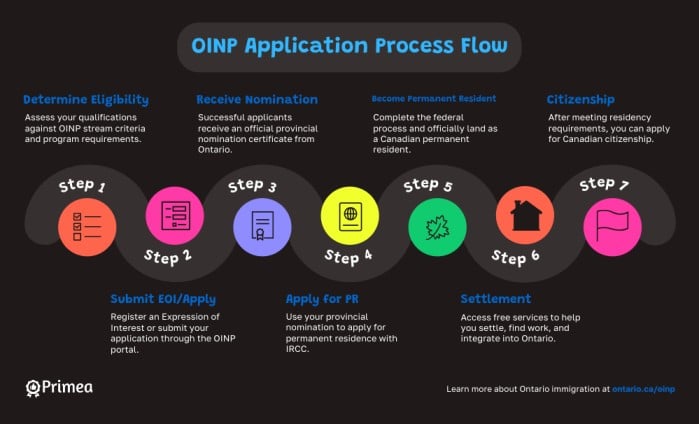
Your Action Plan: Next Steps to Apply for Ontario PNP 2026
Now that you understand the OINP streams, here’s your concrete action plan to move forward:
Step 1: Determine Your Eligibility
- Review each stream’s requirements against your profile
- Identify your NOC code using the NOC 2021 system
- Calculate your CRS score if applying through Express Entry streams
- Verify language test requirements (IELTS or CELPIP for English, TEF Canada or TCF Canada for French)
- Confirm your educational credentials with Educational Credential Assessment (if required)
Step 2: Gather Required Documents
Start collecting documents even before receiving a Notification of Interest:
- Valid passport
- Language test results (must be less than 2 years old)
- Educational Credential Assessment (ECA) report from designated organization
- Reference letters from all employers (on company letterhead, signed, with detailed job duties)
- Proof of work experience (pay stubs, T4s, employment contracts)
- Police clearance certificates (if you’ve lived in any country for 6+ months since age 18)
- Proof of funds (bank statements, investment statements)
- Job offer letter (if applicable to your stream)
- Educational transcripts and degrees
Step 3: Create Your Express Entry Profile (If Applicable)
For Human Capital Priorities, Skilled Trades, and French-Speaking Skilled Worker streams, you must have an active Express Entry profile. Create your profile on the IRCC website and obtain your Express Entry profile number and Job Seeker Validation Code—you’ll need both for your OINP application.
Step 4: Submit Expression of Interest or Wait for NOI
Depending on your stream, you either submit an Expression of Interest (EOI) through the OINP e-Filing Portal, or wait to receive a Notification of Interest (NOI) directly in your Express Entry account. For Masters/PhD streams, you apply directly without EOI or NOI.
Step 5: Submit Complete Application Within Deadline
If you receive a Notification of Interest or invitation to apply, you typically have 45 calendar days to submit your complete application. Double-check every document, ensure consistency across all materials, and pay the application fee ($1,500 CAD as of 2026).
Step 6: Respond to Any Requests for Additional Information
OINP may request additional documents or clarifications. Respond promptly and completely. Most requests have specific deadlines—missing them can result in application rejection.
Step 7: Receive Provincial Nomination and Apply for PR
Once nominated by Ontario, you’ll receive a nomination certificate. If you’re in Express Entry, you’ll automatically receive 600 additional CRS points. You then have 6 months to submit your federal permanent residence application to IRCC.
Conclusion: Your Path to Ontario Starts Here
The Ontario PNP 2026 offers multiple pathways to Canadian permanent residence, each designed for different candidate profiles. Whether you’re a tech professional, skilled tradesperson, international student, or French-speaking worker, there’s likely a stream that fits your background.
The key to success isn’t just meeting the minimum requirements—it’s about choosing the RIGHT stream for your unique situation, presenting a complete and consistent application, and demonstrating genuine intention to contribute to Ontario’s economy and communities.
Key Takeaways:
- Start early: Begin gathering documents months before you plan to apply
- Be strategic: Choose the stream where you’re most competitive, not just the first one you qualify for
- Stay informed: OINP draws and requirements change—monitor official sources regularly
- Be complete: Incomplete applications face delays or rejection—double-check everything
- Consider professional help: Complex cases benefit from regulated immigration consultant guidance
- Plan for the long term: Provincial nomination is step one; federal PR application follows
Ontario continues to welcome skilled immigrants who can contribute to its thriving economy. With proper preparation, strategic planning, and attention to detail, your Ontario PNP 2026 application can be the first step toward building your Canadian dream. The journey starts with understanding your options—and now you have the complete roadmap to navigate the OINP system successfully.
Ready to take the next step? Review your eligibility, gather your documents, and begin your journey to calling Ontario home.
