





If you’re an international student in Canada, the Post-Graduation Work Permit isn’t just a piece of paper—it’s your lifeline to Canadian work experience, career opportunities, and potentially, permanent residency. But here’s what most students don’t realize until it’s too late: the PGWP landscape has completely transformed in 2026.
I’ve watched countless graduates scramble when they discover that their “safe” business diploma no longer qualifies them for a work permit. Others miss critical deadlines or submit incomplete applications, wasting years of investment and planning. The stakes have never been higher, and the margin for error has never been smaller.
In this comprehensive guide, I’ll walk you through everything you need to know about PGWP 2026 requirements—from the new field-of-study restrictions to language proficiency demands, application timelines, and strategic program selection. Whether you’re still choosing your program or preparing to apply for your permit, this article will save you from costly mistakes and position you for success.
What is the Post-Graduation Work Permit (PGWP)?
The Post-Graduation Work Permit is an open work permit that allows international students who graduate from eligible Canadian post-secondary institutions to gain valuable Canadian work experience. Unlike employer-specific work permits, a PGWP gives you the freedom to work for any employer in any location across Canada.
Why the PGWP Matters More Than Ever
The PGWP serves three critical functions in your Canadian immigration journey:
- Canadian Work Experience: Most permanent residency pathways require Canadian work experience. The PGWP is often your only opportunity to gain this experience legally.
- Economic Integration: It bridges the gap between student life and permanent settlement, allowing you to establish professional networks and demonstrate your economic contribution to Canada.
- Pathway to PR: Work experience gained on a PGWP counts toward programs like Canadian Experience Class (CEC), Provincial Nominee Programs (PNPs), and other immigration streams.
The harsh reality? If you don’t qualify for a PGWP or make mistakes in your application, you’re essentially closing the door on most Canadian immigration pathways before you’ve even started.
The 2026 PGWP Landscape: What's Changed and Why It Matters
Major Policy Shifts in 2026
IRCC froze the list of PGWP-eligible fields of study for 2026, which means no programs will be added or removed from the eligibility list this year. While this provides temporary stability, it doesn’t change the fundamental restructuring that occurred in late 2024.
Key Changes Affecting 2026 Applicants:
- Field of Study Requirements: College diploma and certificate graduates must graduate from programs with approved CIP codes
- Language Testing Mandate: All applicants must demonstrate minimum English or French proficiency
- 50% In-Person Rule: Students with lock-in dates after September 1, 2024 must complete at least 50% of their program in Canada
- Public-Private Partnership Restrictions: Most P3 programs are now ineligible unless grandfathered
- Extended PGWP for Master’s: All master’s graduates can now receive 3-year permits
[TABLE 1: PGWP Eligibility Comparison – Before and After November 2024]
| Criteria | Before November 2024 | After November 2024 (2026 Rules) |
|---|---|---|
| Field of Study | Any program at DLI qualified | College/diploma: Must match approved CIP codes; Degrees: Any field |
| Language Testing | Not required | Mandatory (CLB 7 for degrees, CLB 5 for diplomas) |
| Study Location | Flexible online options | Minimum 50% in-person in Canada required |
| Master’s PGWP Length | Based on program length | Automatic 3-year PGWP regardless of program length |
| P3 Programs | Generally eligible | Most ineligible (some exceptions) |
| Application Deadline | 180 days from completion | 180 days from completion (unchanged) |
Why These Changes Were Implemented
Canada’s approach has shifted from volume-based international education to strategic talent acquisition. The government wants to ensure international students fill specific labor market gaps rather than any available position. This aligns PGWP eligibility with Canada’s 10-year labor shortage projections in healthcare, skilled trades, STEM fields, and agriculture.
Complete PGWP 2026 Requirements: Your Eligibility Checklist
1. Institutional Requirements
Your educational institution must meet these criteria:
✓ Designated Learning Institution (DLI) Status: Your school must be on the official DLI list at the time you studied and received your final transcript
✓ PGWP-Eligible Programs: Not all DLIs offer PGWP-eligible programs. Verify your specific program’s eligibility, not just the institution
✓ Exclusions to Watch For:
- Programs at non-Canadian institutions located in Canada
- Most curriculum licensing agreements (public-private partnerships)
- Language schools and ESL programs
- Programs completed primarily through distance learning
Pro Tip: Check your school’s official PGWP eligibility page. Most institutions now list CIP codes and PGWP status by program to help students make informed decisions.


2. Program Duration and Full-Time Study Requirements
Minimum Program Length: Your program must be at least 8 months long (or 900 hours for Quebec programs)
Full-Time Status: You must maintain full-time student status throughout your program, with specific exceptions:
- Your final semester (part-time allowed)
- Authorized leave of absence (150 days or less)
- Medical or pregnancy-related circumstances (with proper documentation)
Important Consideration: If you took any unauthorized breaks, reduced course loads without permission, or switched to part-time status (except final semester), your PGWP eligibility could be compromised. Include a detailed letter of explanation if you have any irregular study patterns.
3. Field of Study Requirements (Critical for Non-Degree Students)
This is where many students get caught off-guard. Here’s the breakdown:
WHO IS EXEMPT:
- Bachelor’s degree graduates (any field)
- Master’s degree graduates (any field)
- Doctoral degree graduates (any field)
- Students who applied for their study permit before November 1, 2024
- Students who applied for PGWP before November 1, 2024
- Flight school graduates from PGWP-eligible institutions
WHO MUST MEET FIELD OF STUDY REQUIREMENTS:
- College diploma students (study permit after November 1, 2024)
- Certificate program graduates (study permit after November 1, 2024)
- Post-graduate diploma students (study permit after November 1, 2024)
Understanding CIP Codes
CIP (Classification of Instructional Programs) codes are 6-digit numbers that classify post-secondary programs by field of study. Canada uses the CIP Canada 2021 system for PGWP eligibility.
Example CIP Codes:
- 51.0801: Medical/Clinical Assistant
- 15.1202: Computer Engineering Technology
- 52.0201: Business Administration and Management (generally NOT eligible at college level)
How to Verify Your Program’s CIP Code:
- Check your institution’s PGWP eligibility page (most list CIP codes by program)
- Review your program’s official curriculum documentation
- Search Statistics Canada’s CIP classification catalogue
- Contact your school’s international student services office
CRITICAL TIMING RULE: Your program’s CIP code must be on the eligible list when you submit EITHER:
- Your study permit application, OR
- Your PGWP application
This means even if a code is removed later, you may still be eligible if it was on the list when you applied for your study permit.
[TABLE 2: PGWP-Eligible Fields of Study Categories (2026)]
| Category | Examples of Eligible Programs | Approximate Number of Eligible CIP Codes |
|---|---|---|
| Healthcare | Nursing, Medical Laboratory Technology, Dental Hygiene, Respiratory Therapy, Medical Assistant | 280+ codes |
| STEM & Engineering Technology | Computer Engineering Technology, Electronics Technology, Mechanical Engineering Technology | 190+ codes |
| Skilled Trades | Electrical, Plumbing, HVAC, Welding, Carpentry, Automotive Service | 140+ codes |
| Agriculture & Natural Resources | Agricultural Business, Horticulture, Environmental Technology | 95+ codes |
| Education & Early Childhood | Early Childhood Education, Education Assistant programs | 45+ codes |
| Legal & Paralegal | Paralegal, Legal Assistant programs | 15+ codes |
Programs Generally INELIGIBLE at College/Diploma Level:
- Business Administration and Management
- General Marketing programs
- Hospitality and Tourism Management
- General IT programs (non-engineering technology)
- Media and Communications studies
- Most arts and humanities diplomas
4. Language Proficiency Requirements
As of November 1, 2024, ALL PGWP applicants must demonstrate language proficiency in English or French.
[TABLE 3: Language Requirements by Education Level]
| Education Level | Required CLB/NCLC Level | What This Means |
|---|---|---|
| Bachelor’s, Master’s, or Doctoral Degree | CLB/NCLC 7 | Upper intermediate – can handle most workplace communication effectively |
| College Diploma, Certificate, Post-Graduate Diploma | CLB/NCLC 5 | Intermediate – can handle basic workplace tasks and everyday communication |
Accepted English Language Tests:
- IELTS General Training (NOT Academic)
- CELPIP General (Canadian English Language Proficiency Index Program)
- PTE Core (Pearson Test of English)
Accepted French Language Tests:
- TEF Canada (Test d’évaluation de français)
- TCF Canada (Test de connaissance du français)
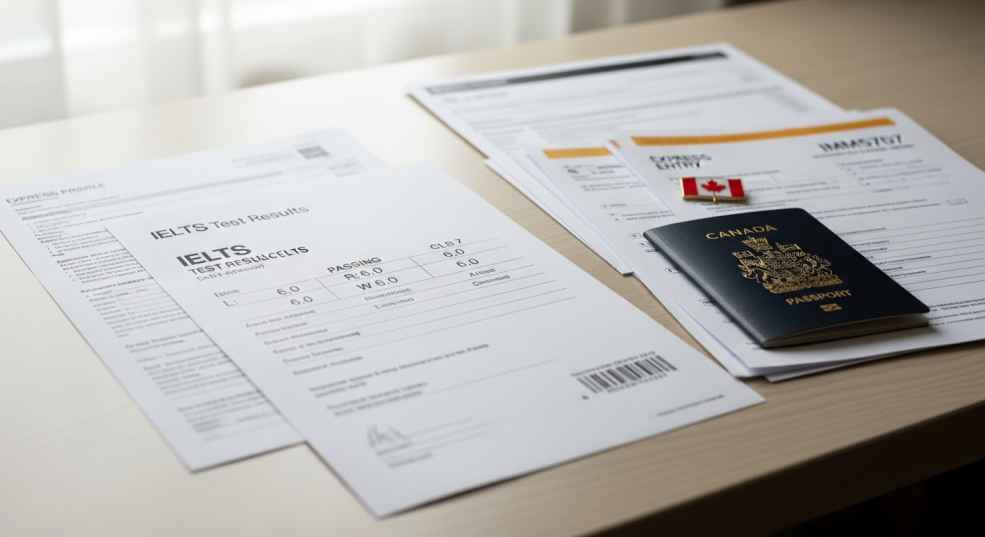
CLB 7 Minimum Scores (Degree Graduates):
- IELTS General: Reading 6.0, Writing 6.0, Listening 6.0, Speaking 6.0
- CELPIP: 7 in all four components
- PTE Core: 60 in all four components
CLB 5 Minimum Scores (College/Diploma Graduates):
- IELTS General: Reading 4.0, Writing 5.0, Listening 5.0, Speaking 5.0
- CELPIP: 5 in all four components
- PTE Core: 42 in all four components
Critical Requirements:
- Test results must be less than 2 years old at time of application
- You need to pass ALL FOUR components (reading, writing, listening, speaking)
- Failing even one component by 0.5 points means ineligibility
- Upload test results in the “Client Information” section (the system won’t prompt you)
Strategic Tip: Take your language test early—at least 3-4 months before you expect to graduate. This gives you time for a retake if needed and ensures you’re not rushing at the last minute.
5. Study Permit and Timeline Requirements
Study Permit Validity: Your study permit must have been valid at some point during the 180 days after you graduated and before you submitted your PGWP application.
Application Deadline: You have exactly 180 days from the date you receive official confirmation of program completion to submit your PGWP application.
What Counts as Official Confirmation:
- Degree or diploma
- Official transcript showing program completion
- Official letter from your school confirming completion
The Lock-In Date Matters: If your “lock-in date” (usually when you submitted your study permit application or when significant policy changes occurred) is on or after September 1, 2024, you must have completed at least 50% of your program in person in Canada. Time spent studying online outside Canada will be deducted from your PGWP length.
Authorization to Work While Waiting: If you submit your PGWP application within 90 days of receiving your completion letter AND your study permit was valid when you applied, you can work full-time while waiting for a decision. You must have complied with work limits during your studies (maximum 24 hours per week off-campus during regular academic terms).
6. Previous PGWP History
One PGWP Per Study Level: Generally, you can only receive one PGWP in your lifetime. However, if you complete a higher level of education, you may be eligible for another PGWP.
Example: If you received a PGWP after completing a college diploma and later complete a bachelor’s degree, you can apply for another PGWP.
Exception for Stacking Programs: If you complete two eligible programs consecutively within two years, both programs can be considered when determining PGWP length.
The PGWP Application Process: Step-by-Step Guide
Step 1: Receive Your Official Completion Confirmation
The moment you receive official confirmation of program completion from your institution starts your 180-day countdown. This date is critical—mark it on your calendar immediately.
What Triggers the Timeline:
- Official transcript showing “degree granted” or “program completed”
- Formal completion letter from your registrar’s office
- Diploma or degree certificate
Important: Once you receive this confirmation, you are NO LONGER eligible to work on or off campus as a student. You must stop working immediately unless you’ve already submitted your PGWP application and are eligible to work while waiting.
Strategic Timing Tip: If possible, apply for your PGWP on the same day you receive your completion letter. This maximizes your ability to work without interruption.
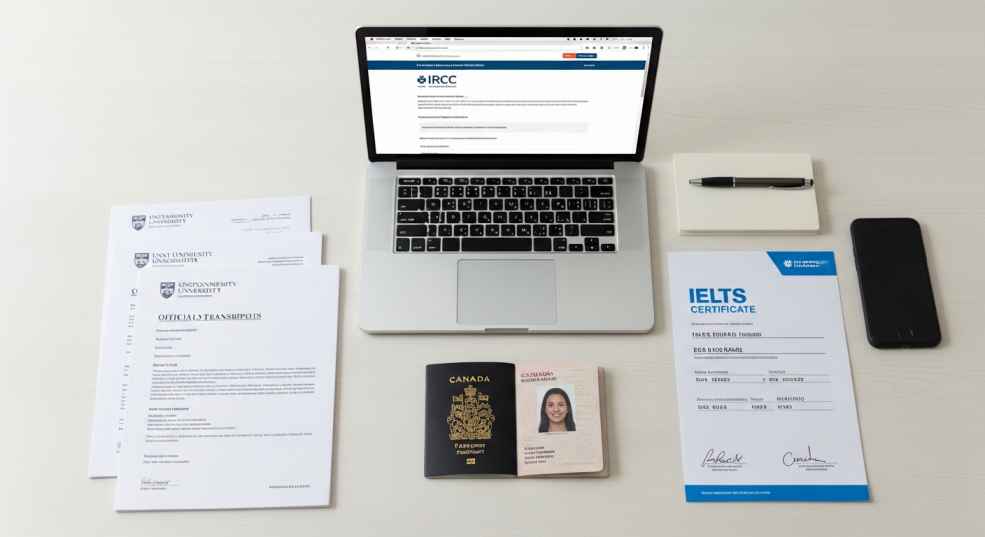
Step 2: Gather Required Documents
Core Documents Required:
- Proof of Program Completion
- Official letter from your DLI
- Official transcript (unofficial acceptable in some cases during application, but have official ready)
- Some schools provide a “completion letter” separate from transcripts
- Valid Passport
- Must be valid beyond your expected PGWP duration
- CRITICAL: Your PGWP cannot extend beyond your passport expiry date
- Consider renewing your passport BEFORE applying if it expires soon
- Language Test Results
- Original test results (electronic copy acceptable)
- Must be less than 2 years old
- Include all four components
- Proof of Eligible Field of Study (if applicable)
- Document showing your program’s CIP code
- Available from your institution’s registrar or international student office
- Digital Photo
- Must meet IRCC specifications
- Recent photo within past 6 months
- Passport-Size Photos for Biometrics
- You’ll need these for your biometrics appointment
- Immigration Medical Exam (if applicable)
- Required for certain occupations (healthcare, childcare, agriculture, food processing)
- Must be completed by IRCC-authorized panel physician
- Valid for 12 months
Additional Documents You May Need:
- Letter of Explanation: If you have any irregularities in your study history (part-time semesters, leaves of absence, program changes)
- Full-Time Study Definition Letter: Some universities provide this automatically (e.g., UBC’s Definition of Full-time Studies for Immigration Purposes Letter)
- Previous Study Permits: Copies of all study permits held during your program
Step 3: Create or Access Your IRCC Secure Account
All PGWP applications must be submitted online through the IRCC portal. No paper applications or border applications (“flagpoling”) are accepted.
How to Create an Account:
- Visit the IRCC website and select “Sign in to your account”
- Choose between:
- GCKey (create a new credential)
- Sign-In Partner (use existing bank credentials)
- Create security questions and answers
- Verify your email address
Keep Your Credentials Secure: You’ll need this account to track your application and receive communications from IRCC.
Step 4: Complete the Online Application
Navigate the Application:
- Log into your IRCC secure account
- Click “Apply to come to Canada” (even if you’re already in Canada)
- Answer questionnaire to generate your personalized document checklist
Critical Questionnaire Answers for PGWP:
- What would you like to do in Canada? → “Work”
- How long are you planning to stay in Canada? → “Temporarily – more than 6 months”
- What is your current country/territory of residence? → “Canada” (if applying from within Canada)
- Are you currently in Canada? → “Yes” (if applicable)
- Work permit type? → “Post-graduation work permit”
Complete Form IMM 5710: Application to Change Conditions, Extend My Stay, or Remain in Canada as a Worker
Key Form Fields:
- UCI (Unique Client Identifier): Found on your study permit (8-10 digits)
- Purpose of Application: Select “Apply for a work permit for the first time or with a new employer”
- Current Immigration Status: “Student”
- From/To Dates: Your arrival date in Canada and study permit expiry date
- Details of intended work in Canada: You can indicate “open work permit” or “any employer”
CRITICAL: Due to system limitations, the document checklist may not automatically request language test results or proof of eligible field of study. You MUST upload these manually in the “Client Information” section.
Step 5: Upload Your Documents
Upload clear, legible scans of all required documents. Use PDF format where possible for text documents, JPG for photos.
Document Upload Tips:
- Name files clearly (e.g., “Passport_JohnSmith.pdf”, “IELTS_Results_JohnSmith.pdf”)
- Ensure all text is readable before uploading
- Combine related documents (e.g., transcript and full-time study letter)
- Double-check you’ve uploaded language results in Client Information section
Step 6: Pay Application Fees
PGWP Fee Breakdown (2026):
- Work Permit Fee: CAD $155
- Open Work Permit Holder Fee: CAD $100
- Total PGWP Fees: CAD $255
Additional Potential Fees:
- Biometrics Fee: CAD $85 (if required)
- Medical Exam: CAD $200-450 (varies by physician and tests required)
- Language Test: CAD $300-400 (varies by test provider)
Payment Methods:
- Credit card (Visa, MasterCard, American Express)
- Visa Debit
- Prepaid cards accepted (keep for 18 months for potential refunds)
- Cardholder name doesn’t need to match applicant
Tip: Pay the biometrics fee at the same time you submit your application to avoid processing delays.
Step 7: Submit Biometrics
Who Needs Biometrics:
- Most applicants (unless recently provided within past 10 years)
- U.S. citizens are exempt
- Some other exemptions apply
Biometrics Process:
- Submit your PGWP application with biometrics fee
- Receive Biometrics Instruction Letter (usually within 24 hours for online applications)
- Book appointment at designated Service Canada location
- Submit fingerprints and photo within 30 days of receiving instruction letter
CRITICAL: Your application will not be processed until biometrics are received. The time to complete biometrics is NOT included in standard processing times.
Processing Consideration: If you’re approaching 10 years since your last biometrics submission, note that your PGWP will only be issued until your biometrics expiry date.
Step 8: Track Your Application and Work Authorization
After Submission:
- You’ll receive a Submission Confirmation letter
- If eligible, you’ll receive an IMM 0127 letter within about one week authorizing you to work while waiting
- Monitor your IRCC account for requests for additional information
- Check processing times regularly (times vary and can change)
Current Processing Time: Check the IRCC website for up-to-date processing times (typically 80-180 days as of early 2026, but this varies)
Work Authorization While Waiting: You can work full-time while your PGWP application is being processed if:
- Your study permit was valid when you submitted your application
- You applied within 90 days of receiving your completion letter
- You maintained full-time status throughout your program
- You complied with work hour limits during studies
Traveling While Application Pending: You can travel outside Canada while your application is being processed, but ensure you have:
- Valid Temporary Resident Visa (TRV) or eTA
- Proof of your pending PGWP application
- Your study permit or work permit (as applicable)
Strategic Program Selection: Choosing the Right Path
If you haven’t yet started your Canadian studies, program selection is THE most critical decision you’ll make. Here’s how to choose strategically:
Decision Framework for Prospective Students
Step 1: Identify Your Immigration Goals
- Do you want to stay in Canada permanently or just gain work experience?
- Which province do you want to live in long-term?
- What’s your career field and how does it align with Canadian labor market needs?
Step 2: Choose Education Level Strategically
Bachelor’s Degree Benefits:
- No field of study restrictions
- Any major qualifies for PGWP
- CLB 7 language requirement (higher but manageable)
- More doors open for provincial nomination programs
- Typically 3-4 years = 3-year PGWP
Master’s Degree Benefits:
- No field of study restrictions
- Automatic 3-year PGWP (even for programs under 2 years)
- Strong boost for Express Entry points
- CLB 7 language requirement
- Preferred by many Provincial Nominee Programs
College Diploma Challenges:
- MUST verify CIP code eligibility
- Field restrictions significantly limit options
- CLB 5 language requirement (lower threshold)
- Shorter programs = shorter PGWP (typically 1-2 years)
- Some PNPs prioritize degree holders
Step 3: Verify CIP Code Eligibility (College Students)
Before committing to ANY college program:
- Get the exact 6-digit CIP code from the institution
- Check IRCC’s current eligible fields list
- Confirm with institution’s international student office
- Understand that the list can change (frozen for 2026 but may change in future)
- Have a backup plan if your field becomes ineligible
Provincial Considerations
Your choice of study location impacts more than your student experience—it shapes your permanent residency pathway.
[TABLE 4: Provincial PGWP and Immigration Landscape (2026)]
| Province | PGWP Considerations | PR Pathway Notes |
|---|---|---|
| Ontario | Most affected by CIP restrictions; many private colleges affected | OINP highly competitive; Skilled Trades stream suspended late 2025 |
| British Columbia | Strong tech sector; BC PNP has own tech list | More immigration slots; strong alignment with PGWP-eligible tech programs |
| Alberta | Growing tech and healthcare demand | AAIP responsive to labor market; good opportunities for skilled trades |
| Quebec | Separate immigration system; French proficiency critical | Must intend to stay in Quebec; unique language requirements |
| Atlantic Provinces | Atlantic Immigration Program opportunities | Smaller markets but dedicated immigration streams |
| Manitoba & Saskatchewan | Community-focused immigration; lower cost of living | Strong support for graduates who stay in province |
Strategic Recommendation: If permanent residency is your goal, research your target province’s Provincial Nominee Program BEFORE choosing where to study. Some provinces have more accessible pathways for PGWP holders.
High-Demand Fields with Strong PGWP-to-PR Pathways
Based on 2026 labor market needs and immigration trends:
Healthcare (Highest Demand):
- Nursing (all levels)
- Medical Laboratory Technology
- Respiratory Therapy
- Dental Hygiene
- Personal Support Worker (PSW)
Why These Work: Healthcare workers are in critical shortage nationwide. Most provinces have dedicated healthcare streams in their PNPs.
Skilled Trades (Consistent Demand):
- Electrical
- Plumbing
- HVAC
- Welding
- Automotive Service Technology
Why These Work: Canada faces massive skilled trades shortages. Many provinces fast-track trades workers for PR.
STEM Engineering Technology (Growing Demand):
- Computer Engineering Technology
- Electronics Engineering Technology
- Mechanical Engineering Technology
- Civil Engineering Technology
Why These Work: Technology sectors are expanding nationwide. These programs lead to TEER 0-2 occupations that qualify for most immigration streams.
Agriculture (Regional Opportunity):
- Agricultural Business and Management
- Horticulture Technology
- Animal Health Technology
Why These Work: Rural and agricultural communities have specific immigration streams and less competition.
Programs to Avoid (College/Diploma Level):
- General Business Administration
- Marketing and Advertising
- Hospitality Management
- Tourism Management
- General Arts and Humanities programs
- Media and Communications (unless specialized tech-focused)
Common PGWP Application Mistakes and How to Avoid Them
Mistake #1: Missing the 180-Day Deadline
The Problem: Many students don’t realize their 180-day countdown starts the moment they receive ANY official confirmation of completion—not from convocation or when they pick up their physical diploma.
The Solution:
- Check your student portal daily after your last exam/thesis defense
- Download your completion letter the SAME DAY it becomes available
- Mark the date immediately and calculate your 180-day deadline
- Set calendar reminders at 90 days, 60 days, and 30 days before deadline
Real Case Study: Sara completed her program in April 2025. She saw a “degree granted” note appear on her transcript on April 15 but didn’t download it because she was waiting for convocation in June. When she finally applied for her PGWP in November (assuming the countdown started at convocation), IRCC rejected her application—she was 45 days past the deadline.
Mistake #2: Incorrect or Missing Language Test Results
The Problem: Students upload language tests in the wrong section, upload expired tests, or fail to meet minimum scores in all four components.
The Solution:
- Upload language results in “Client Information” section (system doesn’t auto-prompt)
- Verify test is less than 2 years old at application submission
- Check you meet minimum scores in ALL FOUR components
- Use IELTS General Training, not Academic
- Keep original test results as PDF, don’t scan photocopies
Verification Checklist Before Upload:
- ✓ Test date within 2 years?
- ✓ All four scores meet or exceed minimum?
- ✓ Correct test type (General for IELTS)?
- ✓ Clear, legible scan?
- ✓ Uploading in Client Information section?
Mistake #3: Working Illegally While Waiting
The Problem: Not all students are eligible to work while their PGWP application is being processed, but many assume they can.
The Solution: Verify you meet ALL requirements to work while waiting:
- Study permit was valid when you submitted PGWP application
- Applied within 90 days of completion letter
- Maintained full-time status throughout program (except final semester)
- Never exceeded work hour limits during studies
If You Don’t Meet These Requirements: Stop working immediately after receiving completion letter. Wait for PGWP approval before resuming employment. Working illegally can result in PGWP refusal and future inadmissibility.
Mistake #4: Choosing an Ineligible Program
The Problem: Students enroll in college diploma programs without verifying CIP code eligibility, assuming all programs at legitimate colleges qualify.
The Solution:
- NEVER rely on recruitment agents alone—verify independently
- Check IRCC’s official eligible fields list
- Get written confirmation of CIP code from institution
- Verify the specific program code, not just the general field
- Understand that program names can be misleading
Example: “Business Technology Management” might sound tech-focused and eligible, but if its CIP code is under general business (52.0201), it’s likely ineligible. Always verify the exact code.
Mistake #5: Incomplete Documentation
The Problem: Missing required documents delays processing or leads to refusal.
The Solution – Pre-Submission Checklist:
□ Completed IMM 5710 form (validated, not just filled) □ Valid passport (extending beyond expected PGWP duration) □ Official completion letter or transcript □ Language test results (less than 2 years old, uploaded in Client Information) □ Proof of eligible field of study (if applicable, uploaded in Client Information) □ Digital photo meeting specifications □ Letter of explanation (if any study irregularities) □ Payment confirmation ($255 PGWP fees + $85 biometrics if applicable) □ Medical exam results (if occupation requires)
Pro Tip: Create a dedicated folder on your computer with clearly labeled documents. Review everything twice before uploading.
[IMAGE PLACEMENT 5] Image Description: Split-screen showing “Common Mistakes” on left (stressed student, crossed out documents, missed deadlines) and “Success Path” on right (organized student, checkmarks, approved application) AI Image Prompt: “Professional infographic style image showing split screen comparison, left side: student making PGWP mistakes with red X marks and disorganized papers, right side: successful organized student with green checkmarks and neat documents, clean modern design, icons and visual elements” Alt Text: Common PGWP application mistakes versus correct application process for 2026
Mistake #6: Not Understanding Spousal Implications
The Problem: PGWP holders don’t realize their spouse’s work permit eligibility changed in 2026.
The New Rules (Effective January 2026):
Spouses of PGWP holders can only get a work permit if the PGWP holder is working in:
- TEER 0, 1, or 2 occupations, OR
- TEER 3 occupations on the high-skilled shortage list
The Solution:
- Understand your target occupation’s TEER level before graduation
- Plan job search strategically if spouse needs work authorization
- Consider applying for spousal open work permit simultaneously with PGWP
- Have contingency plans if you cannot immediately secure qualifying employment
Reality Check: If you graduate and take a retail position (TEER 4) or a general office job that’s not on the shortage list, your spouse cannot work legally in Canada. This significantly impacts family financial planning.
Life After PGWP Approval: Maximizing Your Permit
Understanding Your PGWP Duration
Your PGWP length depends on your program duration:
[TABLE 5: PGWP Duration by Program Length]
| Program Length | PGWP Duration | Special Notes |
|---|---|---|
| 8 months to less than 2 years | Same length as program | Passport must be valid for full duration |
| 2 years or more | 3 years | Maximum PGWP length available |
| Master’s degree (any length ≥8 months) | 3 years | New benefit as of February 2024 |
| Two eligible programs (consecutive) | Combined length (max 3 years) | Programs must be completed within 2 years of each other |
Passport Expiry Impact: Your PGWP cannot exceed your passport’s expiry date. If your passport expires before your eligible PGWP duration, you’ll receive a shorter permit with a note that you can extend it once you renew your passport.
Maximizing Work Experience for Permanent Residency
Your PGWP work experience only counts toward Canadian Experience Class and other PR programs if:
TEER Requirements: Work must be in TEER 0, 1, 2, or 3 categories Hour Requirements: Minimum 1,560 hours (typically 1 year full-time) Authorization: Must be authorized work (on valid work permit) Post-Graduation Timing: Experience gained during studies (on study permit work authorization) generally doesn’t count
Strategic Career Planning:
First 6 Months: Even if you don’t land your ideal job immediately, focus on getting into a TEER 0-3 position. Build Canadian references and networks.
Months 6-12: Once you hit 1,560 hours in qualifying work, you can apply for Canadian Experience Class Express Entry. Don’t wait for 2-3 years—apply as soon as eligible.
Year 2-3: If you haven’t secured PR invitation yet, consider:
- Improving Express Entry score (language retest, additional education)
- Provincial Nominee Program applications
- Strategic job moves to higher TEER levels
Building Your Express Entry Profile
Optimal Timeline:
- Month 6 post-PGWP: Reach 1,560 hours work experience
- Create Express Entry profile
- Retake language test if can improve scores (higher scores = more points)
CRS Score Boosters for PGWP Holders:
- Canadian education (master’s: +23 points; bachelor’s: +15 points)
- Canadian work experience (1 year: +40 points; 2 years: +53 points)
- Higher language scores (CLB 9+: significant point increase)
- Provincial nomination (+600 points – automatic invitation)
Lorem ipsum dolor sit amet, consectetur adipiscing elit. Ut elit tellus, luctus nec ullamcorper mattis, pulvinar dapibus leo.
Frequently Asked Questions (FAQs)
Q: Can I apply for a PGWP from outside Canada?
A: Yes, but you cannot work in Canada until you receive your approved permit. If you apply from within Canada with a valid study permit, you may be eligible to work while waiting. Most students find it advantageous to apply from within Canada.
Q: What happens if my PGWP application is refused?
A: You must leave Canada unless you have another valid status (visitor, student, worker). Refusals are typically due to:
- Missing application deadline
- Ineligible program/institution
- Failure to meet language requirements
- Incomplete documentation
- Previous immigration violations
You can submit a new application if you’re still within your 180-day window and address the refusal reasons.
Q: Can I extend my PGWP?
A: Generally, no. PGWPs cannot be extended except in specific circumstances:
- Your passport expired before your full PGWP eligibility period
- Special government programs (e.g., the 18-month extension program in 2026, which has a deadline of April 30, 2026)
Q: Can I apply for a PGWP twice?
A: You can only receive one PGWP per study level. If you complete a higher level of education (e.g., degree after diploma), you may be eligible for another PGWP.
Q: My program is online/hybrid—am I still eligible?
A: It depends on your lock-in date:
- Study permit before September 1, 2024: Generally eligible
- Study permit after September 1, 2024: Must complete at least 50% in Canada; any online time outside Canada is deducted from PGWP length
Q: Do I need a job offer to apply for PGWP?
A: No. The PGWP is an open work permit—you do not need a job offer to apply. However, if your spouse is applying for a spousal open work permit at the same time, you’ll need proof of qualifying employment (TEER 0-3 or listed TEER 3).
Q: Can I change employers on a PGWP?
A: Yes. The PGWP is an “open” work permit, meaning you can work for any employer anywhere in Canada. You can change jobs as often as needed during your PGWP validity period.
Q: What if I completed part of my program at one institution and transferred to another?
A: Your PGWP length is based on the program length at the institution where you completed your credential. If you completed equivalent programs at both institutions, this may affect your eligibility. Consult with an immigration expert for complex transfer situations.
Q: Can I apply for permanent residency while on a PGWP?
A: Yes! The PGWP is designed to allow you to gain Canadian work experience and apply for permanent residency programs like Canadian Experience Class, Provincial Nominee Programs, and others. Many PGWP holders successfully transition to PR during their permit validity.
Take Action Now: Your Next Steps
If You’re Still Choosing a Program:
- Verify CIP code eligibility at IRCC website
- Research provincial immigration pathways
- Consider degree programs for maximum flexibility
- Calculate total costs including language tests and PGWP fees
If You’re Currently Studying:
- Book your language test 3-4 months before expected graduation
- Verify your program’s PGWP eligibility with your institution
- Ensure you’re maintaining full-time status
- Monitor your study permit expiry date
If You’re About to Graduate:
- Check student portal daily for completion confirmation
- Prepare all documents in advance
- Set up IRCC secure account if you haven’t already
- Calculate your 180-day deadline the moment you get completion notice
- Apply ASAP to maximize work authorization while waiting
If Your PGWP is Approved:
- Focus on securing TEER 0-3 employment
- Track your work hours toward 1,560 requirement
- Create Express Entry profile once eligible
- Research Provincial Nominee Programs
- Consider retaking language test for higher scores
Need Help? For complex situations, transfers, or if you’re unsure about your eligibility, consult with a Registered Canadian Immigration Consultant (RCIC) or immigration lawyer. The investment in professional advice can save you thousands of dollars and years of setbacks.
Your Canadian dream is within reach. Make sure you take the right steps to get there.