







Picture this: You’re sitting in a Montreal café, confidently ordering your café au lait in fluent French, knowing that your language skills haven’t just earned you a perfect espresso—they’ve also secured your pathway to Canadian permanent residency. For thousands of immigrants each year, French language proficiency isn’t just a nice-to-have skill; it’s a game-changing advantage that can dramatically accelerate their immigration journey.
Canada’s bilingual identity creates unique opportunities for French speakers pursuing permanent residence. Whether you’re targeting Express Entry’s Comprehensive Ranking System (CRS) points, applying through the francophone immigration pilot, or planning to settle in Quebec, understanding TEF Canada requirements and developing strong French proficiency can be the difference between a successful application and years of waiting.
In this comprehensive guide, I’ll walk you through everything you need to know about leveraging French language skills for Canadian immigration. You’ll discover how to choose the right language test, prepare effectively, maximize your CRS points, and understand which immigration pathways reward French proficiency most generously. Let’s unlock your path to Canada.


Why French Language Proficiency Matters for Canadian Immigration
Canada’s commitment to bilingualism creates extraordinary advantages for French speakers in the immigration system. Unlike many countries where language proficiency is merely a checkbox requirement, Canada actively rewards French skills with substantial benefits throughout multiple immigration streams.
The CRS Points Advantage: Adding 50+ Points to Your Profile
In Express Entry, French proficiency can add up to 50 additional CRS points—often the difference between receiving an Invitation to Apply (ITA) and remaining in the pool indefinitely. Here’s the breakdown:
For applicants with strong French skills (CLB 7 or higher in all abilities) and English proficiency (CLB 5 or higher), you receive 50 bonus points. Even French-only proficiency without English grants 25 points. These points are awarded in addition to the standard language points you earn, making French an exponential multiplier for your application.
Real-world impact: In recent Express Entry draws, CRS cutoff scores have ranged between 470-540 points. That 50-point French bonus can literally mean the difference between a successful draw and waiting months or years for scores to drop. I’ve seen countless applicants transform ‘maybe next year’ profiles into immediate ITAs simply by investing in French language training.
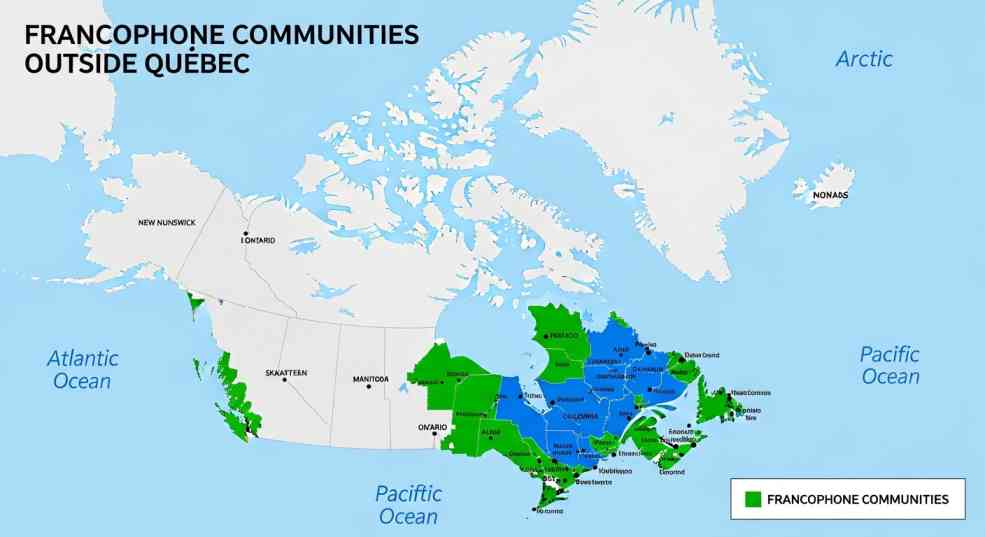
Launched to strengthen French-speaking communities across Canada, the francophone immigration pilot creates dedicated pathways for French speakers settling in provinces and territories outside Quebec. This program recognizes that French proficiency represents both cultural and economic value to Canadian society.
The pilot operates through Express Entry by giving preference to candidates who:
- Demonstrate strong French language abilities (minimum CLB 7)
- Intend to reside in francophone minority communities outside Quebec
- Meet the requirements of one of the federal economic immigration programs
Category-based draws have increasingly targeted francophone candidates, with some recent draws requiring CRS scores 50-100 points lower than general Express Entry draws. This represents one of the most advantageous immigration pathways currently available.
Understanding TEF Canada Requirements and Language Tests
Choosing the right French language test is crucial for your immigration success. While multiple tests are accepted for Canadian immigration, each has specific requirements, formats, and strategic advantages depending on your immigration pathway.
TEF Canada vs TCF Canada: Which Test Should You Take?
For immigration purposes, Canada accepts two main French language tests: Test d’évaluation de français (TEF Canada) and Test de connaissance du français (TCF Canada). Both are internationally recognized, but they differ significantly in format and approach.
Aspect | TEF Canada | TCF Canada |
Test Duration | Approximately 3 hours 30 minutes | Approximately 3 hours |
Format | Computer-based and paper-based options | Computer-based only |
Listening | 60 questions, 40 minutes | 39 questions, 35 minutes |
Reading | 50 questions, 60 minutes | 39 questions, 60 minutes |
Writing | 2 tasks, 60 minutes total | 3 tasks, 60 minutes total |
Speaking | 2 sections, 15 minutes | 3 tasks, 12 minutes |
Validity | 2 years from test date | 2 years from test date |
Cost (CAD) | $400-450 (varies by location) | $400-450 (varies by location) |
Table 1: Comprehensive comparison of TEF Canada and TCF Canada test formats and requirements
Strategic choice: Most candidates prefer TEF Canada for its paper-based option, which some find less stressful than computer-only testing. However, TCF Canada’s shorter duration and quicker results turnaround (often within 2 weeks) make it attractive for those on tight timelines. The choice ultimately depends on your learning style and comfort with technology.
Understanding CLB Levels and Score Requirements
Canada uses the Canadian Language Benchmarks (CLB) system to evaluate language proficiency. For immigration purposes, understanding how your test scores translate to CLB levels is essential for calculating your CRS points accurately.
The CLB scale ranges from 1 to 12, with 12 representing advanced proficiency. For most immigration programs, you’ll need:
- CLB 7 (minimum) for French bonus points in Express Entry
- CLB 9 (ideal) for maximum first official language points
- CLB 5 for second official language (to qualify for additional points)
Reading | Writing | Listening | Speaking | |
CLB 10 | 263-277 | 393-415 | 316-333 | 393-415 |
CLB 9 | 248-262 | 371-392 | 298-315 | 371-392 |
CLB 8 | 233-247 | 349-370 | 280-297 | 349-370 |
CLB 7 | 207-232 | 310-348 | 249-279 | 310-348 |
CLB 5 | 151-180 | 226-270 | 181-216 | 226-270 |
Table 2: TEF Canada score ranges corresponding to CLB levels (Source: IRCC)
Important note: Your CLB level for immigration purposes is determined by your lowest score across all four abilities. For example, if you achieve CLB 9 in reading, writing, and listening but only CLB 7 in speaking, your overall CLB is 7. This makes balanced preparation crucial—don’t neglect any skill area.
How to Learn French for Canada PR: Effective Study Strategies
Achieving the French proficiency needed for maximum immigration points requires strategic, focused preparation. Whether you’re starting from scratch or polishing intermediate skills, the right approach can dramatically accelerate your progress and test performance.
Creating Your Personalized French Learning Roadmap
The journey to CLB 7+ proficiency typically takes 6-18 months of dedicated study, depending on your starting point and learning intensity. Here’s how to structure your preparation effectively:
For absolute beginners (targeting CLB 7 in 12-18 months):
- Months 1-3: Foundation building with structured courses (Duolingo, Babbel, or Alliance Française beginner courses)
- Months 4-6: Grammar mastery and vocabulary expansion (aim for 2,000+ active words)
- Months 7-9: Immersion practices—French podcasts, films, conversation partners
- Months 10-12: Test-specific preparation and practice exams
- Months 13-18: Refinement and retesting if needed
For intermediate learners (targeting CLB 9 in 6-9 months):
- Months 1-2: Diagnostic testing and gap analysis
- Months 3-5: Intensive skill-specific work on weakest areas
- Months 6-7: Full-length practice tests under timed conditions
- Months 8-9: Final refinement and official testing
Top Resources for TEF Canada Test Preparation
Success on TEF Canada requires both general French proficiency and test-specific strategies. Here are the most effective resources categorized by skill area:
Listening comprehension resources:
- InnerFrench podcast (intermediate to advanced, excellent for CLB 7-9 levels)
- TV5Monde ‘Apprendre le français’ with authentic news content
- RFI Savoirs for current affairs in slower, clearer French
- Official TEF Canada practice materials from CCIP (essential for test format familiarity)
Reading comprehension resources:
- Le Monde (advanced current affairs)
- 20 Minutes (accessible daily news)
- Graded readers from Easy French Reader series
- Official TEF reading practice tests
Writing practice:
- iTalki or Preply tutors for personalized feedback (crucial for improvement)
- Bonpatron.com for grammar checking
- DELF B2 writing prompts (similar difficulty to CLB 7-8)
- TEF-specific writing guides with model responses
Speaking practice:
- Daily 1-on-1 conversation practice via iTalki, Cambly, or local language exchange
- Shadowing technique with French audio/video content
- Recording yourself answering TEF practice prompts
- French conversation clubs in your city or online (Meetup, Eventbrite)
The biggest mistake I see candidates make is focusing exclusively on general French learning without test-specific preparation. Spend at least 30% of your study time in the final 2-3 months on official TEF practice materials. The test format, timing, and question types are unique—knowing what to expect eliminates anxiety and prevents avoidable mistakes.
PRO TIP
Common Mistakes to Avoid in TEF Canada Preparation
Having coached hundreds of candidates through French language testing, certain pitfalls appear repeatedly. Avoid these common errors:
- Neglecting time management: TEF Canada is strictly timed. Many capable candidates underperform simply because they spend too long on difficult questions. Practice with a timer religiously and learn to move on strategically.
- Ignoring Canadian French variations: While TEF uses International French, exposure to Quebec French pronunciation and vocabulary helps, especially for listening comprehension. Don’t be thrown off by regional accents in audio sections.
- Over-relying on translation apps: Think directly in French as much as possible. Translation creates awkward phrasing that evaluators easily spot, particularly in writing sections.
- Insufficient speaking practice: Reading and writing can improve through solo study, but speaking requires actual conversation. Schedule regular speaking sessions—even 15 minutes daily makes a massive difference.
- Testing too early: At $400+ per attempt, premature testing is expensive. Use free diagnostic tools to estimate your CLB level before booking. Only schedule your official test when practice scores consistently hit your target.

Maximizing French Language Points in Express Entry
Understanding how to strategically leverage French proficiency in your Express Entry profile can mean the difference between months of waiting and immediate invitation. The points system rewards French skills generously, but only if you optimize your approach.
French as First Official Language vs Second Official Language
One of the most strategic decisions in your Express Entry profile is whether to designate French or English as your first official language. This choice significantly impacts your total CRS score.
Here’s the critical insight most candidates miss: You earn more points by having French as your first official language and English as your second, compared to the reverse—even with identical test scores. This is because:
- First official language points max out at 136 points (single) or 150 points (with spouse)
- Second official language points max out at 24 points (single) or 22 points (with spouse)
- Strong French + competent English grants those 50 bonus points
Strategic example: Candidate A has English CLB 9 (first language) and French CLB 7 (second language). Candidate B has identical scores but designates French as first language and English as second. Candidate B receives higher total points due to the 50-point French bonus, even though both have the same language abilities.
Important caveat: To designate French as your first official language, you must achieve at least CLB 7 in all four abilities (reading, writing, listening, speaking). If your French is CLB 6 or lower in any category, you must use English as first language.
Lorem ipsum dolor sit amet, consectetur adipiscing elit. Ut elit tellus, luctus nec ullamcorper mattis, pulvinar dapibus leo.
Category-Based Express Entry Draws for Francophones
Since mid-2023, IRCC has conducted category-based selection draws specifically targeting French-speaking candidates. These specialized draws represent perhaps the single most advantageous development for French speakers in Express Entry’s history.
Recent data reveals compelling advantages:
- French-language proficiency draws typically have CRS cutoffs 30-70 points lower than general draws
- Some francophone draws have admitted candidates with CRS scores as low as 400-420
- IRCC conducts francophone-specific draws approximately every 3-4 weeks
- Draw sizes range from 500 to 3,500 invitations depending on immigration targets
To qualify for francophone category draws, you must:
- Have valid TEF Canada or TCF Canada test results
- Achieve at least CLB 7 in all four French abilities
- Meet minimum requirements for one of the three federal economic programs (FSW, CEC, or FST)
- Not be claiming the maximum 50 bonus points for provincial nomination (as this typically places you in a separate draw category)
Provincial Programs Favoring French Speakers
Beyond federal programs, several Canadian provinces and territories offer dedicated immigration streams for French speakers, often with faster processing and lower requirements than standard pathways.
Ontario Immigrant Nominee Program (OINP) French-Speaking Skilled Worker Stream
Ontario, Canada’s most populous province and economic hub, actively seeks French speakers through its dedicated stream. This pathway doesn’t require a job offer, making it exceptionally attractive.
Key requirements:
- CLB 7 or higher in French (all four abilities)
- CLB 6 or higher in English
- Canadian bachelor’s degree or foreign equivalent
- Minimum one year of skilled work experience in NOC TEER 0, 1, 2, or 3
- Valid Express Entry profile
- Intent to reside in Ontario
The game-changer: OINP nomination adds 600 points to your Express Entry CRS score, virtually guaranteeing an ITA in the next draw. Recent nomination rounds have selected candidates with CRS scores as low as 430-450, making this stream accessible to many French speakers who wouldn’t qualify for direct Express Entry.
New Brunswick and Other Francophone-Friendly Provinces
New Brunswick, Canada’s only officially bilingual province, offers several pathways particularly suited to French speakers:
Strategic Francophone Initiative: This stream targets French-speaking candidates with strong connections to New Brunswick. Requirements include CLB 5 in French, a settlement plan, and sufficient settlement funds. Processing is notably faster than many other provincial programs.
Additional francophone-friendly provincial options include:
Manitoba: The Manitoba Provincial Nominee Program offers pathways for French speakers, particularly through the Skilled Worker Overseas stream with priority processing.
Saskatchewan: The Saskatchewan Immigrant Nominee Program includes considerations for French language ability in its points-based selection.
Alberta: While not specifically francophone-focused, Alberta’s growing French-speaking communities in Edmonton and Calgary create opportunities, particularly in education and customer service sectors.
Quebec Immigration: A Separate System
Quebec operates its own immigration system independently from the federal government. French proficiency isn’t just advantageous here—it’s virtually mandatory for most pathways.
Important distinction: Quebec does not participate in Express Entry. Instead, it uses a points-based system called Arrima, where French language skills carry enormous weight. In Quebec’s selection grid, you can earn up to 16 points for French (versus maximum 6 points for English), making French proficiency essential rather than optional.
While TEF Canada is accepted for Quebec immigration, Quebec also recognizes TEF Quebec (a slight variation designed specifically for Quebec’s requirements). The difference is minimal, and most candidates use TEF Canada successfully.
For most readers of this guide interested in the francophone immigration pilot or Express Entry bonuses, Quebec programs fall outside the scope. However, if you have advanced French (CLB 9+) and Quebec appeals to you, exploring Quebec’s skilled worker program may offer the fastest path to permanent residence.

Real-World Success Stories and Case Studies
Case Study 1: The Career Switcher
Sarah, a 32-year-old marketing professional from Nigeria, had a CRS score of 425—well below the typical Express Entry cutoffs hovering around 480-500. She held a bachelor’s degree, had four years of skilled work experience, and achieved IELTS scores of CLB 9 in English. Rather than waiting indefinitely for scores to drop or pursuing expensive master’s degrees solely for points, Sarah invested 14 months learning French. She:- Enrolled in Alliance Française courses (3 hours weekly)
- Practiced daily with Duolingo and Babbel (30 minutes)
- Hired a tutor for speaking practice (1 hour weekly, $25/session)
- Studied TEF-specific materials for the final three months
Case Study 2: The Strategic Optimizer
Mohammed, a 28-year-old software developer from Morocco, was already bilingual in French and Arabic but had limited English. His challenge was the reverse of most candidates: he had strong French (CLB 9) but weak English (CLB 5). Initially, Mohammed designated French as his first official language and English as his second, which is the obvious choice given his strengths. However, this strategy faced a problem: he couldn’t qualify for Federal Skilled Worker program without CLB 7 in English. His solution: He studied English intensively for six months, improving from CLB 5 to CLB 7 (equivalent to IELTS 6.0). This allowed him to:- Qualify for Federal Skilled Worker category
- Maintain French as first official language
- Receive the full 50-point French bonus
- Achieve a CRS score of 468
Case Study 3: The Provincial Nominee Success
Lin, a 35-year-old accountant from China with moderate English (CLB 7) and no French knowledge, faced CRS scores in the 380-400 range—far below competitive thresholds. She had a master’s degree but no Canadian education or work experience. Rather than attempting to reach CLB 9 in English (extremely difficult from CLB 7) or pursuing costly Canadian credentials, Lin invested in French:- 16 months of intensive study
- Achieved CLB 7 in French
- Applied to Ontario’s French-Speaking Skilled Worker stream
- Received provincial nomination
Your Action Plan: Next Steps for Immigration Success
French language proficiency represents one of the most powerful levers available in Canadian immigration—one that’s entirely within your control. Unlike factors like age or work experience, your language skills can be systematically improved with focused effort.
Here’s your immediate action plan:
Week 1: Assessment and Goal Setting
- Take a free online French placement test to establish your baseline
- Calculate your current CRS score using IRCC’s official calculator
- Determine target CLB levels needed to reach competitive CRS scores
- Research whether you qualify for provincial francophone streams
Month 1-3: Foundation Building
- Enroll in structured French courses (online or in-person)
- Establish daily practice routines (minimum 30-60 minutes)
- Begin consuming French media (podcasts, news, TV shows)
- Find a language exchange partner or conversation tutor
Month 4-9: Skill Development and Refinement
- Increase study intensity as your skills develop
- Take diagnostic practice tests to identify weak areas
- Focus additional practice on your weakest skill areas
- Begin TEF-specific preparation materials
Month 10-12: Test Preparation and Execution
- Complete full-length practice tests under timed conditions
- Book your official TEF Canada test when practice scores consistently hit targets
- Update your Express Entry profile with new test results
- Apply for relevant provincial programs if qualified
The journey to Canadian permanent residence through French proficiency is challenging but supremely achievable. Every hour you invest in French study brings you measurably closer to your immigration goals, with quantifiable results in CRS points and program eligibility.
Remember: While others are passively waiting for CRS cutoffs to drop or spending tens of thousands on Canadian credentials, you can proactively transform your profile through language learning. The 50 bonus points, priority processing in francophone draws, and provincial nomination opportunities represent advantages that few candidates fully exploit.
Your Canadian dream is within reach. Start learning French today, and those TEF Canada requirements will soon become your greatest immigration asset.