







If you’ve started researching Canada’s Express Entry system, you’ve probably noticed that language scores seem to be everywhere — on eligibility checklists, CRS calculators, and IRCC documentation. There’s a good reason for that. Language proficiency isn’t just a checkbox on your Express Entry application; it’s one of the most powerful levers you can pull to boost your Comprehensive Ranking System (CRS) score and land an Invitation to Apply (ITA).
But the CLB — that’s the Canadian Language Benchmark — can feel like alphabet soup if you’re just getting started. What does CLB 7 actually mean? How does your IELTS band score translate to a CLB level? And what’s the minimum CLB level for Express Entry you need just to get through the door?
This guide breaks all of it down clearly and practically. Whether you’re applying under the Federal Skilled Worker Program (FSWP), the Canadian Experience Class (CEC), or the Federal Skilled Trades Program (FSTP), you’ll walk away knowing exactly where your language scores need to be — and how to push them higher to maximize your chances of receiving an ITA in 2026.
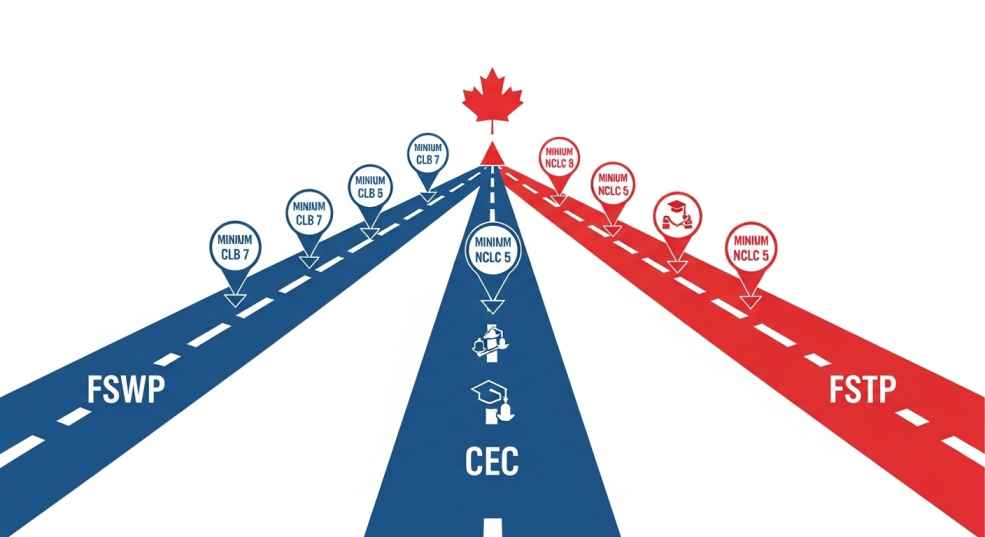
The minimum CLB level for Express Entry varies by program: CLB 7 for FSWP and CEC, CLB 4–5 for FSTP. But meeting the minimum is just the starting line — higher CLB scores translate directly into more CRS points and a better shot at an ITA.
💡 Quick Snapshot
What Is the Canadian Language Benchmark (CLB)?
Before diving into specific numbers, it helps to understand what the CLB actually is. The Canadian Language Benchmark is a national standard used by Immigration, Refugees and Citizenship Canada (IRCC) to measure English proficiency across four skills: Speaking, Listening, Reading, and Writing. There’s a parallel framework for French called Niveaux de compétence linguistique canadiens (NCLC), which uses the same structure.
CLB levels run from 1 (basic) to 12 (advanced mastery), but for immigration purposes, the meaningful range is typically CLB 4 through CLB 10+. Each level corresponds to specific scores on approved language tests — primarily IELTS General Training and CELPIP General for English, and TEF Canada or TCF Canada for French.
The critical thing to understand is that CLB is not a test itself — it’s a reference framework. When IRCC says you need a CLB 7, they mean you need to score at a level on an approved test that maps to CLB 7 in each of the four skills.
Approved Language Tests for Express Entry
As of 2026, IRCC accepts the following tests for Express Entry language assessment:
- IELTS General Training (English) — the most widely used test globally
- CELPIP General (English) — a Canadian-made, computer-delivered test
- TEF Canada (French) — Test d’évaluation de français
- TCF Canada (French) — Test de connaissance du français
Important: IELTS Academic is NOT accepted for Express Entry immigration purposes. Only IELTS General Training qualifies. This is a common and costly mistake — make sure you’re registered for the correct version.
Table 1: IELTS General Training Score to CLB Level Conversion
CLB Level | Speaking | Listening | Reading | Writing |
CLB 4 | 4.0 | 4.5 | 3.5 | 4.0 |
CLB 5 | 5.0 | 5.0 | 4.0 | 5.0 |
CLB 6 | 5.5 | 5.5 | 5.0 | 5.5 |
CLB 7 | 6.0 | 6.0 | 6.0 | 6.0 |
CLB 8 | 6.5 | 7.5 | 6.5 | 6.5 |
CLB 9 | 7.0 | 8.0 | 7.0 | 7.0 |
CLB 10 | 7.5 | 8.5 | 8.0 | 7.5 |
CLB 11 | 8.0 | 9.0 | 8.5 | 8.0 |
CLB 12 | 8.5 | 9.0 | 9.0 | 8.5 |
Source: IRCC Official IELTS to CLB Conversion Chart (ircc.canada.ca)
Table 2: CELPIP General Score to CLB Level Conversion
CLB Level | Speaking | Listening | Reading | Writing |
CLB 4 | 4 | 4 | 4 | 4 |
CLB 5 | 5 | 5 | 5 | 5 |
CLB 6 | 6 | 6 | 6 | 6 |
CLB 7 | 7 | 7 | 7 | 7 |
CLB 8 | 8 | 8 | 8 | 8 |
CLB 9 | 9 | 9 | 9 | 9 |
CLB 10 | 10 | 10 | 10 | 10 |
CLB 11 | 11 | 11 | 11 | 11 |
CLB 12 | 12 | 12 | 12 | 12 |
Source: CELPIP.ca — Official CLB Equivalency Table
Minimum CLB Level for Express Entry: Program-by-Program Breakdown
Not all Express Entry programs have the same language bar. Each of the three federal programs under Express Entry has its own minimum CLB requirement, and understanding these differences could save you months of waiting or rethinking your strategy entirely.
Federal Skilled Worker Program (FSWP)
The FSWP is the flagship Express Entry stream and the most competitive. To be eligible, you need a minimum CLB 7 in all four language skills (Speaking, Listening, Reading, and Writing). There’s no flexibility here — if even one skill falls below CLB 7, you won’t be eligible for the program.
Under the FSWP, language is also one of the six selection factors used to calculate your FSWP points (out of 100 total). A CLB 9+ in all four skills earns maximum language points under FSWP selection criteria. These FSWP points then feed into your overall CRS score.
Canadian Experience Class (CEC)
The CEC is designed for people who already have Canadian work experience, and it also requires a minimum CLB 7 in all four skills for NOC TEER 0 or 1 occupations. For NOC TEER 2 or 3 occupations, the minimum drops slightly to CLB 5.
CEC applicants tend to be strong candidates because their Canadian work history already boosts their CRS score. Combined with a solid language score, CEC candidates regularly receive ITAs even when the cut-off scores are high.
Federal Skilled Trades Program (FSTP)
The FSTP has more lenient language requirements, reflecting the practical, hands-on nature of trades work. The minimums are CLB 5 for Speaking and Listening, and CLB 4 for Reading and Writing. However, don’t let the lower minimum fool you — you’ll still benefit from higher scores when it comes to CRS points.

How CLB Level Affects Your CRS Score
Here’s where things get genuinely exciting — and strategically important. Your CLB level doesn’t just determine eligibility; it directly translates into CRS points, and those points determine whether you’ll receive an ITA.
The CRS awards language points in two categories: First Official Language (up to 136 points for a single applicant) and Second Official Language (up to 24 additional points). These aren’t trivial numbers. In many recent Express Entry draw cycles, the difference between receiving an ITA and not receiving one has been fewer than 10 CRS points.
CRS Points for First Official Language (Single Applicant)
For each skill — Speaking, Listening, Reading, Writing — you can earn up to 34 CRS points at CLB 10 or above. Dropping from CLB 10 to CLB 9 might only cost you a few points per skill, but when you multiply that across four skills, you could be looking at a 20–30 point swing in your total CRS score.
The Power of CLB 9: A Real-World Scenario
Consider two applicants who are identical in every way — same age (28), same NOC TEER 1 job, same education — except for their language scores. Applicant A scores CLB 8 across all four skills. Applicant B scores CLB 9 across all four skills.
That single CLB level difference can translate into roughly 28–40 additional CRS points depending on the specific scores. In draw cycles where the cut-off is sitting at 480, Applicant A at 455 points waits another 6+ months while Applicant B at 490 gets their ITA in the next draw. That’s the real-world cost of not maximizing your language score.
Second Official Language Bonus
Many candidates overlook the second official language bonus, but it can add up to 24 CRS points for a single applicant. If your first official language is English, writing a French language test (TEF Canada or TCF Canada) and achieving even a modest CLB 5 across all four skills can add meaningful points to your CRS score.
This strategy is particularly powerful for candidates who already have some French proficiency — even basic functional French can yield a significant CRS boost. Bilingual candidates who achieve CLB 9+ in both English and French are in elite territory.
Language Requirements for Provincial Nominee Programs (PNPs) Linked to Express Entry
Beyond the federal streams, many provinces operate Express Entry-aligned PNP streams through the Enhanced Nomination pathway. Provincial language requirements vary, but most mirror or exceed federal minimums.
Ontario’s Human Capital Priorities stream, for example, typically targets Express Entry candidates with CLB 7 or higher. British Columbia’s Skills Immigration streams often require CLB 4–7 depending on the occupation. Alberta and Saskatchewan have also used their Express Entry-linked streams to target specific NOC codes with corresponding language thresholds.
The practical takeaway: if you’re planning to use a provincial nomination to add the 600-point CRS boost, don’t assume provincial language requirements are lower or more relaxed. In some cases, specific employer or community-based streams may require demonstrated language ability beyond the federal minimums.
IELTS vs. CELPIP: Which Test Should You Choose?
This is one of the most common questions on immigration forums, and the honest answer is: it depends on your test-taking style, not on which one is ‘easier.’ Both IELTS General Training and CELPIP General are fully accepted by IRCC and convert to the same CLB levels.
Key Differences at a Glance
- Format: IELTS includes a face-to-face Speaking component with a human examiner. CELPIP is entirely computer-based, including Speaking.
- Familiarity: IELTS is globally recognized and test materials are widely available. CELPIP is newer but growing in popularity among Canadian applicants.
- Retake flexibility: Both allow retakes, but CELPIP results are available in about 8 business days, while IELTS typically takes 3–5 days for online, 13 days for paper-based.
- Canadian context: CELPIP uses Canadian English accents and scenarios, which can feel more natural for people already living in Canada.
If you’re anxious about speaking to a live examiner, CELPIP’s computer-based format may feel less stressful. If you’ve been preparing with widely available IELTS materials and practice tests, stick with what you know. Don’t switch tests to chase a perceived advantage — focus on preparation quality.
💡 Pro Tip for Test Selection
Strategies to Improve Your CLB Level Before Applying
If your current test scores don’t hit the CLB level you’re targeting, you’re not stuck. Language scores can be improved with focused preparation, and the ROI — measured in CRS points — is one of the highest of any investment you can make in your Express Entry journey.
1. Know Your Weak Skills
Most applicants have one or two skills that drag down their overall CLB profile. A common pattern is strong Reading and Listening but weaker Speaking and Writing. Target your weakest skills first — improving a CLB 6 Writing to a CLB 8 Writing will yield more CRS points than improving an already-strong CLB 10 Listening to CLB 11.
2. Use Official Practice Materials
Both IELTS and CELPIP offer official practice tests. Don’t rely solely on third-party apps or forums. The official Cambridge Practice Tests for IELTS series (books 1–19) are the gold standard. CELPIP.ca offers free and paid practice tests that mirror the actual exam format precisely.
3. Understand Scoring Rubrics
For Speaking and Writing, examiners use specific rubrics. Understanding what ‘lexical resource’ means in IELTS scoring or how ‘vocabulary range’ is assessed in CELPIP writing can help you target the exact qualities that move your band score up. Many test-takers plateau because they practice quantity without understanding quality.
4. Consider Professional Coaching
A few sessions with a qualified IELTS or CELPIP coach — especially for Speaking and Writing — can identify specific habits and errors that are capping your scores. The cost of a coaching package is trivial compared to the value of an extra 20–30 CRS points, which can mean the difference between receiving an ITA in months versus years.
5. Don’t Wait to Retest
There’s no limit to how many times you can take IELTS or CELPIP, and you can submit your best scores. If you’re one CLB level away from a significant CRS point jump, investing in a retest is almost always worth it. Many successful Express Entry candidates take the test 2–3 times before submitting their profile.
Common Mistakes Applicants Make With Language Requirements
After seeing thousands of Express Entry cases, a few recurring language-related mistakes stand out. Avoiding these could save you months of delay or outright disqualification.
Submitting Expired Test Scores
Language test results are valid for two years from the date of your test, not the date of your Express Entry profile creation. If your IELTS score was from January 2023 and you submit your application in February 2025, your score has expired. IRCC will reject the application and you’ll need to retest. Always verify your test dates before submitting.
Confusing IELTS Academic with IELTS General Training
This mistake is shockingly common. IELTS Academic and IELTS General Training are different tests designed for different purposes. IELTS Academic is for university admissions. IELTS General Training is for immigration. Only IELTS General Training is accepted by IRCC for Express Entry. If you’ve taken IELTS Academic, those scores won’t count and you’ll need to retest.
Not Testing for French When You Could Qualify
Many applicants with even basic French skills skip the French language test because they assume their French isn’t good enough to matter. But even a CLB 5 in French across all four skills can add 16–24 CRS points for a single applicant. That’s potentially a full draw cycle’s worth of CRS advantage, left on the table.
Calculating CLB Based on Overall Band Score
Your CLB level is determined by your score in each individual skill, not your overall IELTS band score. An overall IELTS band score of 7.0 might sound like CLB 9, but if your Writing is 6.0 and your Listening is 7.5, your effective CLB in Writing is only CLB 7. Each skill is evaluated independently.

Frequently Asked Questions About CLB Level for Express Entry
Can I use language scores from more than one test?
No. You must submit all four skills from a single test sitting. You cannot combine your IELTS Speaking score from one sitting with your CELPIP Writing score from another sitting.
Does IRCC accept PTE (Pearson Test of English) for Express Entry?
As of 2026, PTE Core has been added as an accepted English test for Express Entry applications. This gives applicants a third English-language option alongside IELTS General Training and CELPIP General. Always check IRCC’s official website for the most current list of accepted tests, as this has been subject to updates.
What happens if my language score expires after I submit my application but before I receive my PR?
Once you’ve submitted a complete application (after receiving an ITA), an expired language test does not affect your application — the score was valid when submitted. However, if your Express Entry profile is still in the pool and your score expires before you receive an ITA, you’ll need to retest and update your profile.
Can I update my language score while my Express Entry profile is active in the pool?
Yes. You can update your language test results in your Express Entry profile at any time before you receive an ITA. If you retake the test and score higher, update your profile immediately — it could increase your CRS score and bring you closer to an ITA cut-off.
Conclusion: CLB Is Your Most Controllable CRS Variable
Of all the factors that determine your Express Entry success — age, education, work experience, job offers — language proficiency is the one you have the most control over right now. You can’t change your age, and acquiring a valid job offer can take months. But you can pick up a test prep book today, register for an exam next month, and potentially add 20–40 points to your CRS score in a matter of weeks.
Here’s what to take away from this guide. The minimum CLB level for Express Entry is CLB 7 for FSWP and CEC (CLB 4–5 for FSTP), but the minimum is just the entry point. Every CLB level above the minimum translates into real CRS points — and CRS points translate directly into ITAs. CLB 9 in your first official language and CLB 7+ in a second official language is the sweet spot that competitive applicants aim for.
Choose your test wisely — IELTS General Training, CELPIP General, PTE Core, TEF Canada, or TCF Canada — and prepare with official materials and targeted coaching. Understand the CLB conversion charts so you know exactly where your scores stand. And never leave French language points on the table if there’s even a chance you can qualify.
The Express Entry pool is competitive, and cut-off scores fluctuate with every draw. But candidates who maximize their language score give themselves a genuine structural advantage — regardless of what happens with other factors. Your CLB level isn’t just a number; in 2026, it’s one of the clearest paths to a Canadian permanent resident visa.
📌 Key Takeaways • Minimum CLB 7 required for FSWP and CEC (all four skills) • FSTP requires CLB 5 Speaking/Listening and CLB 4 Reading/Writing • Language scores directly add up to 136 CRS points (first language) + 24 bonus points (second language) • IELTS General Training, CELPIP General, and PTE Core all accepted for English • Language scores are valid for 2 years from test date • CLB 9+ in first language and CLB 7+ in second language is the high-impact target • Never submit IELTS Academic scores for Express Entry — only General Training counts |
Sources & Further Reading
- IRCC — Express Entry: Who can apply (Federal Skilled Worker): canada.ca/express-entry/fswp
- IRCC — CRS Tool and Points Grid: ircc.canada.ca/crs-tool
- CELPIP — Official CLB Equivalency Table: celpip.ca/results/clb
- IELTS — Immigration to Canada: ielts.org/canada-immigration
- IRCC — Canadian Language Benchmarks: canada.ca/clb-standards


