







If you work in science, technology, engineering, or mathematics and have been watching Canada’s immigration landscape, February 18, 2026 was a date worth circling on your calendar. On that day, Immigration Minister Lena Metlege Diab took the stage at the Canadian Club in Toronto and laid out a refreshed vision for Express Entry — one that firmly re-confirmed STEM as a priority pathway to Canadian permanent residence.
For STEM professionals, the news is largely positive: the category is officially renewed, dedicated draws are back on the agenda for 2026, and the competitive pool is expected to shrink — which could mean lower CRS cut-offs for eligible candidates. But there is one significant change that every applicant needs to know about before submitting a profile.
This guide breaks down everything you need to know about STEM Express Entry 2026: the renewed requirements, eligible occupations, strategic implications, and the step-by-step path to your Canadian PR.
What Is the STEM Express Entry Category?
Canada’s Express Entry system manages applications for three federal immigration programs: the Federal Skilled Worker Program (FSW), the Canadian Experience Class (CEC), and the Federal Skilled Trades Program (FST). Since May 2023, IRCC has layered a category-based selection system on top of Express Entry, allowing the government to hold targeted invitation rounds for candidates with experience in specific, high-demand sectors.
The STEM category is one of these targeted streams. Rather than competing purely on CRS score in a general draw, STEM-eligible candidates are ranked separately within their category pool and can receive an Invitation to Apply (ITA) at CRS thresholds that are often lower than in general draws. This is a significant advantage for skilled tech workers and scientists who may not score as high as, say, a bilingual applicant with a Canadian master’s degree.
The category targets professionals in roles that drive Canada’s knowledge economy — software developers, engineers, data scientists, cybersecurity specialists, and more. The full occupational list covers dozens of NOC 2021 codes (see Table 2 below).
The Big Change: Work Experience Requirement Doubles in 2026
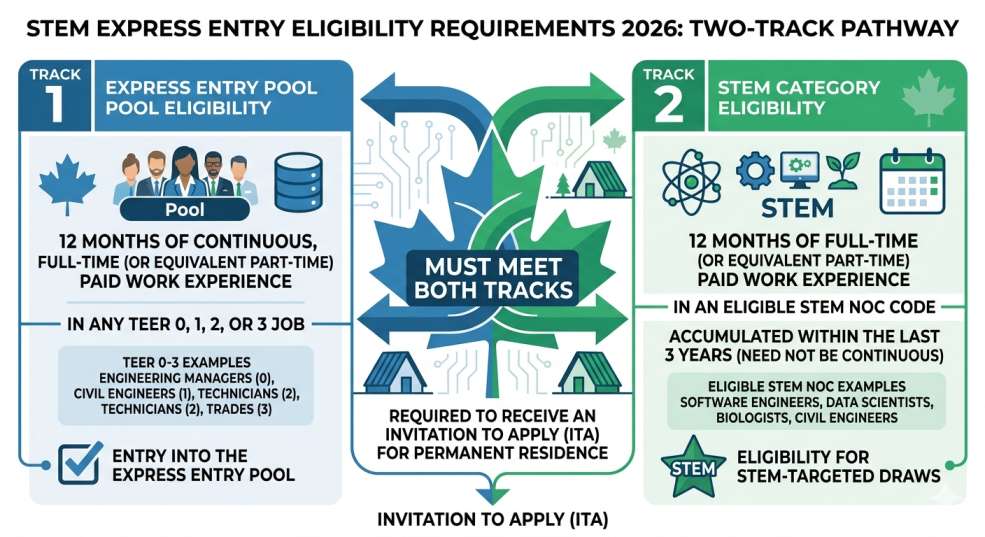
Here is the headline update for STEM Express Entry 2026 that every applicant must understand: the minimum work experience requirement for all renewed category-based draws — including STEM — has been increased from six months to 12 months.
Starting February 18, 2026, you need at least 12 months of full-time work experience (or equivalent part-time hours) in an eligible STEM occupation within the last three years to qualify for a STEM category draw. The previous threshold was just six months.
ℹ️ Key Rule Change
This change applies specifically to category-based eligibility — it is separate from the general Express Entry pool requirements, which still require at least 12 months of skilled work experience in any TEER 0, 1, 2, or 3 occupation to create a profile. In practice, this means:
- You must have 12 months of experience in a qualifying STEM occupation (not just any skilled job).
- This experience does not need to be continuous — it just needs to add up to 12 months within the last three years.
- For the STEM category, the experience can be gained in Canada or abroad (unlike some new 2026 categories that require Canadian work experience specifically).
The government’s stated rationale is straightforward: IRCC believes candidates with a full year of occupation-specific experience are more likely to succeed in that same field once they become permanent residents. It is a quality-over-quantity adjustment, and one that could meaningfully reshape who gets invited.

2025 vs. 2026: What Changed for STEM Express Entry?
To understand where things stand now, it helps to look at the contrast between 2025 and 2026. Notably, despite STEM being listed as a priority category in 2025, IRCC did not hold a single STEM-specific draw throughout the entire year. That was a frustrating reality for thousands of qualified candidates who had optimized their profiles for category selection.
The 2026 announcement changes the picture. STEM has been re-confirmed as a priority category, and IRCC’s public messaging — along with the broader framework of the International Talent Attraction Strategy outlined in Budget 2025 — signals genuine intent to hold STEM draws in 2026.
Here is a direct comparison of the key parameters:
Table 1: Express Entry STEM Category — 2025 vs. 2026 Comparison
Criteria | 2025 Requirements | 2026 Requirements |
Min. Work Experience (Category) | 6 months | 12 months ✅ Doubled |
Experience Location (STEM) | Canada or abroad | Canada or abroad (unchanged) |
Experience Window | Last 3 years | Last 3 years (unchanged) |
STEM Draws in Year | 0 draws held in 2025 | Confirmed priority for 2026 |
Agriculture Category | Active | Retired ❌ |
Cybersecurity included | Yes | Yes (explicitly noted) |
CRS Score Competition | Higher pool, higher cutoffs | Smaller pool = lower expected cutoffs |
Min. CRS (General Draws) | Varies (~480–510 range) | Expected to decrease in targeted draws |
Source: IRCC Ministerial Announcement, February 18, 2026 | canada.ca/express-entry
Which STEM Occupations Are Eligible for Express Entry 2026?
The STEM category covers a broad range of science and technology occupations under Canada’s NOC 2021 classification system. Eligibility is determined by your NOC code — not your job title. Your actual duties must match the NOC description, so it is worth reviewing the official NOC profile for your role before submitting your profile.
Below is a representative list of key STEM occupations eligible for category-based draws. Note that this list is extensive and includes additional engineering subspecialties and scientific roles beyond those shown. Always verify against IRCC’s official published list, as occupations can be added or adjusted.
Table 2: Key STEM Occupations Eligible for Express Entry Category Draws (2026)
Occupation Title | NOC 2021 Code | TEER Level |
Software Engineers and Designers | 21231 | TEER 1 |
Software Developers and Programmers | 21232 | TEER 1 |
Cybersecurity Specialists | 21220 | TEER 1 |
Data Scientists | 21211 | TEER 1 |
Civil Engineers | 21300 | TEER 1 |
Mechanical Engineers | 21301 | TEER 1 |
Electrical and Electronics Engineers | 21310 | TEER 1 |
Computer and Information Systems Managers | 20012 | TEER 0 |
Database Analysts and Data Administrators | 21223 | TEER 1 |
Web Developers and Programmers | 21234 | TEER 1 |
Architects | 21200 | TEER 1 |
Mathematicians, Statisticians and Actuaries | 21210 | TEER 1 |
Biological Scientists | 21110 | TEER 1 |
Chemists | 21100 | TEER 1 |
Physicists and Astronomers | 21102 | TEER 1 |
Source: IRCC / canada.ca — Category-Based Selection | libertyimmigration.ca | Note: List is representative. Verify complete list at canada.ca

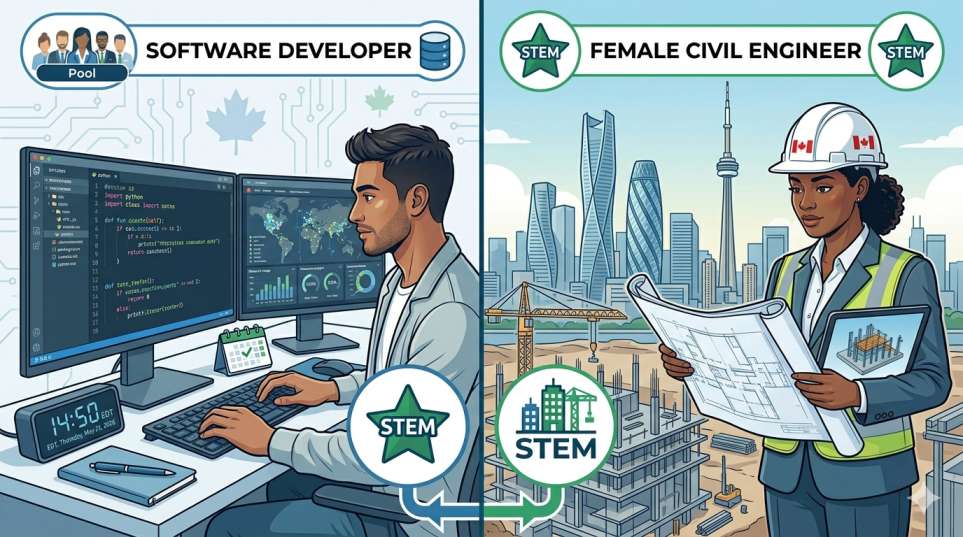
How CRS Scores Are Expected to Shift in 2026 STEM Draws
Why the Eligible Pool Will Shrink
The doubling of the minimum experience requirement from six to twelve months is more than a bureaucratic tweak — it has real implications for CRS score dynamics. Here is the logic:
In previous STEM draws, candidates with as little as six months of experience in an eligible occupation could compete. That created a large, diverse pool. With the bar now set at 12 months, a meaningful portion of that pool — those with six to eleven months of experience — no longer qualifies for category selection.
Immigration consultants at ICC Immigration estimate that a STEM draw that previously had 50,000 eligible candidates might now attract a pool of around 35,000. If IRCC maintains the same invitation volume per draw (historically between 1,000 and 5,000 ITAs per round), the government would need to go deeper into the CRS rankings to issue the same number of invitations — driving cut-off scores down.
What This Means Strategically
For candidates with 12 or more months of STEM experience and a CRS score in the moderate range — let’s say 450 to 490 — this could be genuinely transformative. A score that would have languished in the general pool for months may now be competitive within a targeted STEM draw.
That said, there is an important caveat: IRCC retains full discretion over how many invitations to issue and when to hold draws. If IRCC scales down invitation volumes proportionally to match the smaller pool, CRS scores could remain stable. The takeaway for applicants is to stay informed and watch draw patterns closely as 2026 progresses.
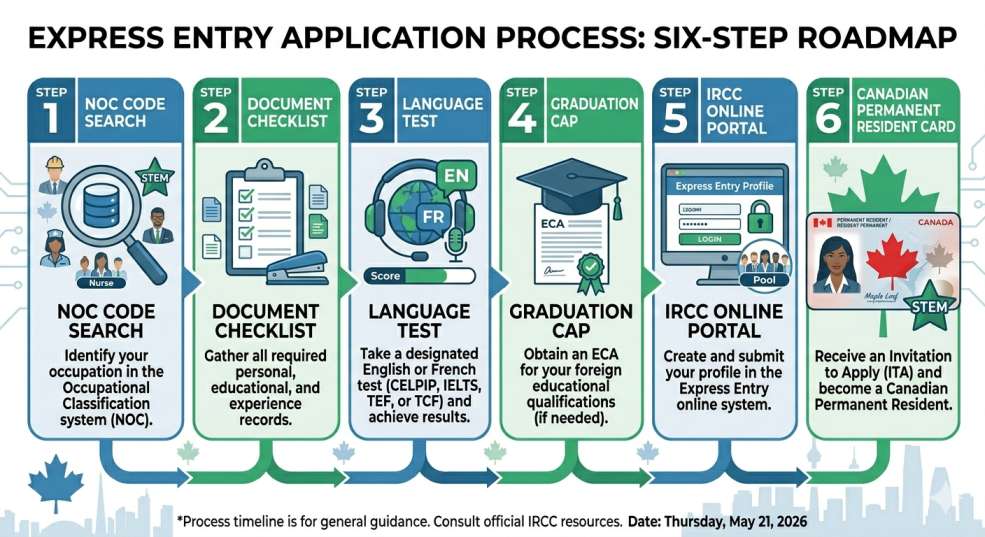
Step-by-Step: How to Apply for STEM Express Entry 2026
If you believe you qualify for the STEM category, here is the path forward:
Step 1: Confirm Your NOC Code
Everything in Express Entry flows from your National Occupational Classification code. Visit the official NOC 2021 database at noc.esdc.gc.ca and search by occupation title. Read the lead statement and main duties carefully — your actual daily responsibilities must align with the description, not just your job title.
Step 2: Verify 12 Months of STEM Experience
Count your full-time equivalent hours in your qualifying STEM occupation over the last three years. You need at least 1,560 hours (30 hours/week × 52 weeks) to meet the 12-month full-time threshold. Part-time experience counts proportionally. Document employment letters, pay stubs, and tax records to support this.
Step 3: Meet Express Entry Program Eligibility
You must qualify for at least one of the three Express Entry programs — Federal Skilled Worker (FSW), Canadian Experience Class (CEC), or Federal Skilled Trades (FST). Most STEM workers apply through FSW (if applying from abroad) or CEC (if already working in Canada). Each has its own eligibility requirements for minimum work experience, language scores, and education.
Step 4: Take Your Language Test
Valid English or French language test results are mandatory. For English, IELTS General Training or CELPIP are accepted. For French, TEF Canada or TCF Canada are required. Aim for CLB 9 or higher — each point increase in language score can add 30 or more points to your CRS total, which is often the difference between a wait and an invitation.
Step 5: Get an Educational Credential Assessment (ECA)
If your highest credential was earned outside Canada, you will need an ECA from a designated organization such as WES, IQAS, or ICAS. This step can take four to eight weeks, so plan ahead.
Step 6: Submit Your Express Entry Profile
Create your profile through your secure IRCC account at ircc.canada.ca. Complete all fields accurately, declare your STEM work experience, and enter your language scores. Once you are placed in the pool, your CRS score is calculated automatically.
Step 7: Monitor Draws and Keep Your Profile Current
Your profile is valid for 12 months. If you receive an ITA, you have 60 days to submit a complete permanent residence application. If your profile expires without an invitation, you can resubmit. Keep your profile updated — any changes in language scores, job experience, or education must be reflected promptly.
STEM Express Entry 2026: Real-World Scenario
Let us put this in practical terms with a hypothetical case study that illustrates how the 2026 changes play out.
Case Study: Priya, a Software Developer from India
Priya has been working as a software developer (NOC 21232) for three years — two years in India and one year in Canada on a work permit. She has an IELTS score of CLB 9 in all bands and a bachelor’s degree in computer science assessed by WES. Her CRS score is 468.
Under the 2025 rules, Priya already exceeded the six-month experience threshold. Under the 2026 rules, she still qualifies because she has more than 12 months of experience in her eligible STEM occupation (her three years total well exceeds the requirement, and the experience can be from Canada or abroad).
In a 2026 STEM category draw, if the cut-off lands at 460, Priya would receive an ITA. In a general draw where cut-offs hover around 490 to 510, she would not. The STEM category draw is her ticket — and the shrinking pool under the new 12-month rule could make that draw more accessible than ever.
Now consider Priya’s colleague Raj, who only has eight months of software development experience. Under the old rules, Raj would have been eligible. Under the new 2026 rules, he is not yet eligible for a STEM category draw. His best move is to accumulate another four months of experience while focusing on boosting his language scores in the general pool.
STEM Category in Context: Where It Fits in Canada’s 2026 Immigration Plan
It is worth placing the STEM category in the broader context of Canada’s 2026 immigration strategy. The overall admissions targets remain capped within the 2026–2028 Immigration Levels Plan — meaning the total number of permanent residents admitted will not increase. What changes is how those spots are allocated.
The February 18, 2026 announcement introduced five new categories (physicians with Canadian work experience, researchers with Canadian work experience, senior managers, transport occupations, and skilled military recruits) while retiring only one existing category (agriculture and agri-food). STEM, healthcare, education, trades, and French-proficiency all continue.
For STEM applicants, this means more competition for the overall invitation pool — but also the continued advantage of category-based selection, which historically produces lower cut-offs than general draws. The key insight from industry experts is that IRCC’s decision to explicitly confirm STEM as a 2026 priority — after zero draws in 2025 — is a meaningful positive signal.
Frequently Asked Questions: STEM Express Entry 2026
Can I use work experience from outside Canada for the STEM category?
Yes. Unlike some of the new 2026 categories (such as researchers and senior managers, which require Canadian work experience), the STEM category allows experience gained in Canada or abroad within the last three years. This makes it accessible to internationally trained professionals who have not yet worked in Canada.
Do I need a job offer to qualify for the STEM category?
No. A job offer is not required for the STEM category, though having one can add 50 to 200 CRS points depending on the occupation level, significantly boosting your chances of an invitation in both general and category draws.
Were there any STEM draws in 2025?
No. Despite STEM being listed as a priority category in 2025, IRCC did not hold any STEM-specific draws that year. This was linked to the overall reduction in Express Entry invitation volumes during 2025. The 2026 re-confirmation signals intent to resume STEM-targeted rounds.
What if my experience is split between two STEM occupations?
Each period of experience must be counted separately by NOC code. The 12-month requirement applies to a single occupation — you cannot combine experience across different NOC codes to meet the threshold. If you have six months as a software developer and six months as a data scientist, you would not currently meet the 12-month single-occupation requirement for either.
Is cybersecurity explicitly included in the 2026 STEM category?
Yes. IRCC explicitly confirmed that cybersecurity workers are included in the STEM category for 2026. Cybersecurity specialists fall under NOC 21220 (TEER 1) and are among the occupations most actively sought as Canada strengthens its digital infrastructure.
Key Takeaways: STEM Express Entry 2026 at a Glance
- STEM is officially confirmed as a priority category for 2026 — after no draws were held in 2025, this is a meaningful reaffirmation.
- The minimum work experience requirement has doubled: you now need 12 months in an eligible STEM occupation within the last three years (up from six months).
- Work experience for the STEM category can be gained in Canada or abroad — unlike some other 2026 categories that require Canadian experience.
- The larger experience threshold means a smaller eligible pool, which immigration experts expect to push CRS cut-offs lower in STEM draws.
- Cybersecurity is explicitly included in the 2026 STEM category, reflecting Canada’s focus on digital economy growth.
- Agriculture and agri-food is the only category retired for 2026; STEM, healthcare, trades, and education all continue.
- Candidates with six to eleven months of STEM experience should focus on accumulating experience and improving CRS scores in the interim.
Conclusion
The Express Entry STEM category in 2026 represents a genuine opportunity for skilled science and technology professionals who want to build their future in Canada. The renewed requirements are tighter in one important way — the 12-month experience threshold — but they are structured in a way that rewards depth of expertise over breadth. If you have a solid year or more in a qualifying STEM role, you are in a stronger competitive position than in many prior years.
Canada’s technology and innovation sectors continue to face acute talent shortages, and IRCC’s decision to re-prioritize STEM draws reflects a clear-eyed understanding of where the labour market gaps lie. For software engineers, data scientists, civil engineers, cybersecurity specialists, and dozens of other professionals, this pathway to Canadian permanent residence deserves serious attention in 2026.
Stay current with draw announcements on the official IRCC website at canada.ca/express-entry, build your profile strategically, and consult a Regulated Canadian Immigration Consultant (RCIC) if you need personalized advice on maximizing your eligibility.

Sources & Further Reading
- IRCC — Category-Based Selection (Official): canada.ca/en/immigration-refugees-citizenship/services/immigrate-canada/express-entry/rounds-invitations/category-based-selection.html
- CIC News — Three New Express Entry Categories 2026: cicnews.com/2026/02/three-new-express-entry-categories-0271729.html
- Moving2Canada — STEM Express Entry Draws 2026: moving2canada.com/immigration/express-entry/stem-specific-draws/
- ICC Immigration — CRS Cutoff Expected to Drop in 2026: iccimmigration.ca/crs-cutoff-expected-to-drop-in-2026-what-this-means-for-express-entry-candidates/
- Immigration.ca — Canada Revamps Express Entry With 5 New Categories: immigration.ca/canada-revamps-express-entry-with-5-new-categories-for-2026/
- Fragomen — Canada Updates to Express Entry Category-Based Selection: fragomen.com/insights/canada-updates-to-express-entry-category-based-selection-for-2026.html
Disclaimer: This article is for informational purposes only and does not constitute immigration legal advice. Immigration rules are subject to change. Always consult the official IRCC website (canada.ca) or a Regulated Canadian Immigration Consultant (RCIC) for the most current guidance and personalized advice.