


Most people don’t get refused because they weren’t qualified. They get refused because they applied under the wrong category.
That sounds like a small distinction. It isn’t. A U.S. software engineer whose employer spends $1,000 and five months chasing an LMIA — when a CUSMA professional permit could have been issued at the airport in an afternoon. A college graduate who assumes their diploma qualifies for a post-graduation work permit, only to learn their program’s CIP code isn’t on IRCC’s list. A spouse who renewed an open work permit three times without issue and gets refused on the fourth, because a rule changed in March 2026 that nobody told them about.
Canada issues well over a million work permits and extensions a year, and the system behind them is genuinely more navigable than it looks — but only once you understand that every named permit you’ve ever heard of is really one of two legal categories wearing a different label. Get the category right and everything downstream (cost, timeline, who applies first, whether you can switch jobs) falls into place.
This guide walks through all the major types of work permits in Canada as they stand in 2026: what each one is, who qualifies, what it costs, how long it takes, and — most importantly — how to work out which one is yours.
What a Canadian Work Permit Actually Is (and Who Needs One)
A work permit is a document issued by Immigration, Refugees and Citizenship Canada (IRCC) that authorizes a foreign national to work in Canada for a defined period. It is not a visa. A visa (or eTA) lets you travel to Canada; a work permit lets you work here. Many people need both, and they’re issued through different processes.
Almost every foreign national doing paid work in Canada needs one. There’s a narrow list of work-permit-exempt activities — certain business visitors, some performing artists, foreign government officers, some short-term researchers — but the default assumption should be that you need a permit. Working without valid authorization can lead to removal and a re-entry ban, and it also poisons future applications.
One more framing point worth internalizing early: a work permit is temporary status, not a shortcut to permanent residence. What makes it valuable is the skilled Canadian work experience it lets you build, which is among the most heavily rewarded factors in Express Entry and most Provincial Nominee Programs. The permit is the vehicle; the experience is the destination.
The Two Types of Work Permit in Canada That Everything Else Flows From
Ask IRCC how many types of work permit exist in Canada and the official answer is two. Every other name — PGWP, spousal, bridging, CUSMA, IEC, Francophone Mobility — is a sub-category of one of these two.
1. Open work permits
An open work permit lets you work for almost any employer, in almost any job, anywhere in Canada. No job offer required. No LMIA required. No employer sponsorship required.
The exceptions are narrow but real: you can’t work for an employer on IRCC’s non-compliant employers list, or for one who regularly offers striptease, erotic dance, escort or erotic massage services. Some open permits also carry conditions — a medical exam requirement before you can work in healthcare, childcare or agriculture, or a geographic restriction limiting you to a nominating province.
Here’s the catch that surprises people: open work permits are not available on request. You can’t simply “apply for an open work permit” because you’d like flexibility. You have to fall into a specific eligible category, and those categories have narrowed substantially since 2024.
2. Employer-specific (closed) work permits
An employer-specific permit — often called a closed work permit — names your employer, your job, your location and your dates on the permit itself. Change any of those, and you generally need a new permit.
In exchange for that rigidity, you get a route that’s available to far more people. You don’t need to fit a special category; you need an employer willing to hire you and complete their side of the paperwork.
TABLE 1: Open vs Employer-Specific Work Permits — Side by Side
| Feature | Open Work Permit | Employer-Specific Work Permit |
|---|---|---|
| Job offer required? | No | Yes |
| LMIA required? | No | Sometimes (TFWP yes, IMP no) |
| Can you change employers? | Yes, freely | No — requires a new permit |
| Who must act first? | You | Your employer (LMIA or Employer Portal offer) |
| Employer pays | Nothing | $1,000 LMIA fee, or $230 compliance fee if LMIA-exempt |
| Applicant pays | $155 permit + $100 open permit holder fee + $85 biometrics | $155 permit + $85 biometrics |
| Where you can apply from | Usually inside Canada only | Inside or outside Canada; some at port of entry |
| Typical processing (2026) | 4–6 months (varies by stream) | 3–6 weeks inland; 6–12 weeks overseas |
| Main risk | You must fit a listed category | You’re tied to one employer |
| Examples | PGWP, spousal OWP, BOWP, IEC Working Holiday | LMIA-based permits, CUSMA, ICT, Francophone Mobility |
Source: IRCC fee bulletin — Work permit R196 and R299(1). Confirm current fees on canada.ca before applying.
Behind Every Permit: The TFWP vs the International Mobility Program
Underneath the open/closed split sits a second distinction that determines your cost and timeline far more than the first one does.
The Temporary Foreign Worker Program (TFWP)
The TFWP is the LMIA route. Before you can apply, your employer must obtain a positive Labour Market Impact Assessment from Employment and Social Development Canada, proving no Canadian citizen or permanent resident was available for the role. The employer pays $1,000 per position — non-refundable, even on refusal — and cannot legally pass that cost to you. If an employer asks you to pay it, that is a red flag serious enough to walk away from.
Requirements tightened again in 2026: low-wage positions now require at least eight consecutive weeks of advertising plus youth-focused recruitment, up from four. Employer-side scrutiny has risen sharply, and LMIA approvals have fallen. The 2026–2028 Immigration Levels Plan sets the TFWP target at just 60,000 new arrivals for 2026.
The International Mobility Program (IMP)
The IMP covers everything that’s LMIA-exempt. Instead of proving a labour shortage, these permits are justified by a broader benefit to Canada — honouring a trade agreement, enabling a corporate transfer, supporting Francophone communities outside Quebec, keeping families together.
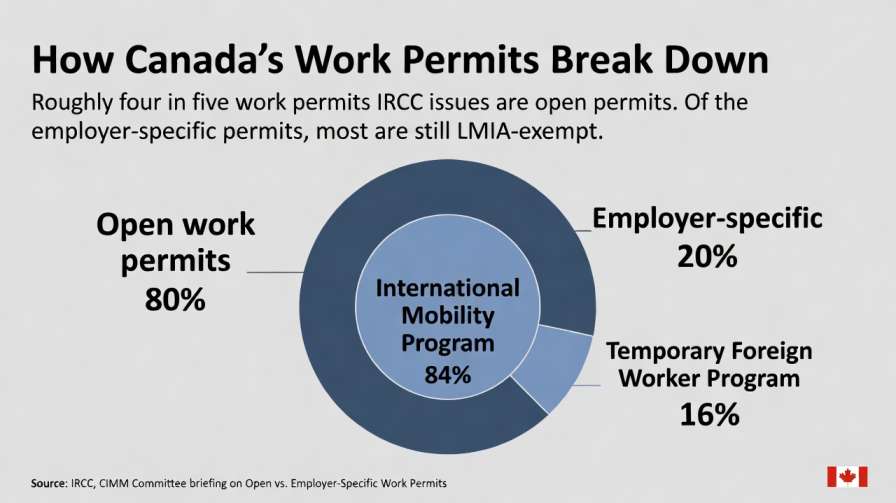
The IMP is where most of the action is. IRCC’s own 2026 transition materials record IMP work permit holders growing from roughly 500,000 in 2019 to just over 1.23 million in 2025 — a 153% increase. The 2026 IMP target is 170,000 new arrivals, nearly triple the TFWP figure.
For employers, the practical upshot is stark: an LMIA-exempt hire costs $230 and moves in weeks. An LMIA-based hire costs $1,000, takes months, and may still be refused. Checking for an exemption before filing an LMIA is the single highest-value thing an employer can do.
Open Work Permit Types in Canada, Explained
Post-Graduation Work Permit (PGWP)
The PGWP is the largest single category of open work permit in Canada — around 40% of all open permit holders — and the most common bridge from a study permit to permanent residence. It’s a one-time-in-a-lifetime benefit, and its length matches your program up to a maximum of three years, with master’s graduates receiving the full three years even from shorter programs.
Three requirements trip people up in 2026:
- Language. Since November 1, 2024, every PGWP applicant must submit a language test less than two years old: CLB/NCLC 7 in all four skills for university graduates, CLB/NCLC 5 for college and polytechnic graduates.
- Field of study. Non-degree graduates (college certificates and diplomas) must have studied a program whose CIP code appears on IRCC’s eligible-fields list. Bachelor’s, master’s and doctoral degree graduates are exempt entirely. IRCC froze this list on January 15, 2026 — no additions or removals until at least January 2027, which is good news for certainty and bad news if your program isn’t on it.
- The 180-day window. You must apply within 180 days of receiving written confirmation of program completion. Miss it by a day and you’re refused. Your PGWP also cannot extend past your passport’s expiry date.
Ask your registrar for your program’s CIP code before you enrol, not after you graduate. This one question has saved more study-to-PR plans than any other. Separately worth knowing: IRCC eliminated the standalone co-op work permit on April 1, 2026 — no separate application, no fee, no processing wait for eligible students.
💡 PRACTICAL TIP
Spousal Open Work Permit (SOWP)
This is the category that has changed most, and where I see the most avoidable heartbreak. Until the end of 2024, the spouse of almost any study or work permit holder could get an open permit. Three rounds of restrictions since have narrowed it dramatically:
- From January 21, 2025: spouses of workers qualify only if the principal worker is employed in a TEER 0 or TEER 1 occupation, plus a limited list of TEER 2 and 3 roles in priority sectors. Spouses of students qualify only if the student is in a master’s program of 16 months or longer, a doctoral program, or a listed professional degree program. College diplomas, certificates and most undergraduate degrees no longer qualify.
- From March 4, 2026: a spousal application under the C42 category is refused if the principal student is in their final academic term when IRCC receives it — and this applies to renewals, not just first applications.
Permits issued before the changes remain valid until expiry. And critically, none of this applies to sponsored spouses — if you’re in Canada with a spousal sponsorship PR application in progress, a separate public policy (code A74) still lets you apply for an open permit, currently extended through December 31, 2026.
Bridging Open Work Permit (BOWP)
The BOWP exists for one purpose: you’ve applied for permanent residence, your PR decision is still months away, and your current work permit is about to expire. The BOWP keeps you working legally in the gap.
You need an eligible PR application in progress (CEC, FSWP, FSTP, PNP, AIP, caregiver classes or Quebec skilled worker) and you must apply before your current permit expires. Validity runs up to 24 months or until the PR decision, whichever comes first.
Timing advice: apply four to six months before expiry. Earlier than that and you may not yet meet the eligibility stage; later and you risk a gap. Officers in 2026 are also asking for evidence that the PR application is genuinely progressing, not just filed.
International Experience Canada (IEC)
IEC is the youth mobility route: citizens of around 36 partner countries, typically aged 18–30 or 18–35, can live and work in Canada for up to two years. The Working Holiday category issues an open permit; Young Professionals and International Co-op are employer-specific.
IEC runs on a pool-and-invitation lottery with country-specific quotas that can fill fast. Pools open for each season in the preceding December. If you had a 2025 profile that wasn’t drawn, you need a new one — profiles don’t carry over.
Other open permit categories
Smaller but important: vulnerable worker permits for people experiencing abuse on an employer-specific permit, permits for refugee claimants and protected persons, destitute student permits, and occupation-restricted open permits (code C90) tied to certain caregiver pilots. One 2026 change to note: dependent children are generally no longer eligible for open permits based solely on a parent’s status.

Employer-Specific Work Permit Types
LMIA-based work permits (TFWP)
The standard route. Employer gets a positive LMIA, you apply for the permit naming that employer and job. High-wage and low-wage streams carry different advertising, wage and housing obligations, and employers face ESDC inspections with penalties up to $100,000 per violation.
One important 2026 change for planners: an LMIA-backed job offer no longer adds CRS points in Express Entry. If your entire strategy was “get an LMIA for the 50 points,” that strategy is obsolete. LMIA work still builds valuable Canadian experience for CEC and PNP purposes — but the direct points bonus is gone.
Trade agreement permits — CUSMA, CETA, CPTPP, CUKTCA
If you’re American or Mexican and your occupation appears on the CUSMA professionals list (60+ occupations), you may be able to obtain a permit without an LMIA, often at the port of entry in a single visit. CETA covers EU citizens, CPTPP covers 11 member states, and CUKTCA covers UK nationals. These use the T-series exemption codes (T34 traders, T35 investors, T36 professionals, T37/T38 intra-company transferees) — the codes were renumbered in December 2022, so older guides will steer you wrong.
Intra-company transferees (ICT)
A multinational moving an executive, senior manager or specialized-knowledge employee into a related Canadian entity. LMIA-exempt under code C12 (or the CUSMA equivalent). Duration caps: seven years for executives and senior managers, five for specialized knowledge workers.
Francophone Mobility (C16)
A genuinely underused route. Employers outside Quebec can hire French-speaking or bilingual foreign nationals for positions outside Quebec with no LMIA and no employer compliance fee. You need French test results meeting the operational threshold. For French speakers, this is often the fastest and cheapest employer-specific option available.
Provincial nominee–linked permits (T13)
If a province has nominated you and your PR application is in progress, a nomination-linked permit lets you start working — though it may restrict you to the nominating province.
TABLE 2: Every Major Work Permit Type in Canada, Compared
| Permit type | Open or closed? | Job offer? | LMIA? | Typical validity | Who it’s for |
|---|---|---|---|---|---|
| PGWP | Open | No | No | 8 months – 3 years | Graduates of eligible Canadian DLI programs |
| Spousal OWP (C42/C41) | Open | No | No | Matched to partner’s permit | Spouses of TEER 0/1 workers or master’s/PhD students |
| Sponsored spouse OWP (A74) | Open | No | No | Until PR decision | Spouses in Canada with a sponsorship PR application |
| Bridging OWP (A75) | Open | No | No | Up to 24 months | PR applicants with an expiring work permit |
| IEC Working Holiday | Open | No | No | Up to 24 months | Youth aged 18–30/35 from partner countries |
| IEC Young Professionals | Closed | Yes | No | Up to 24 months | Youth with a related job offer |
| Vulnerable worker OWP | Open | No | No | Up to 12 months | Workers facing abuse on a closed permit |
| LMIA work permit (TFWP) | Closed | Yes | Yes | Length of the offer | Workers with an employer who secured an LMIA |
| CUSMA professional (T36) | Closed | Yes | No | Up to 3 years, renewable | U.S./Mexican citizens in listed occupations |
| Intra-company transferee (C12/T37) | Closed | Yes | No | 5–7 years max | Executives, managers, specialized knowledge staff |
| Francophone Mobility (C16) | Closed | Yes | No | Up to 2 years | French-speaking hires outside Quebec |
| PNP-linked permit (T13) | Closed | Yes | No | Up to 2 years | Provincial nominees awaiting PR |
How to Work Out Which Work Permit Type Is Yours
Run these questions in order. The first “yes” is usually your answer.
- Did you just graduate from an eligible Canadian DLI program? → PGWP (check your CIP code and language test first).
- Is your spouse or partner a TEER 0/1 worker, a master’s/doctoral student, or sponsoring you for PR? → Spousal open work permit.
- Do you have a PR application in progress and an expiring work permit? → Bridging open work permit.
- Are you 18–35 and a citizen of an IEC partner country? → IEC.
- Do you have a Canadian job offer? If yes, ask whether an exemption applies before anyone files an LMIA: trade agreement? Intra-company transfer? French-speaking role outside Quebec? Significant benefit?
- None of the above? → Employer-specific permit through the LMIA route, or reconsider a study-then-PGWP plan.
What It Costs and How Long It Takes
TABLE 3 (optional — can be merged into TABLE 1): 2026 Fee Reference
| Fee | Amount (CAD) | Who pays |
|---|---|---|
| Work permit processing | $155 | Applicant |
| Biometrics | $85 | Applicant |
| Open work permit holder fee | $100 | Applicant |
| Restoration of status | $239.75 | Applicant |
| LMIA processing | $1,000 per position | Employer (never the worker) |
| Employer compliance fee (IMP) | $230 per worker | Employer |
| Performing artists group (3+) | $465 | Applicants |
Source: IRCC fee bulletin — Work permit R196 and R299(1) and ESDC LMIA fee pages. Verify current amounts before paying.
Timelines in 2026, roughly: employer portal offers confirm in 1–3 business days. CUSMA professional permits are often issued same-day at the port of entry. Global Talent Stream carries a two-week service standard. In-Canada employer-specific permits run 3–6 weeks; overseas applications 6–12 weeks depending on visa office. PGWP processing has been averaging 80–120 days. Bridging permits have been running 4–6 months.
Three Scenarios That Show Why Category Choice Matters
Priya, college graduate, Brampton. Two-year business administration diploma, applied for her study permit in March 2025. Because she applied after November 1, 2024 and her credential is a diploma rather than a degree, her PGWP hinges entirely on whether her CIP code is on the frozen eligible-fields list. She checks with her registrar in her second-last semester — not after convocation — and books her IELTS at the same time. That sequencing is the whole ballgame.
Daniel, U.S. mechanical engineer, hired by a firm in Calgary. His employer’s HR team started an LMIA. A licensed consultant flagged that mechanical engineer is a listed CUSMA profession. The employer withdrew, saved $1,000 and four months, and Daniel entered on a T36 permit.
Amara and Kofi, Ottawa. Kofi is on a work permit in a TEER 1 role; Amara held a spousal open permit. When Kofi moved to a TEER 3 position not on the priority list, Amara’s renewal was refused. The job change looked minor. It wasn’t. Any change to the principal’s occupation should trigger a review of the dependent’s permit eligibility before the change happens.
From Work Permit to Permanent Residence
This is the part most guides bury. Your permit type shapes your PR odds more than most applicants realise.
Open permits — especially the PGWP — let you chase the right job rather than accept the first one. Since skilled work experience in TEER 0, 1, 2 or 3 occupations is what feeds Canadian Experience Class and most PNP streams, the ability to change employers is a strategic asset, not just a convenience.
Closed permits deliver the same experience but with less room to manoeuvre. And with the LMIA points bonus gone from Express Entry, the case for enduring a closed permit purely for CRS reasons has weakened considerably. Two narrow exceptions remain where a job offer can still add points: intra-company transferees under an international agreement, and qualifying Francophone Mobility offers.
The practical takeaway: think two permits ahead. Which permit gets you working now, which one bridges you to a PR decision, and does the experience you’ll accumulate in between actually qualify for the program you’re targeting?
Key Takeaways
- There are two legal types of work permit in Canada — open and employer-specific. Every named permit is a version of one of them.
- Open permits aren’t open to everyone. You must fit a listed category, and those categories narrowed significantly in 2025 and 2026.
- Check for an LMIA exemption before anyone files an LMIA. It’s the difference between $230 and two weeks versus $1,000 and five months.
- PGWP applicants: verify your CIP code and book your language test early. The eligible-fields list is frozen until at least January 2027, so you can plan with confidence — but only if you check.
- Spousal permit holders: a change in your partner’s job or academic term can end your eligibility. Review before the change, not after.
- Apply for a bridging permit 4–6 months before expiry, never at the last minute.
- The LMIA no longer earns Express Entry points. Build your PR strategy around qualifying work experience instead.
- Rules move fast. Three separate spousal permit changes landed between January 2025 and March 2026. Always verify against canada.ca on the day you apply.
The system rewards people who understand the architecture before they start filling in forms. Spend an hour identifying your correct category, and you’ll save yourself months.
Frequently Asked Questions
How many types of work permit are there in Canada? Officially two: open and employer-specific. In practice, there are a dozen or so commonly used sub-categories sitting underneath those two, each with its own exemption code and eligibility rules.
Can I apply for an open work permit without a job offer? Yes — that’s the defining feature. But you still need to qualify under a specific listed category such as PGWP, spousal, bridging, IEC or vulnerable worker.
Can I switch from a closed work permit to an open one? Only if you become eligible for an open category — for example by filing a PR application (BOWP) or through the vulnerable worker provisions. There’s no general conversion.
Does a work permit lead to permanent residence? Not automatically. It gives you Canadian work experience, which is heavily weighted in Express Entry and provincial programs. The permit is the vehicle, not the destination.
Who pays the LMIA fee? The employer, always. $1,000 per position, non-refundable. It cannot be charged back to the worker in any form — not as a direct payment, a payroll deduction, or a reimbursement agreement. If an employer asks, treat it as a serious warning sign.
Sources and Further Reading
- IRCC — Open vs. Employer-Specific Work Permits (CIMM briefing)
- IRCC Deputy Minister Transition Binder 2026 — Temporary Workers
- IRCC — CIMM Temporary Foreign Workers, March 2026
- IRCC fee bulletin — Work permit R196 and R299(1)
- IRCC — Occupation-restricted and bridging open work permits (program delivery update)
- Statistics Canada — Foreign workers in Canada: work permit holders vs employment income records
Disclaimer
The information in this article is provided for general informational and educational purposes only and does not constitute legal or immigration advice. FreshStartCanada.com is not a law firm and is not a licensed immigration consultancy. Nothing here creates a solicitor-client or consultant-client relationship.
Canadian immigration rules, fees, processing times and eligibility criteria change frequently — several of the rules described above changed more than once between January 2025 and March 2026 alone. Figures and policies in this article were checked against official IRCC and ESDC sources as of September 2026 and may have changed since publication.
Before making any decision or submitting any application, verify the current requirements on the official Government of Canada website at canada.ca and consider consulting a lawyer authorised to practise in Canada or a consultant licensed by the College of Immigration and Citizenship Consultants (CICC). Only a licensed representative who has reviewed your complete file can advise on your individual situation. FreshStartCanada.com accepts no liability for any loss arising from reliance on this content.
